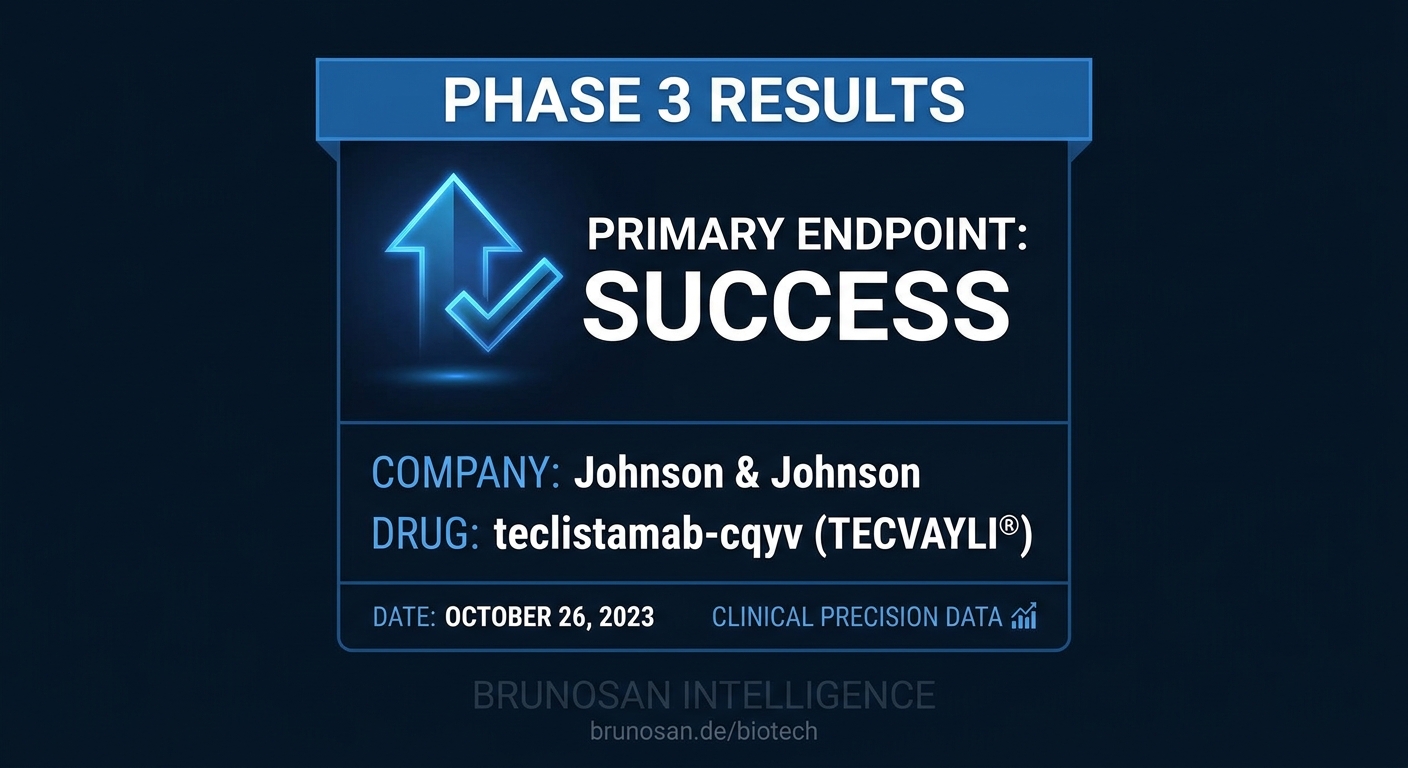
J&J's TECVAYLI Shows Superior Survival in Early Relapse Multiple Myeloma
Johnson & Johnson reported positive topline results from the Phase 3 MajesTEC-9 study, showing TECVAYLI (teclistamab-cqyv) improved both progression-free and overall survival in multiple myeloma patients after as few as one prior therapy. The data strongly support moving the treatment into earlier lines. This directly challenges the current standard of care for first relapse.
Drug Profile
TECVAYLI is a T-cell redirecting, IgG4-based bispecific antibody. It functions by simultaneously binding to the CD3 receptor on the surface of T-cells and to the B-cell maturation antigen (BCMA) expressed on multiple myeloma cells. This dual binding forms a synapse that redirects cytotoxic T-cells to recognize and eliminate the BCMA-expressing cancer cells. As an off-the-shelf biologic, it offers logistical advantages over patient-specific cell therapies like CAR-T. Its structure is designed to engage T-cells effectively while minimizing non-specific immune activation.
Clinical Data
| Endpoint | Result | Comparator | Trial | | :--- | :--- | :--- | :--- | | Progression-Free Survival (PFS) | Met primary endpoint; demonstrated superior PFS | Standard of Care | MajesTEC-9 | | Overall Survival (OS) | Met key secondary endpoint; demonstrated superior OS | Standard of Care | MajesTEC-9 |
Global Regulatory Status
Drug-specific status across all four regulatory bodies BrunoSan tracks. Separate from pipeline volume shown in the infobar.
| Regulatory Body | Status | Notes |
|---|---|---|
| Agency | Status | Details |
| FDA (U.S.) | ✓ Approved | Oct 2022, for r/r MM after ≥4 prior lines |
| EMA (Europe) | ✓ Approved | Aug 2022, Conditional Marketing Authorisation for r/r MM after ≥3 prior therapies |
| Health Canada | ✓ Approved | May 2023, for r/r MM after ≥3 prior lines |
| ANVISA (Brazil) | ✓ Approved | Jan 2024, for r/r MM after ≥3 prior lines |
STATUS
Market Impact
The positive MajesTEC-9 results position TECVAYLI to disrupt the treatment paradigm for early-relapse multiple myeloma. The current market for second- and third-line therapy is dominated by daratumumab-based combination regimens. Demonstrating a superior overall survival benefit provides a powerful clinical and commercial argument to displace these incumbents. TECVAYLI's main competitor in the BCMA bispecific class is Pfizer's ELREXFIO (elranatamab), which is also being studied in earlier lines. This data gives Johnson & Johnson a potential first-mover advantage in establishing its off-the-shelf product as a new standard of care in a larger patient population before the fifth line of therapy.
This success reinforces a critical structural trend in oncology: moving the most effective therapies into earlier treatment settings. A strong OS signal is the highest bar for clinical evidence and is essential for securing favorable payor coverage and inclusion in treatment guidelines. For Johnson & Johnson, which also markets the BCMA-directed CAR-T therapy CARVYKTI, this result solidifies its strategic dominance in the myeloma space. The company can now offer two distinct, highly effective BCMA-targeted modalities—an accessible bispecific for earlier relapse and a potent cell therapy for later, more refractory disease—creating a comprehensive franchise that will be difficult for competitors to overcome.
Label expansion for TECVAYLI into the 1-3 prior lines setting is highly probable based on these topline results. Based on BrunoSan pipeline data, oncology assets demonstrating a statistically robust overall survival benefit in a pivotal Phase 3 trial have a near-certain probability of securing supplemental approval from major regulatory bodies. Our cross-regulatory tracking, which encompasses 14,915 historical events and over 2,200 EMA entries, confirms a consistent pattern of rapid regulatory action for therapies that meet this high evidence bar in hematologic cancers