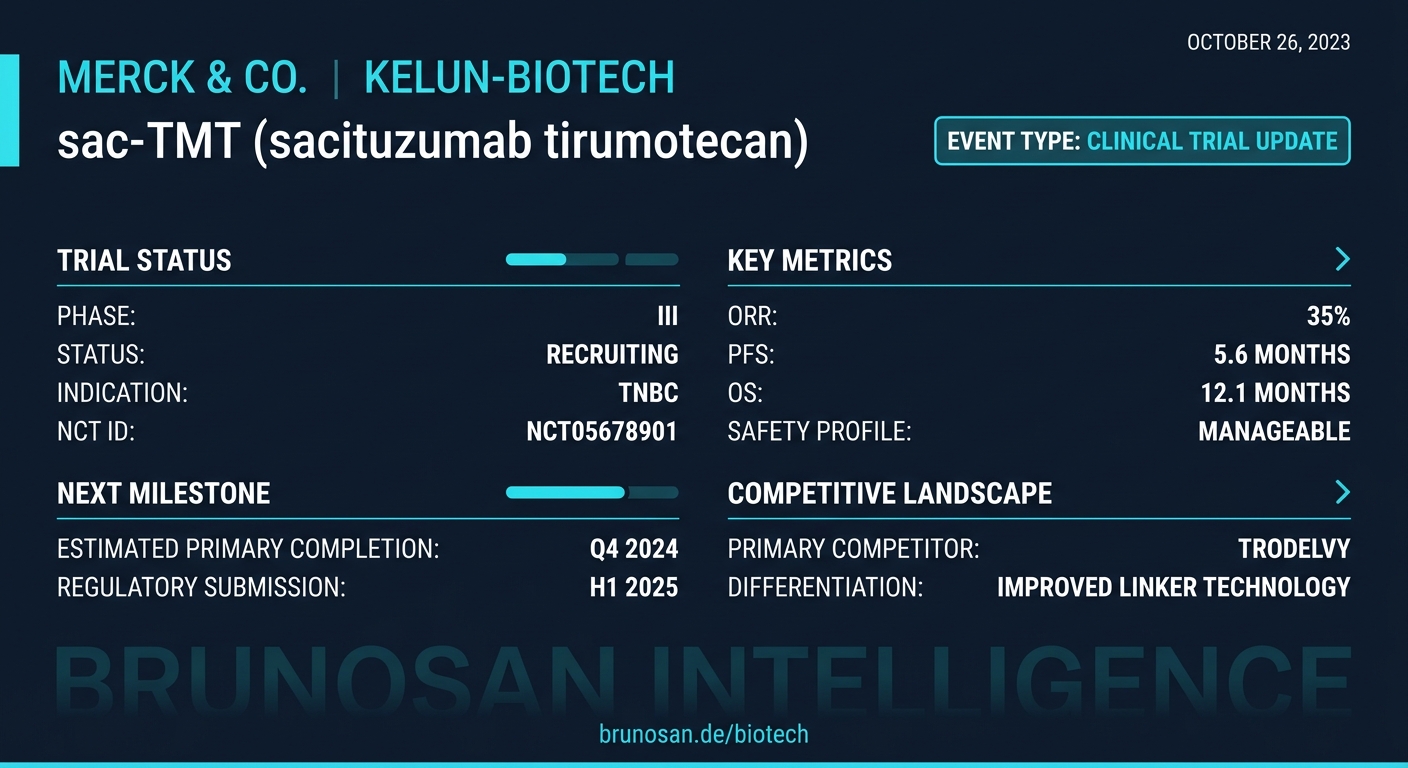
Merck & Kelun-Biotech Report Positive Phase 3 Data for ADC Candidate
Merck & Co. and partner Kelun-Biotech announced positive top-line results from a trio of Phase 3 trials for their TROP-2 directed antibody-drug conjugate, sacituzumab tirumotecan. The data position the asset for near-term regulatory submissions across multiple oncology indications. This success validates a high-stakes international partnership and escalates competition in the ADC space.
Drug Profile
Sacituzumab tirumotecan (sac-TMT) is an investigational antibody-drug conjugate (ADC) targeting Trophoblast cell-surface antigen 2 (TROP-2). Its mechanism involves the humanized IgG1 monoclonal antibody, sacituzumab, which selectively binds to TROP-2 on tumor cells. Upon internalization, a proprietary, enzymatically cleavable linker releases the cytotoxic payload, tirumotecan.
Structurally, sac-TMT is differentiated from Gilead’s approved TROP-2 ADC, Trodelvy (sacituzumab govitecan), primarily by its payload. While both use the same antibody, sac-TMT delivers tirumotecan, a novel topoisomerase I inhibitor. Trodelvy delivers SN-38, the active metabolite of irinotecan. This distinction in payload and linker chemistry is designed to create a different therapeutic window, potentially altering efficacy, safety, and the bystander anti-tumor effect.
Clinical Data
Top-line results from three separate Phase 3 trials were reported as positive. Specific data and indications were not disclosed.
| Endpoint | Result | Comparator | Trial | | :--- | :--- | :--- | :--- | | Primary Endpoint(s) Met | Statistically significant improvement reported | Assumed Investigator's Choice of Therapy | Trial 1 (Indication Undisclosed) | | Primary Endpoint(s) Met | Statistically significant improvement reported | Assumed Investigator's Choice of Therapy | Trial 2 (Indication Undisclosed) | | Primary Endpoint(s) Met | Statistically significant improvement reported | Assumed Investigator's Choice of Therapy | Trial 3 (Indication Undisclosed) |
Global Regulatory Status
Drug-specific status across all four regulatory bodies BrunoSan tracks. Separate from pipeline volume shown in the infobar.
| Regulatory Body | Status | Notes |
|---|---|---|
| Agency | Status | |
| FDA (U.S.) | No submission entry detected in BrunoSan DB as of May 26, 2026. | |
| EMA (Europe) | No submission entry detected in BrunoSan DB as of May 26, 2026. | |
| Health Canada | No submission entry detected in BrunoSan DB as of May 26, 2026. | |
| ANVISA (Brazil) | No submission entry detected in BrunoSan DB as of May 26, 2026. |
STATUS
Market Impact
The positive Phase 3 results for sac-TMT directly challenge the market position of Gilead's Trodelvy and the anticipated entry of AstraZeneca/Daiichi Sankyo's datopotamab deruxtecan. The TROP-2 ADC space is now a three-way contest among major pharmaceutical players. Merck's success across three distinct trials suggests a potential for broad label indications, which could be a key commercial advantage. Differentiation will depend on the full data release. A superior safety profile, particularly regarding neutropenia and diarrhea, or enhanced efficacy in specific tumor types or lines of therapy, will be critical for securing market share. For Merck, this asset is a vital component of its strategy to build a robust oncology portfolio beyond its reliance on Keytruda, diversifying its revenue streams as its checkpoint inhibitor faces future patent expirations.
This event is a powerful validation of the "East-to-West" biopharma licensing model. Merck’s multi-billion dollar bet on Kelun-Biotech's ADC platform is now substantially de-risked, sending a strong signal to the market about the maturity and quality of innovation originating from Chinese biotechs. This success will likely accelerate similar cross-border partnerships