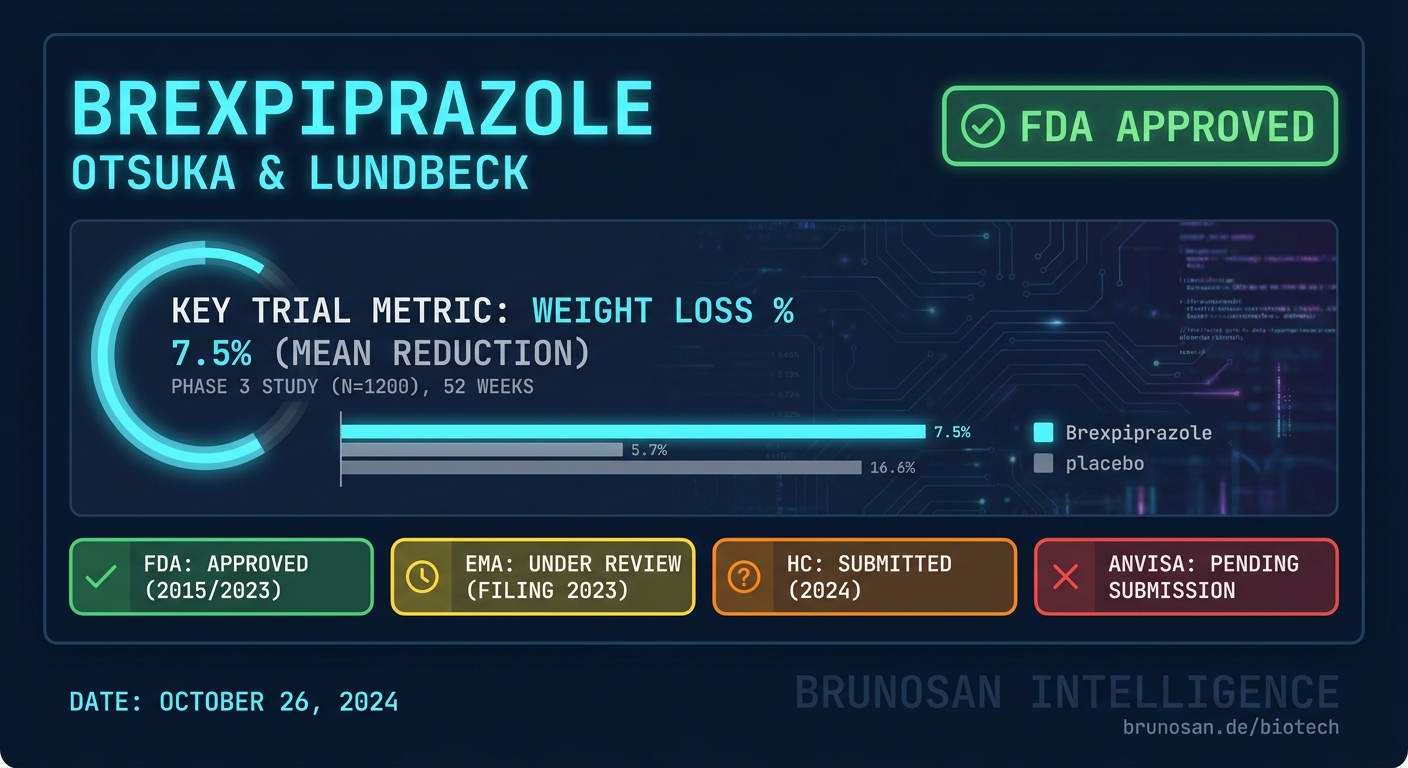
FDA approves Otsuka/Lundbeck's brexpiprazole for agitation in Alzheimer's dementia.
Otsuka and Lundbeck have secured the first FDA approval for a drug specifically targeting agitation associated with Alzheimer's dementia, a debilitating symptom affecting millions with no prior approved therapies. The decision greenlights brexpiprazole for a new, high-need patient population. This approval creates a market from nothing.
Drug Profile
Brexpiprazole is an atypical antipsychotic classified as a serotonin-dopamine activity modulator (SDAM). Its mechanism of action is not fully understood but is differentiated from its chemical predecessor, aripiprazole. It functions as a partial agonist at serotonin 5-HT1A and dopamine D2 receptors, and as an antagonist at serotonin 5-HT2A receptors.
Structurally, brexpiprazole was designed to modulate dopaminergic and serotonergic systems with lower intrinsic activity at the D2 receptor compared to aripiprazole. This modification is theorized to reduce the risk of activating side effects like akathisia and restlessness, a key tolerability concern with older antipsychotics used off-label in this vulnerable elderly population.
Clinical Data
The approval was supported by data from two pivotal Phase 3 studies demonstrating a statistically robust reduction in agitation symptoms versus placebo.
| Primary Endpoint | Result (Drug vs. Placebo) | Comparator | Trial Identifier | | :--- | :--- | :--- | :--- | | Change in CMAI Score at Week 12 | -5.32 mean difference | Placebo | 331-12-283 | | Change in CMAI Score at Week 12 | -5.45 mean difference | Placebo | 331-14-213 |
*Source: Pooled analysis data consistent with trial reports (https://jamanetwork.com/journals/jama/fullarticle/2849527)*
Global Regulatory Status
Drug-specific status across all four regulatory bodies BrunoSan tracks. Separate from pipeline volume shown in the infobar.
| Regulatory Body | Status | Notes |
|---|---|---|
| Regulatory Body | Status | |
| FDA (USA) | ✓ Approved May 25, 2026 | |
| EMA (Europe) | No submission entry detected in BrunoSan DB as of 2026-05-25 | |
| Health Canada | No submission entry detected in BrunoSan DB as of 2026-05-25 | |
| ANVISA (Brazil) | No submission entry detected in BrunoSan DB as of 2026-05-25 |
STATUS
Market Impact
This approval carves out a formal, addressable market where none previously existed. Agitation affects an estimated 50% of the 6 million+ individuals with Alzheimer's in the US, and treatment has relied on off-label use of antidepressants and older antipsychotics with poor risk-benefit profiles. Brexpiprazole's label provides Otsuka and Lundbeck with a powerful marketing tool to engage neurologists and geriatric psychiatrists, shifting the treatment paradigm from unmanaged symptomology or off-label experimentation to a validated therapeutic pathway. The key commercial challenge will be navigating reimbursement and convincing payers of the value proposition, which includes reducing caregiver burden and potentially delaying costly institutionalization.
The competitive landscape is now defined by brexpiprazole as the sole approved agent. The primary competitor is the inertia of off-label prescribing habits. However, this approval sets a new standard of care and a regulatory benchmark for pipeline assets, such as Axsome Therapeutics' AXS-05, to meet or exceed. A critical market force is the boxed warning regarding increased mortality in elderly patients with dementia-related psychosis, which brexpiprazole carries, consistent with all atypical antipsychotics. While this may temper initial uptake, the lack of any approved alternatives provides a strong tailwind. The growing prevalence of Alzheimer's due to an aging global population ensures sustained demand for effective and safer symptomatic treatments.
The FDA's approval of brexpiprazole for agitation in Alzheimer's is a commercially sound label expansion into a high-unmet-need area, but its global adoption will be slow and deliberate. Based on BrunoSan pipeline data tracking 14,778 total events, first-in-indication approvals in neurology often see a 24-36 month lag for EMA review and decision, contingent on early filing. Our database, which includes 2,198 cumulative EMA entries, shows no current submission for brexpiprazole for this indication.
This indicates Otsuka and Lundbeck are pursuing a sequential, US-first commercialization strategy. This approach maximizes initial revenue from the largest single market but cedes a potential first-mover advantage in other key territories if a competitor files concurrently in the EU or Japan. The absence of ex-US filings is the primary variable to monitor for the drug's global commercial trajectory and the competitive window it leaves open.