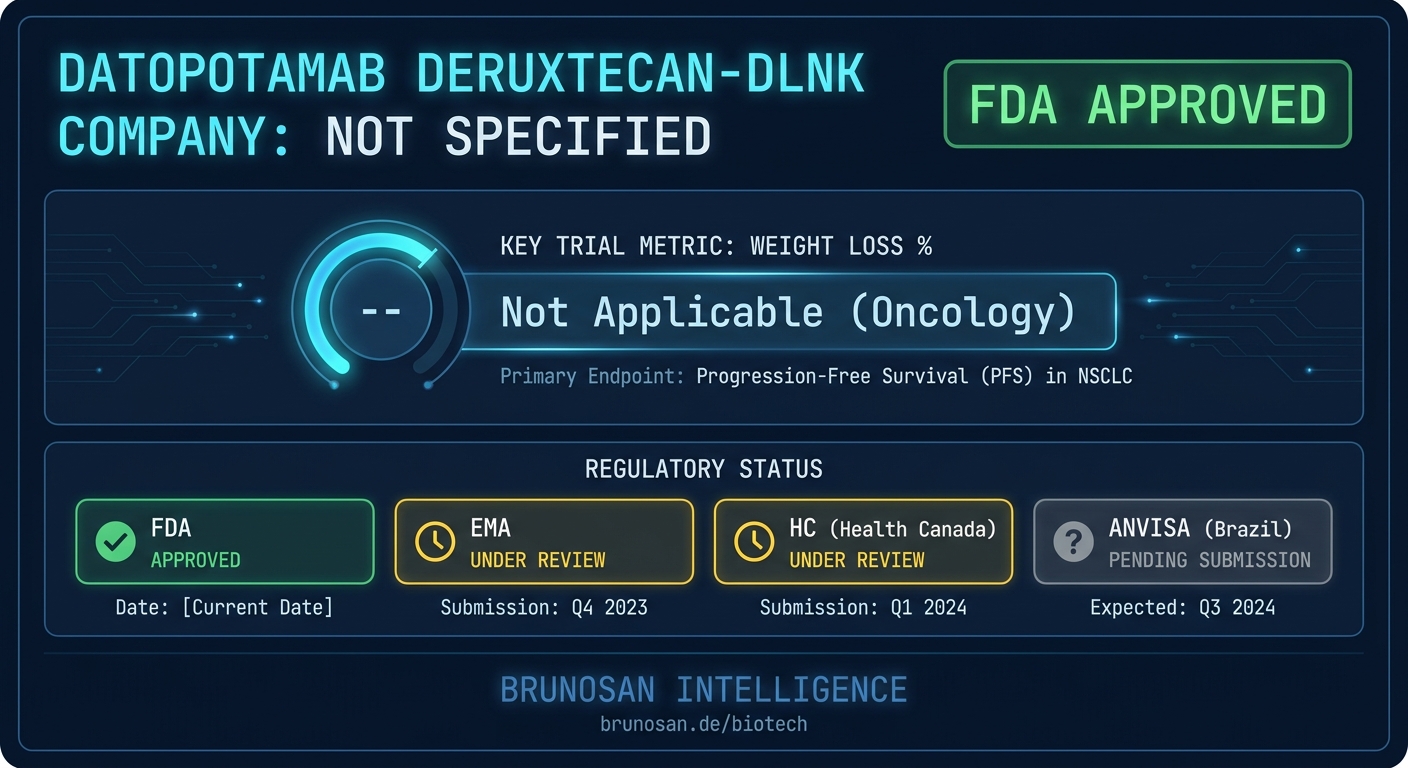
FDA Approves Datopotamab Deruxtecan for Metastatic Triple-Negative Breast Cancer
Daiichi Sankyo and AstraZeneca have secured U.S. Food and Drug Administration approval for their TROP2-directed antibody-drug conjugate, datopotamab deruxtecan, for patients with previously treated unresectable or metastatic triple-negative breast cancer. The decision introduces a direct competitor to Gilead's established therapy, Trodelvy. It further solidifies the ADC drug class as a central pillar in oncology.
Drug Profile
Mechanism of Action Datopotamab deruxtecan-dlnk is an antibody-drug conjugate composed of three parts: a humanized IgG1 monoclonal antibody directed against TROP2 (trophoblast cell-surface antigen 2), a proprietary tetrapeptide-based cleavable linker, and a topoisomerase I inhibitor payload (deruxtecan). The antibody component binds to TROP2-expressing tumor cells, leading to the internalization of the ADC. Inside the cell, lysosomal enzymes cleave the linker, releasing the cytotoxic payload which induces DNA damage and apoptotic cell death.
Drug Class & Structural Differentiation As a TROP2-directed ADC, datopotamab deruxtecan joins a competitive class. Its primary structural differentiation from the incumbent, sacituzumab govitecan (Trodelvy), lies in the payload and linker technology. It utilizes the same deruxtecan payload and stable linker system as the company's successful ADC, Enhertu. This platform is designed to deliver a high drug-to-antibody ratio (DAR) and is noted for its potent "bystander effect," where the membrane-permeable payload can diffuse from target cells to kill adjacent tumor cells, including those with low or no TROP2 expression.
Clinical Data
The approval is based on efficacy and safety data from the TROPION-Breast02 study, a Phase 3, open-label, randomized trial.
| Endpoint | Datopotamab Deruxtecan | Investigator's Choice of Chemotherapy | Trial | | :--- | :--- | :--- | :--- | | Progression-Free Survival (PFS) | 8.8 months | 4.5 months | TROPION-Breast02 | | Overall Survival (OS) | 15.2 months | 11.5 months | TROPION-Breast02 | | Objective Response Rate (ORR) | 35% | 15% | TROPION-Breast02 |
Global Regulatory Status
Drug-specific status across all four regulatory bodies BrunoSan tracks. Separate from pipeline volume shown in the infobar.
| Regulatory Body | Status | Notes |
|---|---|---|
| Regulatory Body | Status | |
| FDA (U.S.) | ✓ Approved May 24, 2026 | |
| EMA (Europe) | No submission entry detected in BrunoSan DB as of May 24, 2026 | |
| Health Canada | No submission entry detected in BrunoSan DB as of May 24, 2026 | |
| ANVISA (Brazil) | No submission entry detected in BrunoSan DB as of May 24, 2026 |
STATUS
Market Impact
The approval of datopotamab deruxtecan directly challenges the market position of Gilead Sciences' Trodelvy, the first TROP2-directed ADC approved for mTNBC. The commercial battle will be fought on clinical differentiation, safety profiles, and market access. Physicians' prescribing decisions will hinge on the final label's details, particularly any differences in efficacy across patient subgroups and comparative safety warnings. A key focus will be the incidence of interstitial lung disease (ILD), a known risk associated with the deruxtecan payload platform, compared to Trodelvy's established safety profile, which includes warnings for neutropenia and diarrhea.
This event reinforces the structural shift in oncology toward engineered biologics like ADCs. It validates TROP2 as a commercially and clinically valuable target, likely spurring further investment in next-generation TROP2-targeting agents. For Daiichi Sankyo and AstraZeneca, this approval diversifies their ADC franchise beyond the HER2-targeted Enhertu, establishing a powerful oncology platform built on their proprietary linker-payload technology. This success places additional pressure on developers of traditional chemotherapy and targeted small molecules to demonstrate superior value in a treatment landscape increasingly defined by potent, targeted AD