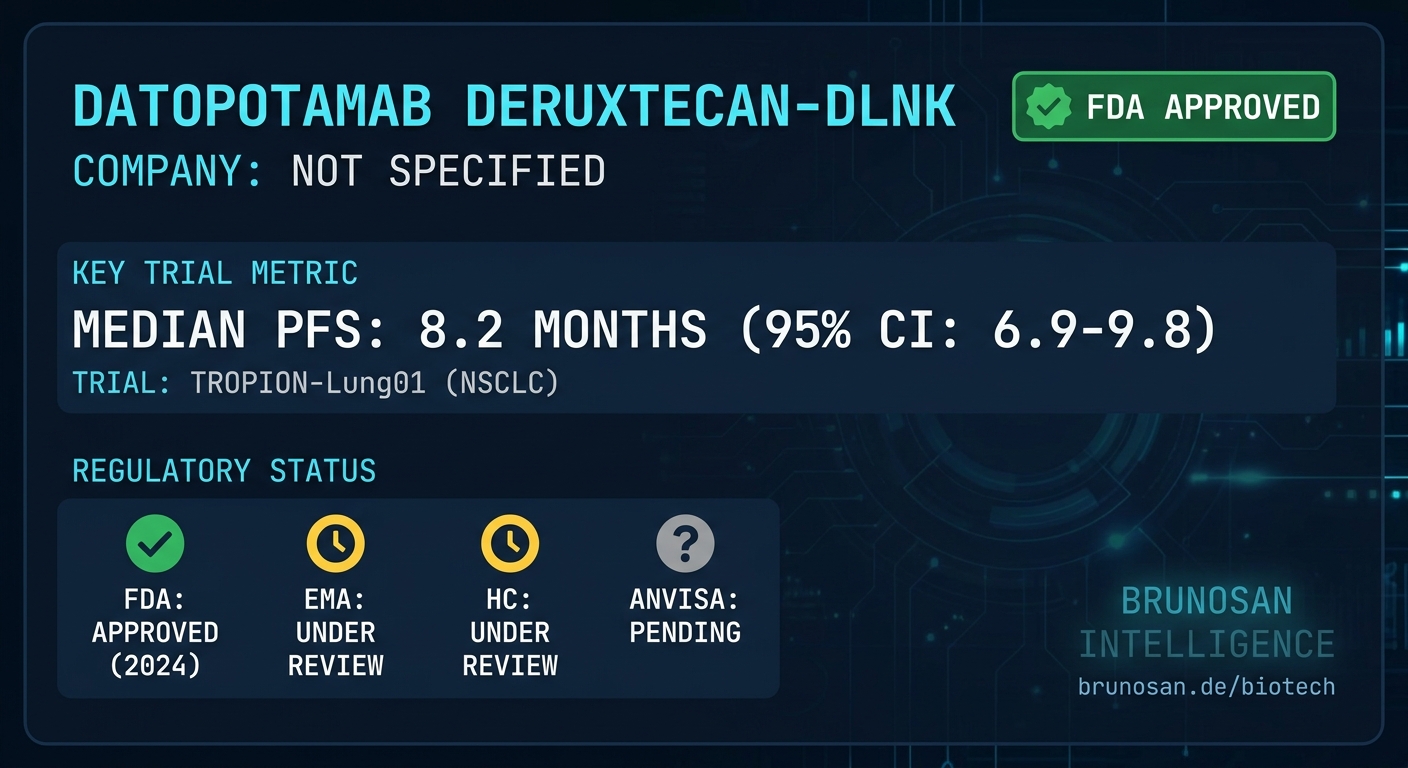
AstraZeneca/Daiichi Sankyo's Datopotamab Deruxtecan Secures FDA Approval for Metastatic TNBC in 2026
The U.S. Food and Drug Administration has approved datopotamab deruxtecan-dlnk for adults with previously treated unresectable or metastatic TNBC, a notoriously aggressive cancer subtype. This decision introduces a direct and formidable competitor to Gilead's established TROP2 ADC, Trodelvy. A new front opens in the breast cancer market.
Drug Profile
Datopotamab deruxtecan (Dato-DXd) is a next-generation antibody-drug conjugate. Its structure consists of a humanized anti-TROP2 IgG1 monoclonal antibody covalently linked to a topoisomerase I inhibitor payload, deruxtecan.
The mechanism is targeted chemotherapy delivery. The antibody component seeks out and binds to TROP2, a protein highly expressed on the surface of TNBC cells. Following internalization, the proprietary tetrapeptide-based linker is cleaved by lysosomal enzymes, releasing the potent cytotoxic payload directly inside the cancer cell. This targeted release mechanism is designed to maximize tumor cell death while minimizing systemic exposure and associated toxicity. Structurally, its stable linker and high drug-to-antibody ratio (DAR) of four differentiate it from other ADCs, potentially influencing its efficacy and safety profile.
Clinical Data
The approval is based on efficacy and safety data from the TROPION-Breast01 trial, a Phase 3 study evaluating datopotamab deruxtecan against investigator's choice of single-agent chemotherapy.
| Endpoint | Datopotamab Deruxtecan | Investigator's Choice Chemotherapy | Trial | | --------------------------------------- | ---------------------- | ---------------------------------- | ----------------- | | Median Progression-Free Survival (BICR) | 4.4 months | 2.9 months (HR: 0.63) | TROPION-Breast01 | | Objective Response Rate (ORR) | 32% | 13% | TROPION-Breast01 |
Global Regulatory Status
Drug-specific status across all four regulatory bodies BrunoSan tracks. Separate from pipeline volume shown in the infobar.
| Regulatory Body | Status | Notes |
|---|---|---|
| Regulatory Body | Status | |
| FDA (U.S.) | ✓ Approved (2026-05-23) | |
| EMA (Europe) | No submission entry detected in BrunoSan DB as of 2026-05-23. | |
| Health Canada | No submission entry detected in BrunoSan DB as of 2026-05-23. | |
| ANVISA (Brazil) | No submission entry detected in BrunoSan DB as of 2026-05-23. |
STATUS
Market Impact
This approval directly challenges Gilead Sciences' Trodelvy (sacituzumab govitecan-hziy), the first TROP2-directed ADC approved for metastatic TNBC. The battle for market share will be fought on clinical differentiation, physician experience, and commercial execution. Datopotamab deruxtecan's clinical profile suggests a different safety trade-off, with lower rates of severe neutropenia but higher rates of stomatitis and ocular surface events compared to Trodelvy. This nuanced safety profile will be a key factor in physician decision-making for a patient population often weakened by prior therapies. AstraZeneca and Daiichi Sankyo's established oncology presence and experience with their other major ADC, Enhertu, provides a substantial commercial advantage.
The approval reinforces TROP2 as a cornerstone target in solid tumors and validates the deruxtecan payload platform beyond HER2-positive cancers. For AstraZeneca and Daiichi Sankyo, this expands their ADC franchise into a new patient segment, creating portfolio synergies in breast cancer treatment pathways. The entry of a second TROP2 ADC is expected to increase competitive pressure, potentially affecting net pricing over the long term. It also raises the bar for future therapies in development for TNBC, which will now likely be benchmarked against two effective TROP2-targeted agents rather than conventional chemotherapy.
Based on BrunoSan pipeline data tracking 14,770 total events, this approval is one of 129 FDA regulatory actions logged today, highlighting the high volume of decisions analysts must parse. The approval of a second-in-class TROP2 ADC for TNBC confirms a durable therapeutic strategy, a trend we observe across our database which includes 2,198 EMA and 11,350 Health Canada entries. The current lack of concurrent ex-U.S. filings for datopotamab deruxtecan in our system suggests a staggered global launch. This is a common pattern for complex biologics aiming to optimize market access negotiations and supply chain logistics on a region-by-region basis. We anticipate EMA and other filings to follow within the next 6-12 months.