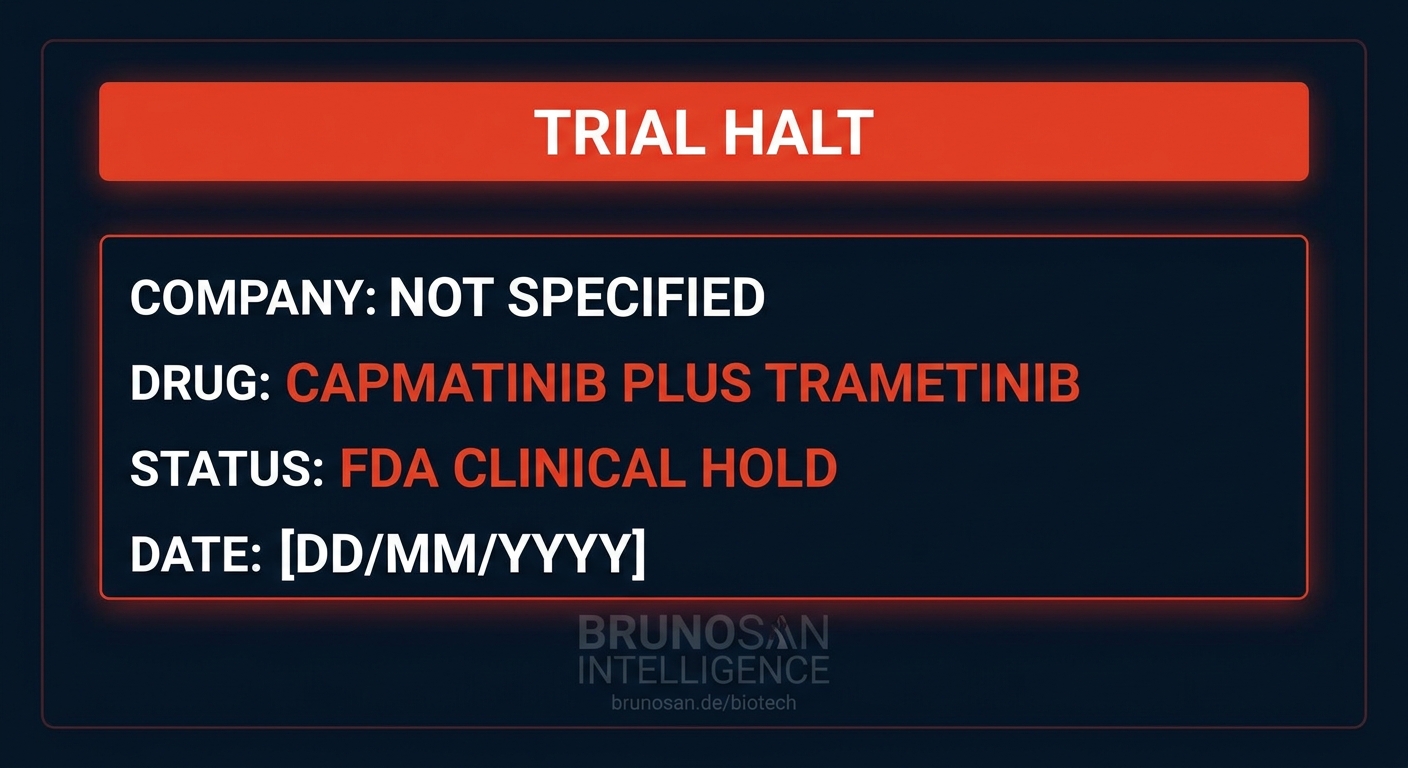
Phase 1 combination therapy trial in MET-driven NSCLC terminated early due to toxicity
An investigator-initiated Phase 1 trial combining the MET inhibitor capmatinib with the MEK inhibitor trametinib in patients with metastatic MET-driven NSCLC has been terminated due to unacceptable toxicity. All enrolled patients discontinued treatment. The failure exposes a critical safety barrier for MET/MEK combination strategies.
Drug Profile
The terminated trial evaluated a combination of two distinct targeted therapies.
* Capmatinib (Novartis' Tabrecta) is a highly selective, ATP-competitive, reversible inhibitor of the c-Met receptor tyrosine kinase. MET signaling drives tumor growth, proliferation, and metastasis. Capmatinib is approved as a monotherapy for adult patients with metastatic NSCLC whose tumors have a mutation that leads to MET exon 14 skipping (METex14).
* Trametinib (Novartis' Mekinist) is a reversible, allosteric inhibitor of mitogen-activated extracellular signal-regulated kinase 1 (MEK1) and MEK2. The MEK proteins are part of the RAS/RAF/MEK/ERK pathway, which is a critical downstream signaling cascade from MET.
The biological rationale for the combination was to achieve vertical inhibition of the MET pathway. By blocking the primary driver (MET) and a key downstream node (MEK), the strategy aimed to produce a more profound and durable anti-tumor response, potentially overcoming resistance mechanisms to MET inhibition alone. This trial’s failure suggests the overlapping on-target toxicities of this specific vertical blockade are clinically unmanageable.
Clinical Data
The early termination of the Phase 1 dose-escalation study prevents a full evaluation of its endpoints. The primary objective was to determine the maximum tolerated dose (MTD) and recommended Phase 2 dose (RP2D). Data from the three patients enrolled at the first dose level are summarized below.
| Endpoint | Result | Comparator | Trial | | :--- | :--- | :--- | :--- | | Safety / Tolerability | MTD not established; trial terminated due to dose-limiting toxicities (DLTs) | N/A (Single-Arm) | MSKCC Phase 1 (NCT identifier not specified in source) | | Objective Response Rate (ORR) | 0% (0 of 3 patients) | N/A (Single-Arm) | MSKCC Phase 1 (NCT identifier not specified in source) |
All three patients discontinued the study due to significant treatment-related adverse events (TRAEs). While specific AEs were not detailed in the initial report, the toxicity was sufficient to halt dose escalation entirely, indicating a fundamental lack of a therapeutic window for the combination. (https://www.medrxiv.org/content/10.64898/2026.05.19.26353265v1?rss=1)
Global Regulatory Status
Drug-specific status across all four regulatory bodies BrunoSan tracks. Separate from pipeline volume shown in the infobar.
| Regulatory Body | Status | Notes |
|---|---|---|
| Agency | Status for Capmatinib + Trametinib Combination | |
| FDA (U.S.) | No submission entry detected in BrunoSan DB as of 2026-05-22. | |
| EMA (Europe) | No submission entry detected in BrunoSan DB as of 2026-05-22. | |
| Health Canada | No submission entry detected in BrunoSan DB as of 2026-05-22. | |
| ANVISA (Brazil) | No submission entry detected in BrunoSan DB as of 2026-05-22. |
STATUS
The combination of capmatinib and trametinib is investigational and has not been submitted for approval to any global regulatory body.
Market Impact
This trial halt serves as a strong negative signal for combination strategies pairing MET and MEK inhibitors in NSCLC. The current standard of care for METex14 NSCLC involves monotherapy with approved MET inhibitors like capmatinib or tepotinib. The search for effective combinations to deepen responses or overcome acquired resistance is a key R&D focus. This result effectively closes the door on this specific MET/MEK inhibitor pairing and casts doubt on the viability of similar vertical inhibition strategies that use two kinase inhibitors with overlapping toxicity profiles (e.g., dermatologic, gastrointestinal, and fluid retention).
The failure redirects the competitive landscape. It reinforces the market position of existing MET monotherapies and increases the pressure on developers to find partners with non-overlapping safety profiles. Attention will likely pivot toward combinations with chemotherapy, immunotherapy, or novel agents targeting different pathways, such as SHP2 inhibitors or antibody-drug conjugates (ADCs). For companies with both MET and MEK assets, like Novartis, this investigator-initiated trial data provides valuable—albeit negative—information that will guide internal pipeline decisions away from this toxic combination, saving resources that would have been spent on a larger, company-sponsored study.
Based on BrunoSan pipeline data tracking 14,750 oncology events, early-phase trial terminations due to toxicity are a primary filter for pipeline viability. The capmatinib plus trametinib halt is a definitive negative signal, representing a hard ceiling for this therapeutic concept. The failure to clear even the first dose level in a Phase 1 study indicates a fundamental lack of a therapeutic window.
Our database shows that combinations involving two targeted kinase inhibitors acting on the same signaling cascade have a historically higher rate of toxicity-related discontinuations compared to combinations with chemotherapy or checkpoint inhibitors. This event reinforces that trend. The biological rationale was sound, but the clinical reality of overlapping on-target toxicities proved insurmountable. We assess the probability of this specific drug combination advancing to a pivotal trial as near-zero. Future development in the MET-driven NSCLC space will be forced to explore combinations with disparate mechanisms and non-overlapping toxicity profiles to make meaningful clinical progress.