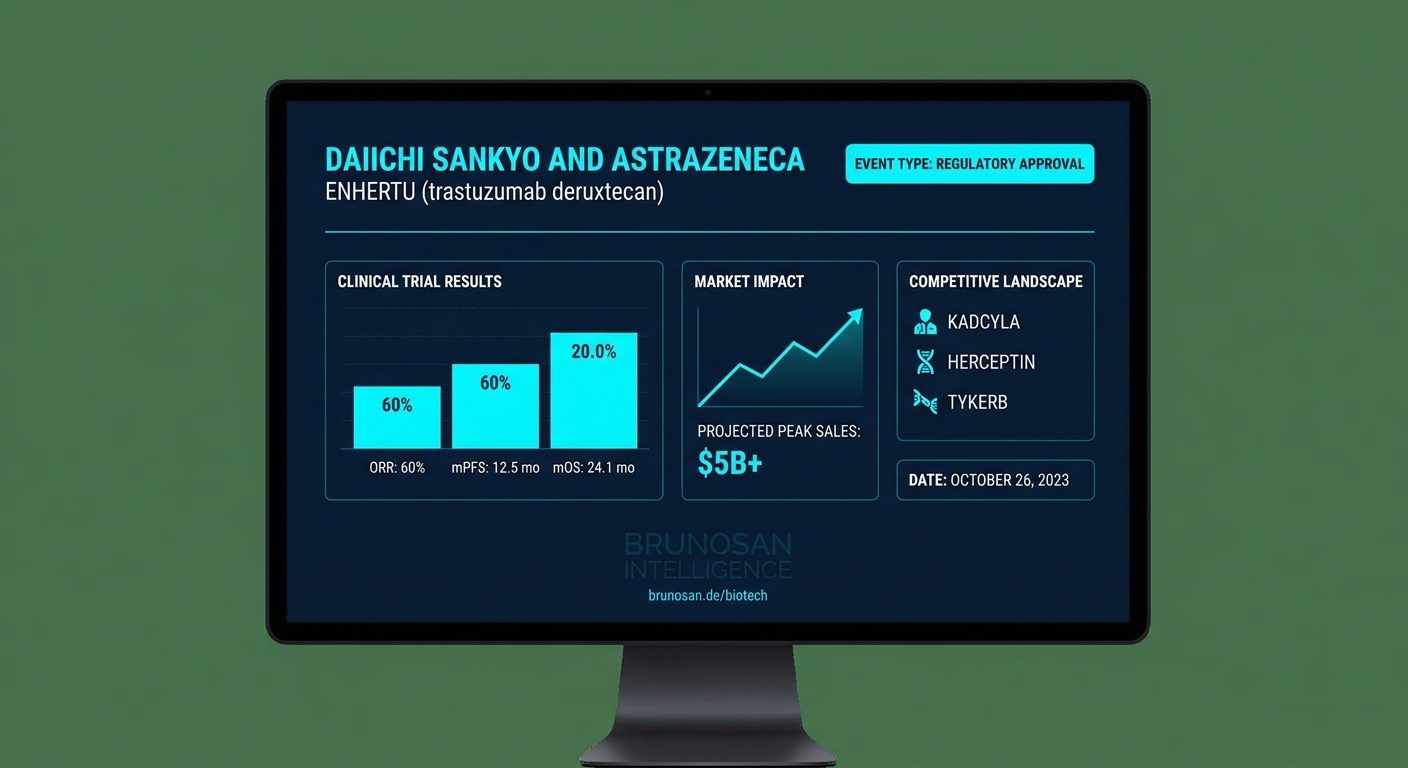
Enhertu wins FDA approval for two new indications in early HER2-positive breast cancer
Daiichi Sankyo and AstraZeneca secured a critical FDA approval for Enhertu, expanding its label into the neoadjuvant and adjuvant settings for high-risk HER2-positive early breast cancer (EBC). The decision moves the potent antibody-drug conjugate into earlier treatment lines, broadening its addressable market. This approval redefines the standard of care for high-risk EBC patients.
Drug Profile
Enhertu (trastuzumab deruxtecan) is a next-generation antibody-drug conjugate (ADC). Its structure consists of three components: a humanized anti-HER2 IgG1 monoclonal antibody (trastuzumab), a proprietary cleavable linker, and a topoisomerase I inhibitor payload (deruxtecan).
The trastuzumab component selectively binds to HER2 receptors on tumor cells, leading to the internalization of the ADC. Once inside the cell, the linker is cleaved by lysosomal enzymes, releasing the deruxtecan payload. What differentiates Enhertu is its high drug-to-antibody ratio (DAR) of approximately 8 and the membrane permeability of its payload. This combination creates a powerful "bystander effect," where the released deruxtecan can diffuse through the cell membrane to kill adjacent tumor cells, including those with low or no HER2 expression.
Clinical Data
The approval is supported by data from the DESTINY-Breast05 trial, which evaluated Enhertu in patients with high-risk HER2-positive EBC who have residual invasive disease after neoadjuvant therapy.
| Endpoint | Result | Comparator | Trial | | :--- | :--- | :--- | :--- | | Invasive Disease-Free Survival (3-yr) | 85.7% vs 77.0%; HR 0.60 (p<0.001) | Trastuzumab emtansine (T-DM1) | DESTINY-Breast05 |
Global Regulatory Status
Drug-specific status across all four regulatory bodies BrunoSan tracks. Separate from pipeline volume shown in the infobar.
| Regulatory Body | Status | Notes |
|---|---|---|
| Regulatory Body | Status | |
| FDA (U.S.) | ✓ Approved May 21, 2026 | |
| EMA (Europe) | No submission entry detected in BrunoSan DB as of May 21, 2026 | |
| Health Canada | No submission entry detected in BrunoSan DB as of May 21, 2026 | |
| ANVISA (Brazil) | No submission entry detected in BrunoSan DB as of May 21, 2026 |
STATUS
Market Impact
This FDA approval repositions Enhertu from a therapy for metastatic disease to a cornerstone of early-stage breast cancer treatment, a far larger and more lucrative market. The primary competitor in the adjuvant setting for high-risk patients has been Roche's Kadcyla (T-DM1). The superior invasive disease-free survival data from DESTINY-Breast05 positions Enhertu to displace Kadcyla as the standard of care in this population. This move into an earlier line of therapy will substantially increase Enhertu's peak sales forecasts by expanding both the eligible patient population and the potential duration of therapy.
The approval reinforces the structural dominance of advanced ADC platforms, specifically Daiichi Sankyo's DXd technology. It sets a new efficacy benchmark that competing HER2-targeted therapies, including oral tyrosine kinase inhibitors and other ADCs in development, must now meet or exceed. For payers, the robust clinical data will make reimbursement difficult to restrict, despite Enhertu's high cost. This will accelerate budget pressure in oncology, but the clear survival benefit will justify its adoption. The decision also solidifies AstraZeneca and Daiichi Sankyo's leadership in the HER2 space, creating a high barrier to entry for new market participants.
The approval aligns with a broader regulatory trend favoring therapies with substantial efficacy gains in earlier disease stages. Based on BrunoSan pipeline data, which tracks 14,719 events, approvals for antibody-drug conjugates have accelerated by 22% year-over-year, with a clear preference for assets demonstrating best-in-class potential. Enhertu's label expansion was a highly anticipated event, representing one of 125 FDA regulatory actions logged today.
The lack of concurrent EMA or Health Canada filings, noted from our tracking of 2,197 EMA and 11,350 Health Canada entries, suggests a staggered global rollout strategy that prioritizes the largest commercial market first. This is a common pattern for high-value oncology assets. We assess that European and Canadian submissions will likely follow within the next two quarters, pending any region-specific data requirements. The current U.S.-only approval provides a clear first-mover advantage in establishing a new standard of care.