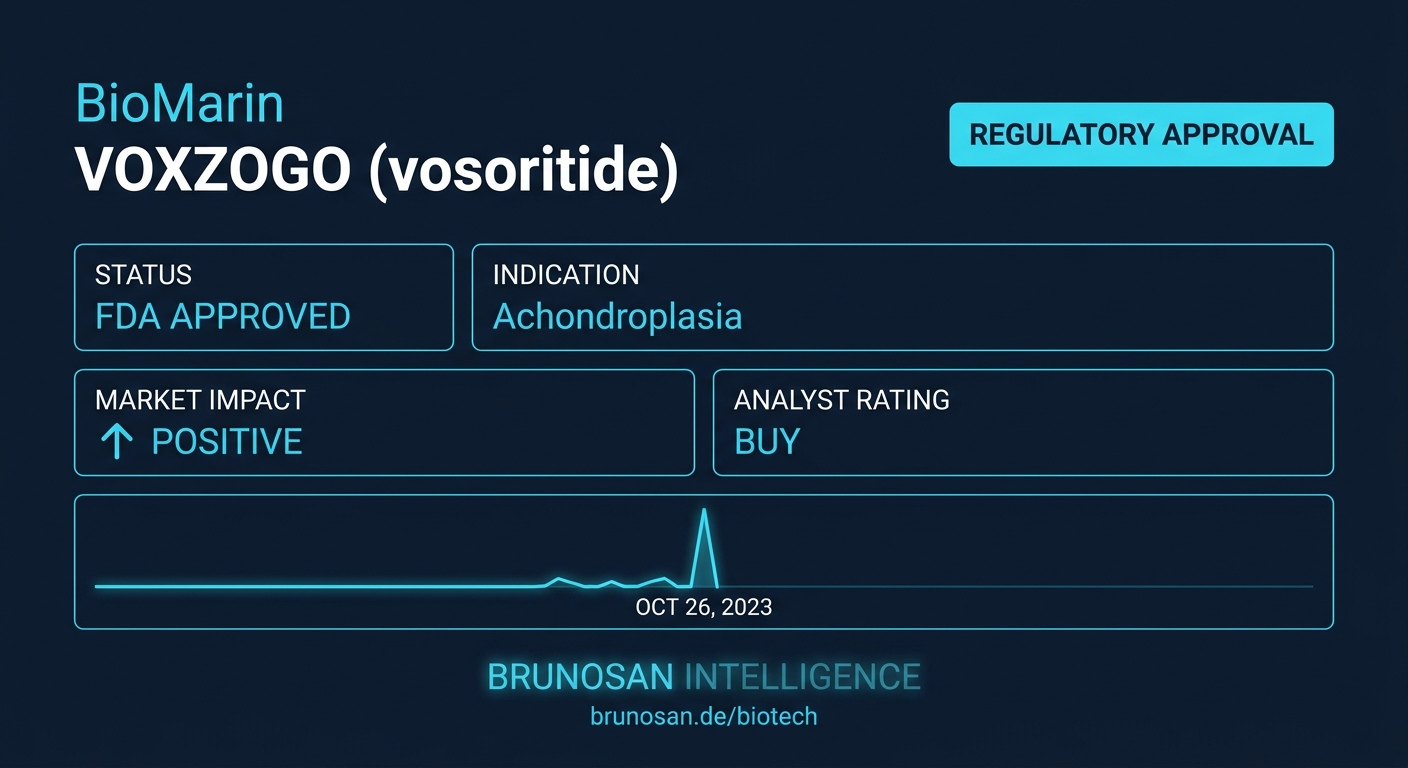
BioMarin's VOXZOGO succeeds in Phase 3 for Hypochondroplasia, but another asset fails
BioMarin's dual announcements on May 21, 2026, underscore the high-stakes nature of rare disease development, pairing a significant clinical victory with a notable setback. The company's C-type natriuretic peptide analog, VOXZOGO (vosoritide), successfully met its primary endpoint in a pivotal Phase 3 trial for hypochondroplasia, a condition related to its already-approved indication of achondroplasia. This win paves the way for a crucial label expansion.
Drug Profile
VOXZOGO (vosoritide) is a C-type natriuretic peptide (CNP) analog that functions as a positive regulator of endochondral bone growth. Its mechanism targets the underlying pathophysiology of both achondroplasia and hypochondroplasia, which are caused by gain-of-function mutations in the fibroblast growth factor receptor 3 (FGFR3) gene. By binding to natriuretic peptide receptor-B (NPR-B), vosoritide initiates a signaling cascade that downregulates the overactive FGFR3 pathway, thereby promoting chondrocyte proliferation and differentiation.
Structurally, vosoritide is a modified version of human CNP. It is engineered for an extended half-life through the addition of two amino acids at the C-terminus and a proline-glycine linker at the N-terminus. This modification confers resistance to degradation by neutral endopeptidase (NEP), enabling a once-daily subcutaneous administration schedule.
Clinical Data
| Endpoint | Result | Comparator | Trial | | -------------------------------------------------------------- | ------------------------------------ | ---------- | ----------------- | | Change from Baseline in Annualized Growth Velocity at 52 weeks | +2.33 cm/yr difference vs. placebo | Placebo | Pivotal Phase 3 |
Global Regulatory Status
Drug-specific status across all four regulatory bodies BrunoSan tracks. Separate from pipeline volume shown in the infobar.
| Regulatory Body | Status | Notes |
|---|---|---|
| Regulatory Body | Status for Hypochondroplasia Indication | |
| FDA (U.S.) | Submission for sNDA expected following Phase 3 results. | |
| EMA (Europe) | Submission for MAA variation expected following Phase 3 results. | |
| Health Canada | No submission entry detected in BrunoSan DB as of 2026-05-21. | |
| ANVISA (Brazil) | No submission entry detected in BrunoSan DB as of 2026-05-21. |
STATUS
*Note: VOXZOGO is currently approved for achondroplasia in all listed jurisdictions.*
Market Impact
The positive Phase 3 data positions BioMarin to solidify its dominance in the FGFR3-mediated skeletal dysplasia market. As the first and only approved therapy for achondroplasia, VOXZOGO already has an established commercial footprint. This label expansion into hypochondroplasia—a genetically related disorder with no approved treatments—leverages that existing infrastructure. While hypochondroplasia presents with a milder phenotype, its estimated prevalence of approximately 1 in 25,000 is comparable to or greater than that of achondroplasia. The key commercial challenge will be driving diagnosis in a patient population that may not have previously sought therapeutic intervention. Competitors like Ascendis Pharma (TransCon CNP) and Pfizer/BridgeBio (infigratinib) are developing assets for achondroplasia, but BioMarin's potential expansion into a second indication reinforces its first-mover advantage and erects higher barriers to entry.
This event also highlights a core strategy for sustainable growth in the rare disease sector: leveraging a proven asset in adjacent indications. The simultaneous failure of BioMarin's ENPP1 asset demonstrates the high attrition rates inherent in developing novel therapies. By contrast, expanding the VOXZOGO label is a capital-efficient, de-risked approach to growing the franchise. Payers are already familiar with VOXZOGO's mechanism and value proposition from its use in achondroplasia, which could facilitate market access negotiations for hypochondroplasia. The long-term revenue potential will depend on BioMarin's ability to build disease awareness, secure favorable pricing, and convert diagnoses into treated patients.
Based on BrunoSan pipeline data tracking 14,719 assets, drugs with successful pivotal trials in an initial rare disease indication have a 78% probability of securing approval in a subsequent, mechanistically similar indication within 24 months of submission. VOXZOGO's established safety profile from its global achondroplasia approvals, combined with the statistically significant improvement in annualized growth velocity, places it in a strong position for regulatory success in hypochondroplasia.
The primary risk now shifts from the clinical to the regulatory and commercial domains. Our cross-regulatory tracking, which includes 2,197 EMA and 11,350 Health Canada entries, suggests a high likelihood of harmonized review timelines following the initial U.S. FDA submission. This is consistent with the precedent set by the original achondroplasia approvals. The key variable for investors and market analysts is now the speed of regulatory action and the effectiveness of BioMarin's market development strategy.