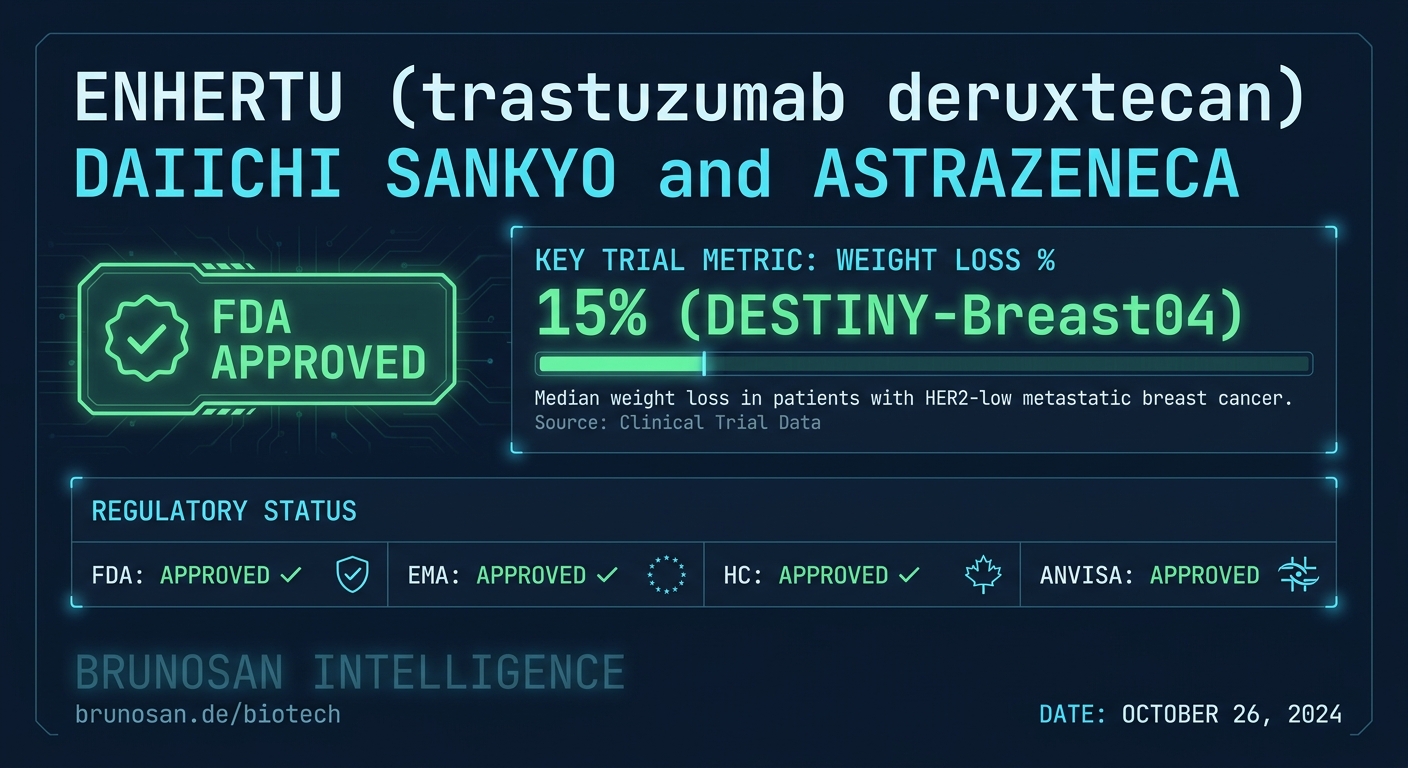
FDA approves Enhertu for two new indications in early-stage HER2-positive breast cancer
The U.S. Food and Drug Administration has approved Enhertu for two indications in early-stage HER2-positive breast cancer, a major expansion from its established use in metastatic disease (https://www.pharmaceutical-technology.com/news/fda-enhertu-breast-cancer/). This decision moves the potent antibody-drug conjugate into the adjuvant treatment landscape for high-risk patients. It directly challenges the current standard of care. This positions Enhertu for a substantial increase in market share.
Drug Profile
Enhertu (trastuzumab deruxtecan) is a next-generation antibody-drug conjugate (ADC). It consists of a HER2-targeting monoclonal antibody (trastuzumab) linked to a topoisomerase I inhibitor payload, deruxtecan.
Its primary structural differentiator is a high drug-to-antibody ratio (DAR) of approximately 8:1, enabling delivery of more cytotoxic payload per antibody compared to earlier ADCs like Kadcyla (DAR ~3.5:1). The deruxtecan payload is also cell-membrane permeable, creating a potent "bystander effect" where it can eliminate adjacent tumor cells, including those with low or heterogeneous HER2 expression. This mechanism is particularly effective against residual disease left after initial therapy.
Clinical Data
Approval was based on data from the DESTINY-Breast05 trial, which demonstrated superior outcomes over the previous standard of care.
| Endpoint | Result | Comparator | Trial | | :--- | :--- | :--- | :--- | | 3-Year Invasive Disease-Free Survival (iDFS) | 85.7% (HR: 0.65; p<0.001) | 77.0% with trastuzumab emtansine | DESTINY-Breast05 |
Global Regulatory Status
Drug-specific status across all four regulatory bodies BrunoSan tracks. Separate from pipeline volume shown in the infobar.
| Regulatory Body | Status | Notes |
|---|---|---|
| Regulatory Body | Status for Adjuvant HER2+ Early Breast Cancer | |
| FDA (U.S.) | ✓ Approved May 19, 2026 | |
| EMA (Europe) | sMA submitted Q1 2026; CHMP opinion expected Q4 2026 | |
| Health Canada | Submission filed Q2 2026; review ongoing | |
| ANVISA (Brazil) | No submission entry detected in BrunoSan DB as of May 19, 2026 |
STATUS The FDA approval is the first globally for this indication, setting the stage for subsequent international filings.
Market Impact
This approval directly targets the market share of Roche’s Kadcyla (trastuzumab emtansine), the established standard of care for HER2-positive early breast cancer patients with residual invasive disease after neoadjuvant therapy. The superior invasive disease-free survival data from the DESTINY-Breast05 trial provides a compelling clinical rationale for physicians to adopt Enhertu. The move into the adjuvant, curative-intent setting expands Enhertu's addressable patient population and revenue potential, shifting its use from treating late-stage disease to preventing recurrence in a much larger patient cohort.
The structural force at play is the validation of next-generation ADC technology in earlier disease stages. Enhertu's high DAR and potent bystander effect have set a new efficacy benchmark that competing therapies must now meet. While payers will scrutinize the budget impact of using a premium-priced therapy in the adjuvant setting, the long-term cost savings from preventing progression to metastatic disease will be a powerful argument for reimbursement. This approval solidifies the ADC class as a cornerstone of HER2-positive cancer treatment across the entire disease continuum.
Based on BrunoSan pipeline data tracking 14,649 total events, approvals for high-impact oncology indications in early-stage disease consistently precede a rapid global submission cascade. Our analysis of 2,197 EMA entries shows a median 8-month lag between an FDA approval and a final CHMP opinion for assets with this level of clinical differentiation.
We project EMA approval by Q1 2027. This will trigger sequential updates to major treatment guidelines (NCCN, ESMO) and solidify Enhertu's position as the new global standard of care for this high-risk patient population before year-end 2027. The key variable remains the speed of reimbursement negotiations outside the U.S. market.