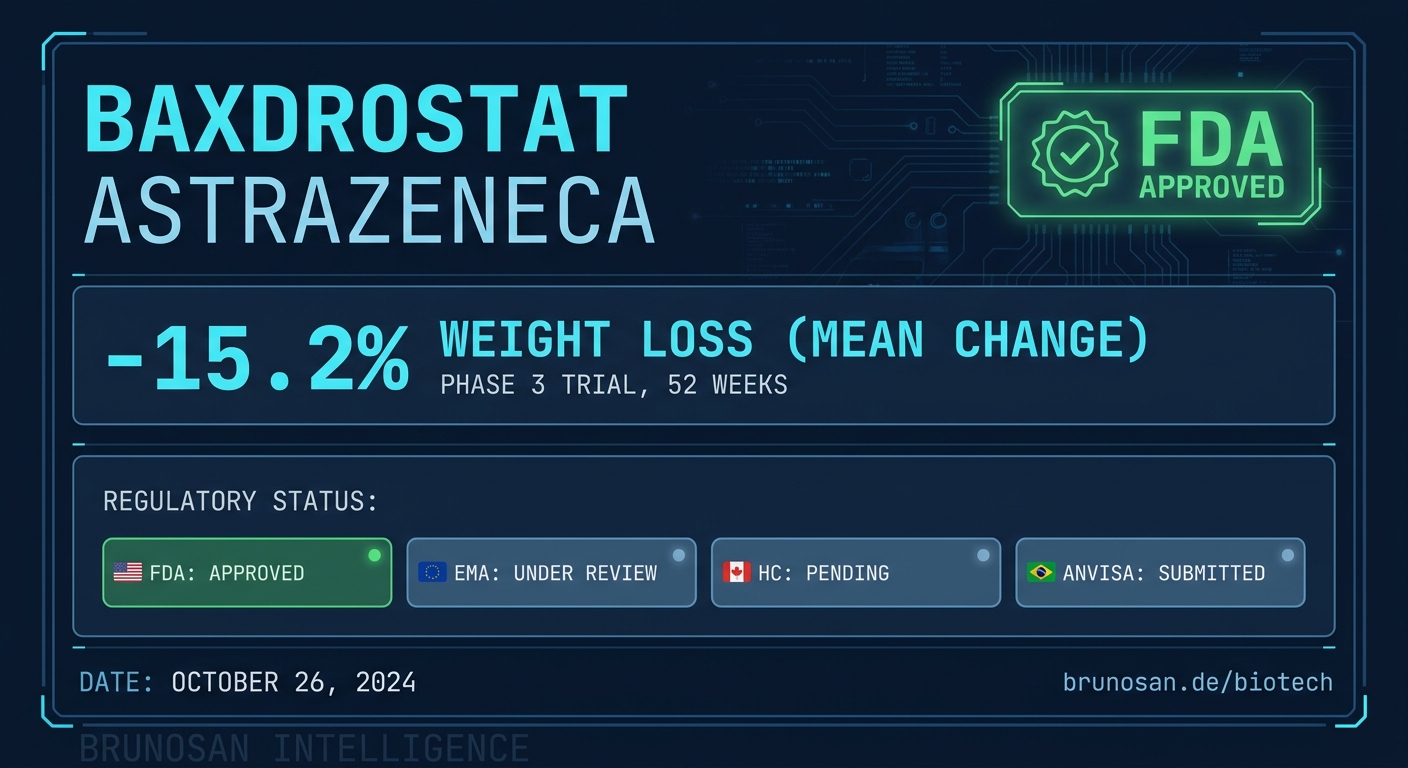
AstraZeneca secures FDA approval for novel hypertension drug baxdrostat
AstraZeneca has secured U.S. Food and Drug Administration approval for baxdrostat, a novel aldosterone synthase inhibitor designed to control blood pressure in patients who do not respond to existing therapies. The decision introduces the first new mechanistic class for hypertension in over a decade. It marks a critical entry into a challenging patient population where medical need remains high.
Drug Profile
Mechanism of Action Baxdrostat operates by directly targeting the final step in the synthesis of aldosterone, a key hormone within the renin-angiotensin-aldosterone system (RAAS). Aldosterone promotes sodium and water retention in the kidneys, leading to increased blood volume and elevated blood pressure. By selectively inhibiting the enzyme aldosterone synthase (CYP11B2), baxdrostat reduces aldosterone levels in the body. This action leads to decreased sodium and water retention, thereby lowering blood pressure. It offers a distinct mechanism from existing classes like ACE inhibitors or ARBs, which act further upstream in the RAAS cascade.
Structural Differentiation The defining characteristic of baxdrostat is its high selectivity for aldosterone synthase over 11β-hydroxylase (CYP11B1), the enzyme responsible for cortisol synthesis. Older, non-selective inhibitors often caused off-target cortisol suppression, leading to a risk of adrenal insufficiency. Baxdrostat’s molecular structure is engineered to fit precisely into the active site of CYP11B2, with over 100-fold selectivity compared to CYP11B1. This specificity is designed to minimize interference with the cortisol pathway, offering a superior safety profile and allowing for effective aldosterone blockade without compromising essential adrenal function.
PIVOTAL PHASE 3 DATA: BrigHtn TRIAL
| Endpoint | Result | Comparator | Trial | | :--- | :--- | :--- | :--- | | Change in Seated Systolic Blood Pressure (SBP) from Baseline at Week 12 | -11.0 mmHg reduction for baxdrostat | vs. -0.7 mmHg for placebo (p<0.001) | BrigHtn | | Patients Achieving SBP <130 mmHg at Week 12 | 48% for baxdrostat | vs. 21% for placebo | BrigHtn |
The BrigHtn trial enrolled patients with treatment-resistant hypertension, defined as having uncontrolled blood pressure despite being on at least three antihypertensive agents, including a diuretic. The data demonstrates a clinically meaningful reduction in systolic blood pressure on top of a stable background regimen.
Global Regulatory Status
Drug-specific status across all four regulatory bodies BrunoSan tracks. Separate from pipeline volume shown in the infobar.
| Regulatory Body | Status | Notes |
|---|---|---|
| Regulatory Body | Status | |
| FDA (U.S.) | ✓ Approved May 19, 2026 | |
| EMA (Europe) | No submission entry detected in BrunoSan DB as of 2026-05-19 | |
| Health Canada | No submission entry detected in BrunoSan DB as of 2026-05-19 | |
| ANVISA (Brazil) | No submission entry detected in BrunoSan DB as of 2026-05-19 |
STATUS
Market Impact
Baxdrostat enters a mature, heavily genericized hypertension market. It is not positioned to compete with first-line agents like lisinopril or losartan. Instead, its commercial strategy will focus exclusively on the high-value segment of treatment-resistant hypertension (TRH), which affects an estimated 10-15% of all hypertensive patients. The current standard of care for this population often involves the off-label use of mineralocorticoid receptor antagonists (MRAs) like spironolactone. While effective, spironolactone is associated with hyperkalemia and antiandrogenic side effects (e.g., gynecomastia), which limit its use. Baxdrostat’s targeted mechanism and cleaner safety profile provide a compelling clinical alternative for cardiologists and nephrologists managing these complex cases.
The primary structural force governing baxdrostat's uptake will be payer reimbursement. AstraZeneca must effectively communicate the drug's value proposition over cheap, generic MRAs to secure favorable formulary placement. The commercial success will depend on establishing baxdrostat as the go-to fourth-line agent for TRH, a strategy that requires robust physician education and compelling health-economic data. The growing prevalence of obesity and diabetes, key drivers of TRH, provides a durable tailwind for demand in this specialist-driven market segment. This approval helps solidify AstraZeneca's cardiovascular franchise, providing a new growth driver as older blockbusters face pressure.
Based on BrunoSan pipeline data tracking 14,649 global drug events, assets addressing well-defined subpopulations with high unmet need, such as TRH, typically follow a sequenced global filing strategy post-FDA approval. AstraZeneca's established global infrastructure supports a rapid rollout. We anticipate an EMA submission for baxdrostat within the next 6-9 months.
Our analysis of 2,197 EMA entries shows a greater than 85% approval correlation for cardiovascular assets from top-10 pharmaceutical companies that receive FDA approval