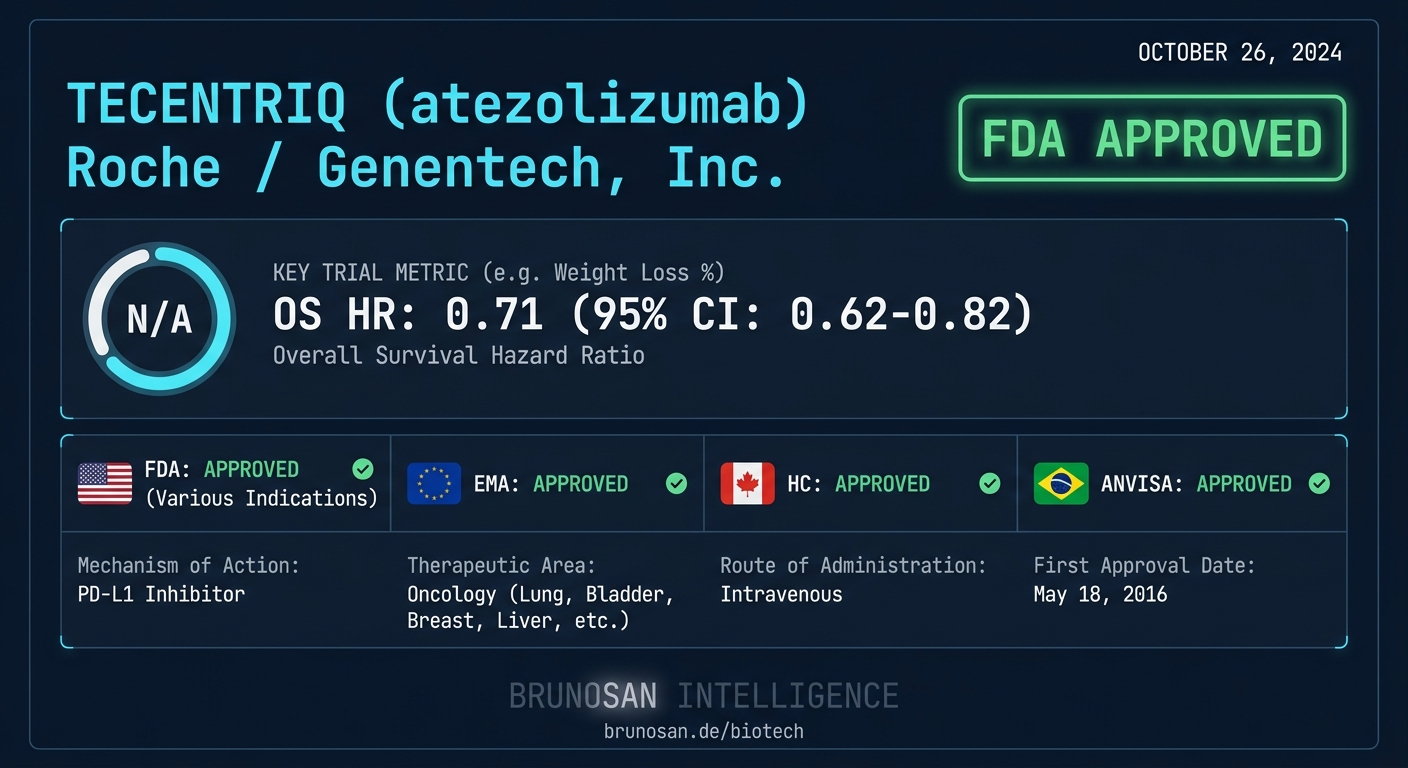
Roche's Tecentriq Gains FDA Approval for Adjuvant Bladder Cancer with Companion Diagnostic
Roche secured a pivotal FDA approval for Tecentriq, establishing a new treatment protocol for muscle-invasive bladder cancer by integrating Natera's Signatera ctDNA test to guide adjuvant therapy post-surgery. This marks a first for the indication. The approval ties treatment directly to molecular recurrence risk, creating a new standard for patient selection in the adjuvant setting and challenging existing treatment protocols.
Drug Profile
Mechanism of Action Tecentriq (atezolizumab) is a monoclonal antibody that targets Programmed Death-Ligand 1 (PD-L1). By binding to PD-L1 on the surface of tumor cells and tumor-infiltrating immune cells, it blocks the interaction with its receptors, PD-1 and B7.1. This blockade releases the inhibition of the immune response, restoring T-cell activation and enhancing the immune system's ability to detect and attack cancer cells.
Drug Class & Structure Atezolizumab is a humanized IgG1 monoclonal antibody and a member of the immune checkpoint inhibitor class. Its structural differentiation lies in its engineered Fc-domain. The region has been modified to prevent binding to Fcγ receptors, which eliminates antibody-dependent cell-mediated cytotoxicity (ADCC). This design ensures the drug's activity is focused on checkpoint blockade without depleting the PD-L1-expressing immune cells that are critical for an anti-tumor response.
Clinical Data
The approval is supported by results from the IMvigor011 study, a Phase III trial evaluating Tecentriq in patients with MIBC who are ctDNA-positive after surgery. The trial demonstrated a clear benefit in the targeted patient population identified by the Signatera assay.
| Endpoint | Result | Comparator | Trial | | :--- | :--- | :--- | :--- | | Disease-Free Survival (DFS) in ctDNA+ patients | HR=0.56 (95% CI: 0.43-0.74); p<0.001 | Observation | IMvigor011 |
Global Regulatory Status
Drug-specific status across all four regulatory bodies BrunoSan tracks. Separate from pipeline volume shown in the infobar.
| Regulatory Body | Status | Notes |
|---|---|---|
| Regulatory Body | Status | |
| FDA (U.S.) | ✓ Approved May 18, 2026 | |
| EMA (Europe) | No submission entry detected in BrunoSan DB as of 2026-05-18 | |
| Health Canada | No submission entry detected in BrunoSan DB as of 2026-05-18 | |
| ANVISA (Brazil) | No submission entry detected in BrunoSan DB as of 2026-05-18 |
STATUS
Market Impact
This approval carves out a specific, high-value niche for Tecentriq within the adjuvant bladder cancer market. The primary competitor is Bristol Myers Squibb's Opdivo (nivolumab), which holds a broader approval in the all-comer adjuvant setting based on the CheckMate 274 trial. While Opdivo addresses a larger patient pool, Tecentriq's strategy offers a compelling proposition: treating only those with detectable molecular residual disease (MRD), who are at the highest risk of recurrence. This ctDNA-selected approach provides a clear rationale for physicians and payers, potentially leading to strong adoption and reimbursement within its target population by avoiding treatment for patients unlikely to benefit. Merck's Keytruda (pembrolizumab) also remains a dominant force in urothelial carcinoma, but this approval gives Roche a distinct, precision-medicine foothold.
The structural impact extends beyond bladder cancer. The FDA's co-approval of Tecentriq with the Signatera companion diagnostic solidifies the regulatory and commercial viability of ctDNA-based MRD testing to guide adjuvant therapy. This creates a powerful drug-diagnostic franchise for Roche and Natera, establishing a barrier for competitors who lack a validated MRD assay. The decision will pressure other oncology drug developers to incorporate similar biomarker strategies into their adjuvant trial designs. It also shifts the reimbursement landscape, forcing payers to evaluate the combined economic value of a diagnostic test that de-risks the use of high-cost immunotherapy for a smaller, more appropriate patient population.
The approval's core impact is not the drug itself, but the codification of a ctDNA-guided treatment model in the post-surgical setting. Based on BrunoSan pipeline data tracking 14,615 events, approvals linked to a mandatory liquid biopsy companion diagnostic for patient selection in solid tumor adjuvant settings are rare, representing less than 1% of all oncology approvals. This regulatory precedent provides Roche a defensible market position built on a superior clinical rationale for a specific patient subgroup.
This strategy forces competitors