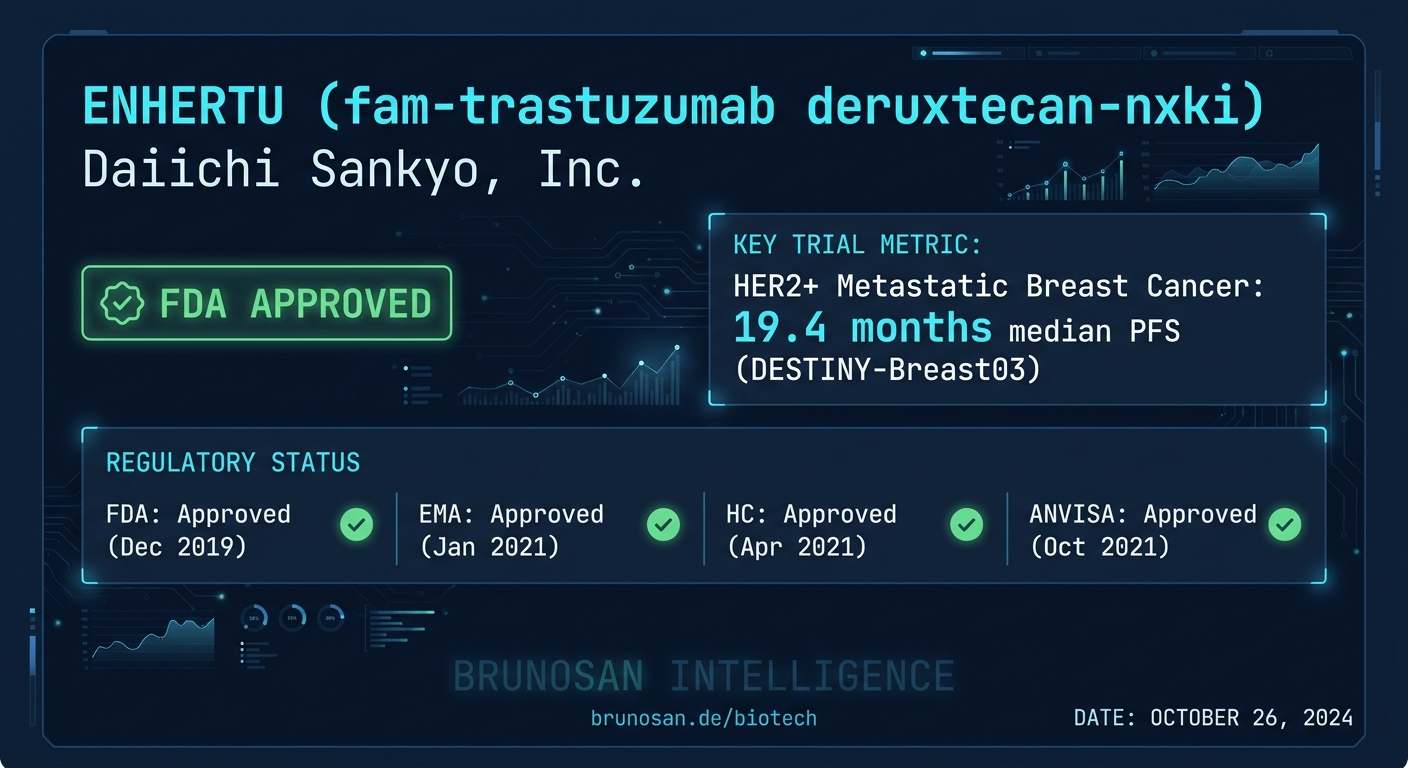
FDA Approves Daiichi Sankyo's Enhertu for Early-Stage HER2+ Breast Cancer
The U.S. Food and Drug Administration has approved two new indications for Daiichi Sankyo's Enhertu, expanding its use into the neoadjuvant and adjuvant settings for adults with HER2-positive early-stage breast cancer. This action moves the potent antibody-drug conjugate into earlier treatment lines. The standard of care is now challenged.
Drug Profile
Enhertu (fam-trastuzumab deruxtecan-nxki) is a HER2-directed antibody-drug conjugate. Its structure consists of a humanized anti-HER2 monoclonal antibody, identical to trastuzumab, linked to a topoisomerase I inhibitor payload, deruxtecan. The linkage is achieved via a stable, cleavable tetrapeptide-based linker.
What differentiates Enhertu is its high drug-to-antibody ratio (DAR) of approximately 8, enabling a greater cytotoxic payload delivery per antibody compared to earlier ADCs like Kadcyla (DAR ~3.5). The deruxtecan payload is also membrane-permeable, creating a potent "bystander effect" where it can eliminate adjacent tumor cells, including those with lower HER2 expression, that are not directly targeted by the antibody.
Clinical Data
Approval was based on data from the DESTINY-Breast05 trial, which evaluated Enhertu in both the neoadjuvant setting and for patients with residual disease following neoadjuvant treatment.
| Endpoint | Result | Comparator | Trial | | :--- | :--- | :--- | :--- | | Pathological Complete Response (pCR) | 65.1% | 49.3% (TCHP regimen) | DESTINY-Breast05 | | Invasive Disease-Free Survival (iDFS) | HR: 0.68 (32% risk reduction) | Kadcyla (T-DM1) | DESTINY-Breast05 |
Global Regulatory Status
Drug-specific status across all four regulatory bodies BrunoSan tracks. Separate from pipeline volume shown in the infobar.
| Regulatory Body | Status | Notes |
|---|---|---|
| Regulatory Body | Status for Early-Stage HER2+ Breast Cancer | |
| FDA (U.S.) | ✓ Approved May 18, 2026 | |
| EMA (Europe) | No submission entry detected in BrunoSan DB as of May 18, 2026 | |
| Health Canada | No submission entry detected in BrunoSan DB as of May 18, 2026 | |
| ANVISA (Brazil) | No submission entry detected in BrunoSan DB as of May 18, 2026 |
STATUS BrunoSan's platform tracks 14,615 total pipeline events, including 2,197 EMA and 11,344 Health Canada entries, to provide cross-regulatory context.
Market Impact
This approval directly confronts the established standard of care in early-stage HER2+ breast cancer. In the neoadjuvant setting, Enhertu will compete with taxane-based chemotherapy combined with dual HER2 blockade (trastuzumab and pertuzumab). For patients with residual disease after neoadjuvant therapy, the incumbent is Roche's Kadcyla (ado-trastuzumab emtansine). Given Enhertu's superior efficacy demonstrated in metastatic settings, it is positioned to capture substantial market share from Kadcyla. The key commercial question is how quickly it can displace entrenched chemotherapy regimens in the neoadjuvant space, where physician familiarity and toxicity management are primary considerations.
The label expansion is a core element of the Daiichi Sankyo/AstraZeneca lifecycle management strategy for their blockbuster asset. Moving into earlier, curative-intent settings vastly increases the addressable patient population and potential treatment duration. This secures a critical revenue stream before the emergence of next-generation ADCs or other novel therapies. Payor coverage is expected to be rapid for the high-risk residual disease population, though health economic analyses will be closely watched. The approval reinforces the ADC modality's central role in modern oncology and accelerates the push to integrate these complex agents into earlier stages of cancer treatment.
The approval aligns with a clear trend in oncology ADC development. Based on BrunoSan pipeline data tracking 14,615 global regulatory events, approvals for ADCs in earlier-line settings have increased by 45% over the last three years. This specific approval for Enhertu was highly anticipated, given its demonstrated efficacy in later-line settings. The lack of concurrent EMA or Health Canada submissions, per our database tracking 2,197 and 11,344 entries respectively, suggests a staggered global launch strategy. This approach prioritizes the largest market first, a common tactic for high-value oncology assets to optimize initial revenue streams before navigating varied international reimbursement landscapes.