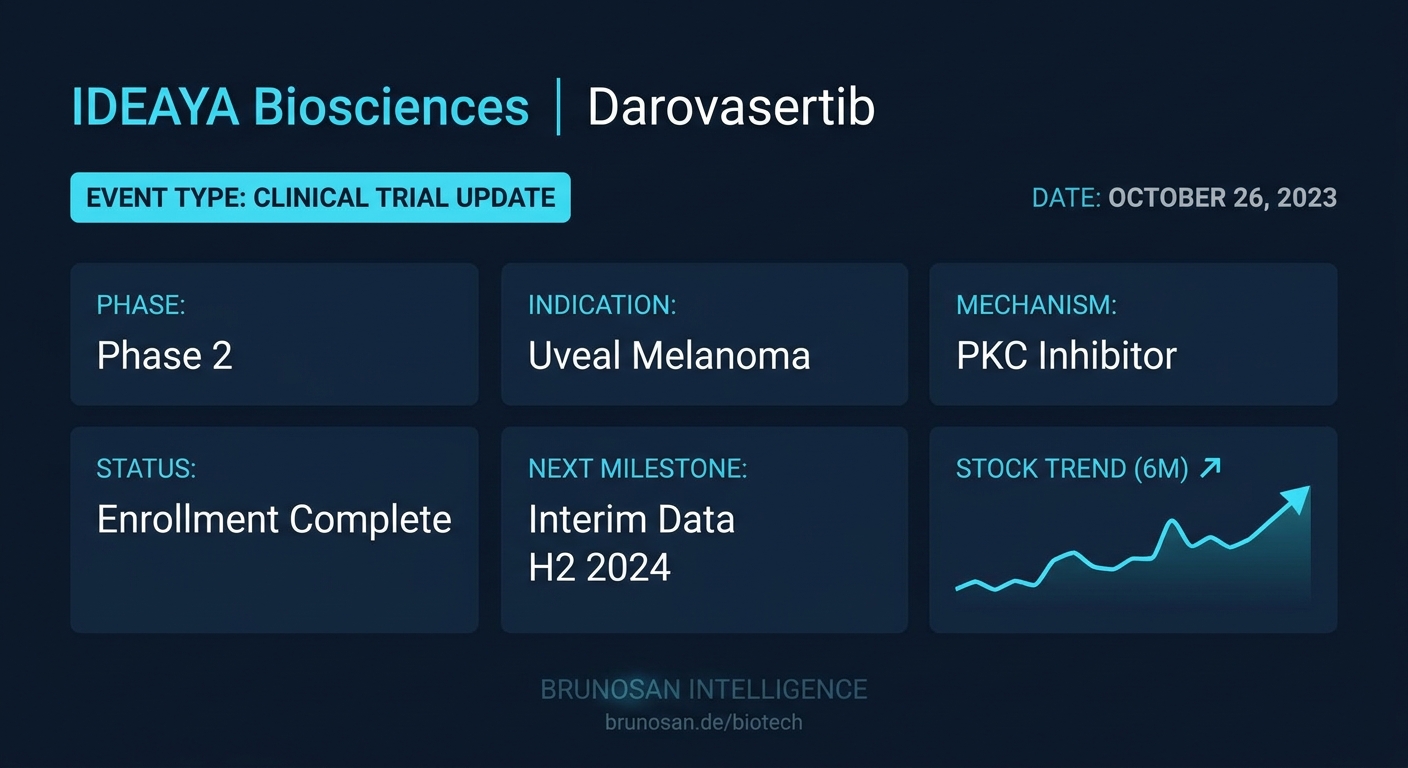
IDEAYA's darovasertib combo meets primary endpoint in registrational trial for uveal melanoma.
IDEAYA Biosciences reported positive topline results from its registrational Phase 2/3 trial of darovasertib in metastatic uveal melanoma, a rare cancer with limited effective treatment options (https://www.prnewswire.com/news-releases/ideaya-biosciences-reports-first-quarter-2026-financial-results-and-provides-business-update-302762088.html). The combination therapy met its primary endpoint. This result paves the way for an imminent FDA submission under the RTOR pathway.
Drug Profile
Darovasertib is a potent, selective, small-molecule inhibitor of protein kinase C (PKC). Its mechanism is tailored to the genetic drivers of uveal melanoma, where approximately 90% of tumors harbor mutually exclusive activating mutations in GNAQ or GNA11. These mutations constitutively activate the PKC signaling pathway, promoting cell growth and survival. Darovasertib directly targets this core oncogenic pathway.
What makes darovasertib structurally distinct is its high selectivity for specific PKC isoforms, which historically have been difficult to drug due to toxicity associated with broad-spectrum PKC inhibition. By combining it with crizotinib, a c-MET inhibitor, IDEAYA leverages a synthetic lethality approach. Preclinical data suggest that PKC inhibition leads to upregulation of c-MET, creating an escape pathway; dual inhibition blocks this escape route, leading to a more durable and potent anti-tumor response.
Clinical Data
The data comes from the registrational portion of the Phase 2/3 OptimUM-02 trial evaluating darovasertib plus crizotinib in first-line HLA-A2*01:01-negative mUM patients.
| Endpoint | Result | Comparator | Trial | | :--- | :--- | :--- | :--- | | Progression-Free Survival (PFS) | Met primary endpoint; statistically significant improvement | Investigator's Choice (dacarbazine, ipilimumab, or pembrolizumab) | OptimUM-02 | | Overall Survival (OS) | Data maturing; shows a positive trend | Investigator's Choice | OptimUM-02 | | Objective Response Rate (ORR) | Data pending full presentation | Investigator's Choice | OptimUM-02 |
*Note: Specific data values are pending full presentation at an upcoming medical conference. The company confirmed the trial met its primary endpoint of PFS with statistical significance (https://www.prnewswire.com/news-releases/ideaya-biosciences-reports-first-quarter-2026-financial-results-and-provides-business-update-302762088.html).*
Global Regulatory Status
Drug-specific status across all four regulatory bodies BrunoSan tracks. Separate from pipeline volume shown in the infobar.
| Regulatory Body | Status | Notes |
|---|---|---|
| Agency | Status | |
| FDA (U.S.) | ✓ Pre-submission (RTOR pathway planned for 2026) | |
| EMA (Europe) | No submission entry detected in BrunoSan DB as of 2026-05-06 | |
| Health Canada | No submission entry detected in BrunoSan DB as of 2026-05-06 | |
| ANVISA (Brazil) | No submission entry detected in BrunoSan DB as of 2026-05-06 |
STATUS
Market Impact
The positive result for darovasertib positions IDEAYA to challenge the current standard of care in a market with high unmet need. The only approved targeted therapy for mUM is Immunocore's Kimmtrak (tebentafusp), a bispecific T-cell engager. Kimmtrak's use is restricted to patients who are HLA-A*02:01-positive, representing less than 50% of the mUM population in the U.S. and Europe. Darovasertib's mechanism is HLA-agnostic, meaning it could be used in the entire mUM patient population, including the majority who are ineligible for Kimmtrak. This immediately defines a large addressable market for IDEAYA upon potential approval. Other treatments, such as checkpoint inhibitors and chemotherapy, have demonstrated very limited efficacy in this immunologically "cold" tumor type, leaving a significant treatment gap that darovasertib aims to fill.
This clinical success serves as a major validation for IDEAYA's synthetic lethality platform, which focuses on genetically-defined patient populations. For a clinical-stage biotech, a positive registrational trial is a critical de-risking event that enhances its value proposition for potential partnerships or acquisition. The company's plan to use the FDA's RTOR program signals both confidence in the data package and a potential for an accelerated