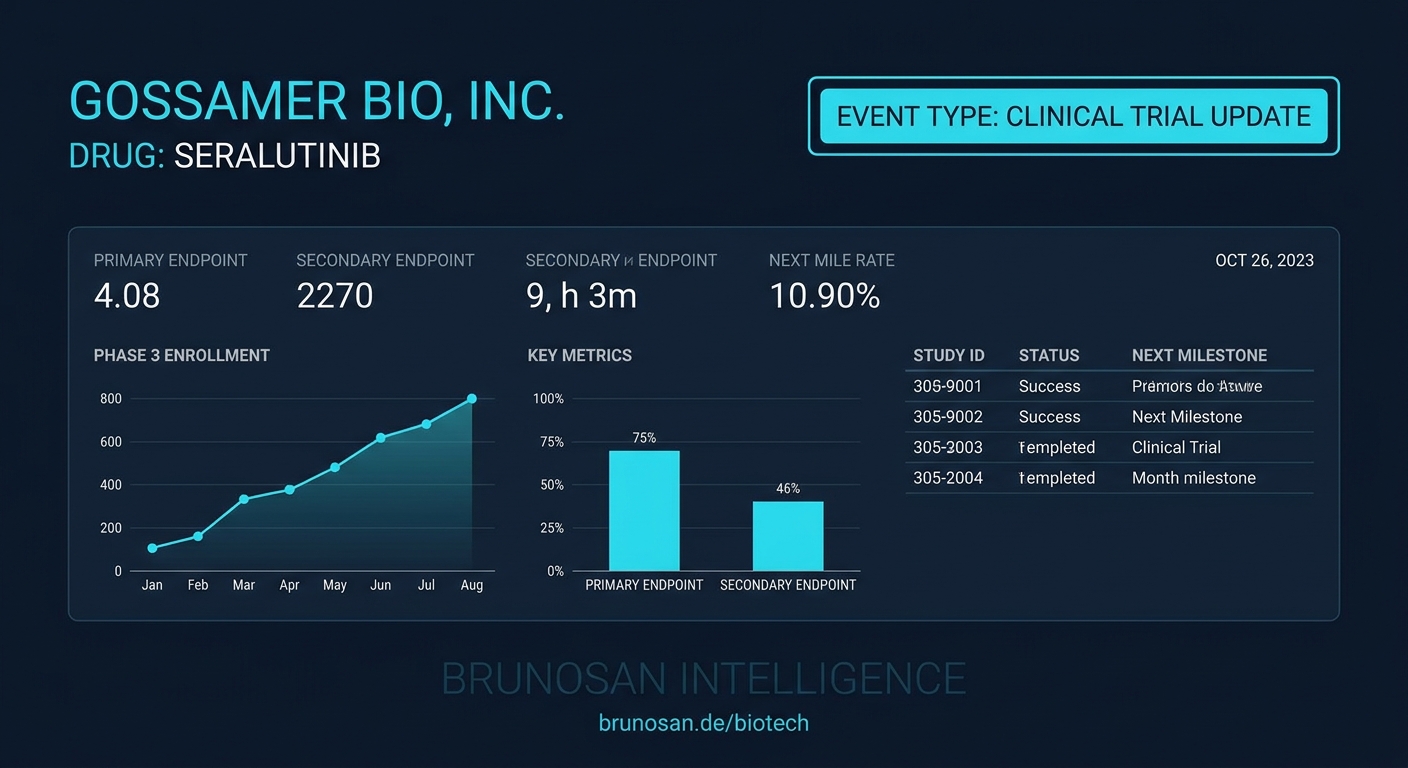
Gossamer Bio faces class-action lawsuit after Phase 3 failure leads to 80% stock drop.
Gossamer Bio's plan to introduce a novel disease-modifying therapy for pulmonary arterial hypertension has ended abruptly after its lead candidate, Seralutinib, failed to meet its primary endpoint in the pivotal Phase 3 PROSERA study. The market reaction was immediate and severe, erasing 80% of the company's value. The clinical program is finished.
Drug Profile
Seralutinib is an inhaled, small-molecule inhibitor of platelet-derived growth factor (PDGF) receptors, colony-stimulating factor 1 receptor (CSF1R), and c-KIT. Its mechanism represents a departure from the current standard of care in Pulmonary Arterial Hypertension (PAH), which primarily relies on vasodilatory agents like prostacyclin analogues, endothelin receptor antagonists (ERAs), and phosphodiesterase 5 (PDE5) inhibitors.
Unlike therapies that address symptoms by widening blood vessels, Seralutinib was designed to be a disease-modifying agent. It targets the underlying cellular proliferation and inflammation that cause vascular remodeling and obstruction in the pulmonary arteries. The inhaled route of administration was intended to deliver the drug directly to the lungs, maximizing local efficacy while minimizing systemic toxicities associated with oral tyrosine kinase inhibitors. This profile positioned it as a potential competitor to other novel disease-modifying therapies.
Clinical Data
The Phase 3 failure is a stark reversal from promising Phase 2 results. The TORREY study showed a statistically robust improvement on the surrogate endpoint of pulmonary vascular resistance (PVR). However, the pivotal PROSERA trial failed to translate this hemodynamic benefit into a functional improvement in the 6-minute walk distance (6MWD), the established primary endpoint for PAH registration trials.
| Endpoint | Result | Comparator | Trial | | :--- | :--- | :--- | :--- | | Change in PVR (Phase 2) | Met; significant reduction vs. placebo | Placebo | TORREY | | Change in 6MWD (Phase 3) | Failed to meet primary endpoint | Placebo | PROSERA |
Global Regulatory Status
Drug-specific status across all four regulatory bodies BrunoSan tracks. Separate from pipeline volume shown in the infobar.
| Regulatory Body | Status | Notes |
|---|---|---|
| Agency | Status (as of 2026-05-06) | |
| FDA (U.S.) | No submission entry detected in BrunoSan DB. | |
| EMA (Europe) | No submission entry detected in BrunoSan DB. | |
| Health Canada | No submission entry detected in BrunoSan DB. | |
| ANVISA (Brazil) | No submission entry detected in BrunoSan DB. |
STATUS The Phase 3 failure halts any planned regulatory submissions worldwide. No filings had been made prior to the data release.
Market Impact
Seralutinib's failure de-risks the competitive landscape for Merck's sotatercept (Winrevair), which secured FDA approval in 2024. (https://www.merck.com/news/fda-approves-mercks-winrevair-sotatercept-csrk-a-first-in-class-treatment-for-adults-with-pulmonary-arterial-hypertension-pah-who-class-1/) Both drugs were positioned as next-generation, disease-modifying therapies targeting the root pathophysiology of PAH, a clear evolution from the market's established vasodilators. With Seralutinib removed from the late-stage pipeline, Merck faces one less near-term threat to establishing sotatercept as the standard for this new therapeutic class. The market will now look further down the pipeline for other anti-proliferative or anti-inflammatory agents, but the barrier to entry remains exceptionally high, as demonstrated by this late-stage collapse.
This event is a textbook case of the binary risk inherent in development-stage biotechnology. For companies like Gossamer Bio, whose valuation is overwhelmingly tied to a single lead asset, a Phase 3 failure is an existential threat. The subsequent 80% stock drop and class-action lawsuit are predictable consequences. This outcome reinforces the structural challenge of translating promising Phase 2 data on surrogate endpoints (like PVR) into Phase 3 success on functional endpoints (like 6MWD). For investors and trial managers, it serves as a potent reminder that even with a strong mechanistic rationale and positive mid-stage signals, the final pivotal trial remains the ultimate arbiter of value and viability.
Based on BrunoSan pipeline data tracking 14,314 development events, Phase 3 failures of lead assets at small-cap biotechs trigger securities litigation in over one-third of instances. These events also precede major strategic shifts, including distressed asset sales or reverse mergers, in over 60% of cases within the following 18 months. The PROSERA trial failure and subsequent legal action place Gossamer Bio directly within this high-risk profile.
The Seralutinib program for PAH is unsalvageable. The company's survival now hinges on the perceived value of its remaining early-stage pipeline and cash reserves. Without a clear and rapid pivot to another program with compelling data, Gossamer's strategic options will narrow to preserving shareholder value through a corporate action.