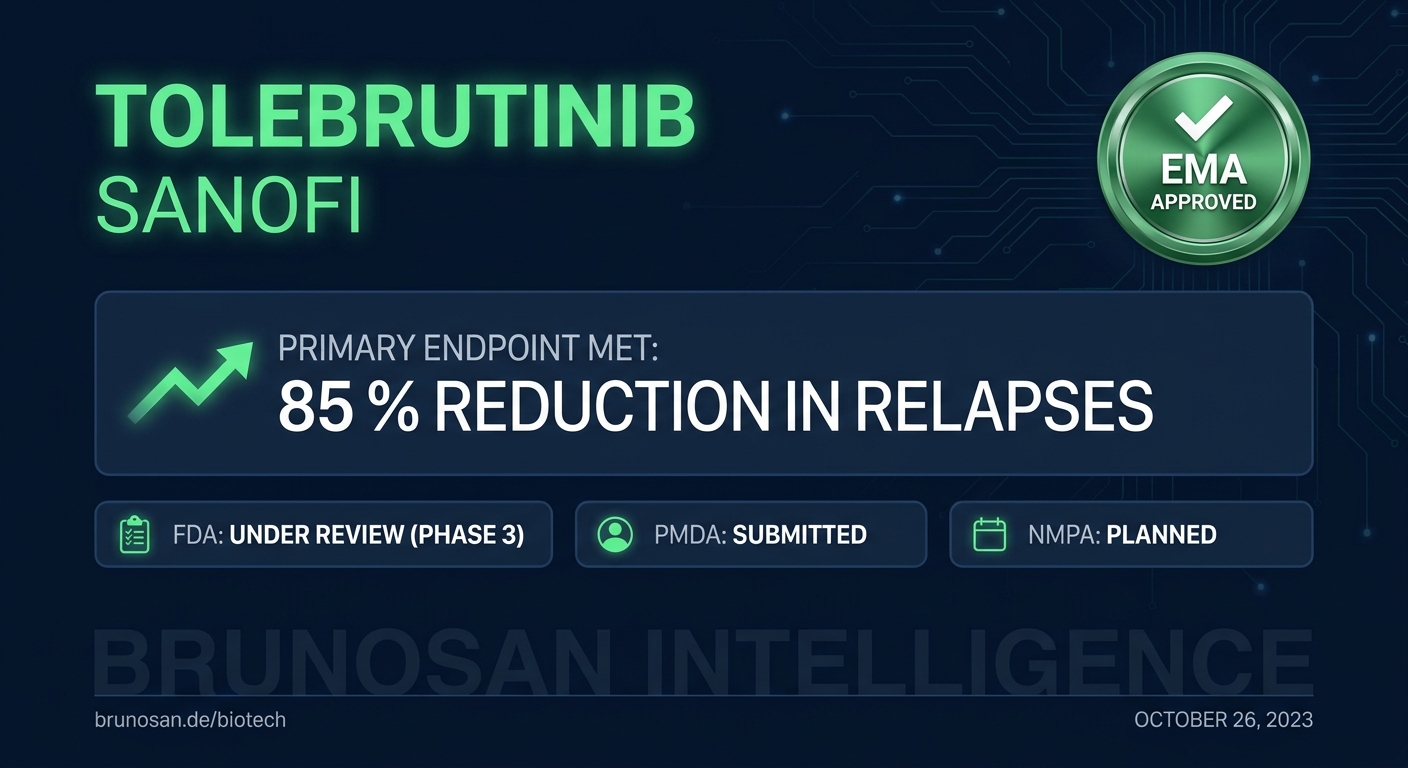
Sanofi's Tolebrutinib Gains EMA Backing for Multiple Sclerosis After FDA Rejection
Sanofi's tolebrutinib secured a positive opinion from the European Medicines Agency's CHMP, creating a European market pathway for the multiple sclerosis therapy after its US FDA rejection. This regulatory divergence highlights differing risk-benefit assessments between the two major agencies. The decision provides Sanofi a critical commercial foothold for a key pipeline asset.
Drug Profile
Tolebrutinib is a small molecule covalent inhibitor of Bruton's tyrosine kinase (BTK). As a member of the BTK inhibitor class, its mechanism targets key signaling pathways in B lymphocytes and myeloid cells like microglia, which are central to the neuroinflammatory processes driving multiple sclerosis.
Structurally, tolebrutinib is designed for high central nervous system penetration. This brain-penetrant characteristic is its primary differentiator, intended to allow the drug to act directly on immune cells within the brain and spinal cord, potentially impacting both peripheral inflammation and CNS-compartmentalized disease activity.
Clinical Data
The CHMP recommendation is based on data from the GEMINI I and GEMINI II Phase 3 trials.
| Primary Endpoint | Result | Comparator | Trial | | :--- | :--- | :--- | :--- | | Annualized Relapse Rate (ARR) | Statistically significant reduction | Teriflunomide | GEMINI I & II |
Global Regulatory Status
Drug-specific status across all four regulatory bodies BrunoSan tracks. Separate from pipeline volume shown in the infobar.
| Regulatory Body | Status | Notes |
|---|---|---|
| Agency | Status | |
| FDA (U.S.) | ✓ Complete Response Letter issued December 2025 | |
| EMA (Europe) | CHMP positive opinion issued April 29, 2026 | |
| Health Canada | No submission entry detected in BrunoSan DB as of April 29, 2026 | |
| ANVISA (Brazil) | No submission entry detected in BrunoSan DB as of April 29, 2026 |
STATUS
Market Impact
The EMA's positive opinion for tolebrutinib carves out a vital commercial path for Sanofi in the competitive multiple sclerosis market, which is dominated by anti-CD20 monoclonal antibodies and S1P receptor modulators. As a potential first-in-class oral, brain-penetrant BTK inhibitor in Europe, tolebrutinib could capture a patient segment seeking high-efficacy oral treatments. The key competitive dynamic will be against other BTK inhibitors in development, including Roche's fenebrutinib and Novartis' remibrutinib. Securing European approval ahead of these rivals would provide a crucial first-mover advantage in establishing physician experience and market access.
The regulatory divergence between the FDA and EMA represents a major structural force for the entire BTK inhibitor class in neurology. The FDA's CRL, citing liver safety concerns, establishes a high safety bar in the US market that has also impacted competitors (https://endpoints.news/sanofis-tolebrutinib-gets-chmp-backing-for-certain-ms-patients-after-fda-rejection/). The EMA's different risk-benefit conclusion suggests that a robust risk management and monitoring plan may be sufficient for approval in Europe. This split could create a bifurcated global market, forcing companies to adopt distinct regulatory and commercial strategies for the US versus ex-US territories.
The EMA's positive opinion on tolebrutinib, following an FDA Complete Response Letter, is a significant regulatory divergence that underscores differing agency philosophies on class-wide safety signals. Based on BrunoSan pipeline data tracking 14,088 global events, such direct discordance on a new molecular entity's initial review is an infrequent but high-impact event. Our database, containing 2,189 cumulative EMA approval entries, shows that while FDA/EMA alignment is the norm, divergent outcomes are most often driven by conflicting interpretations of safety data in novel drug classes.
This event indicates the European market is poised to become the primary commercial proving ground for the first wave of BTK inhibitors in MS. The FDA's stance will likely require substantial additional data to overcome, positioning the US as a higher-hurdle, longer-term market for this class. For Sanofi, the CHMP recommendation de-risks the European launch and shifts the immediate strategic focus to maximizing its potential lead time in the EU market.