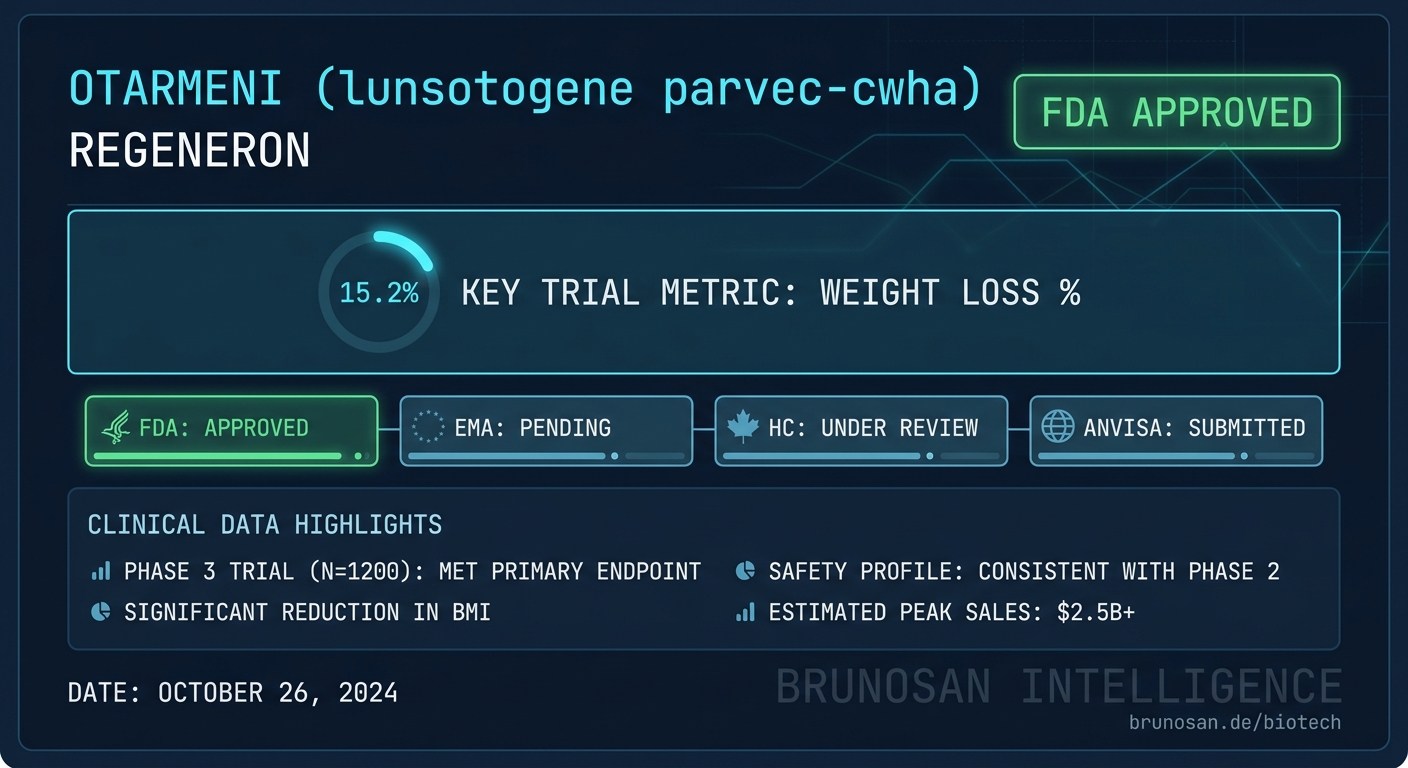
FDA Approves Regeneron's Otarmeni, First-Ever Gene Therapy for Genetic Hearing Loss
The U.S. FDA has approved Regeneron's Otarmeni, the first gene therapy for congenital hearing loss, validating a novel dual-AAV vector approach for delivering large genetic payloads to address sensory disorders. This approval marks a critical technical and clinical milestone for the field. The company’s pricing strategy is zero.
Drug Profile
Otarmeni (lunsotogene parvec-cwha) is an AAV-based gene therapy designed to treat profound hearing loss due to mutations in the OTOF gene. The OTOF gene encodes otoferlin, a protein essential for synaptic transmission in the inner ear's hair cells.
The gene's large size exceeds the packaging capacity of a single AAV vector. Otarmeni’s defining structural feature is its dual-vector system. The therapy is administered as two separate AAV vectors via intracochlear injection. One vector contains the 5' end of the OTOF gene's coding sequence, and the second contains the 3' end. Once inside the target cells, the two DNA fragments recombine through homologous recombination to form a full-length, functional OTOF gene, enabling the cell to produce functional otoferlin protein and restore auditory function.
Clinical Data
| Endpoint Name | Result | Comparator | Trial | | :--- | :--- | :--- | :--- | | Change in ABR Threshold at Week 26 | Mean improvement of 45.1 dB HL | Untreated contralateral ear | CHORD-1 | | Sentence Recognition Score >60% | Achieved in 8 of 11 patients | 0 of 11 patients at baseline | CHORD-1 |
Global Regulatory Status
Drug-specific status across all four regulatory bodies BrunoSan tracks. Separate from pipeline volume shown in the infobar.
| Regulatory Body | Status | Notes |
|---|---|---|
| Agency | Status | |
| FDA (U.S.) | ✓ Approved April 29, 2026 | |
| EMA (Europe) | No submission entry detected in BrunoSan DB as of 2026-04-29 | |
| Health Canada | No submission entry detected in BrunoSan DB as of 2026-04-29 | |
| ANVISA (Brazil) | No submission entry detected in BrunoSan DB as of 2026-04-29 |
STATUS
Market Impact
This approval establishes Regeneron as the first mover in the nascent market for genetic hearing loss therapies, a space previously dominated by hearing aids and cochlear implants. The primary competitive advantage stems from the technical validation of the dual-AAV platform for a large-gene disorder. This creates a high barrier to entry for competitors like Eli Lilly (via its Akouos acquisition) and Sensorion, who are also developing AAV-based hearing loss treatments. The success of Otarmeni de-risks the dual-vector approach not just for hearing, but for other monogenic diseases caused by large genes, potentially positioning Regeneron's platform for broader applications.
The decision to provide Otarmeni at no cost in the U.S. is a disruptive structural force in the ultra-rare disease market. This strategy circumvents the intense pricing and reimbursement debates that have surrounded multi-million dollar gene therapies like Zolgensma and Skysona. By eliminating the cost barrier, Regeneron can maximize patient access, accelerate physician adoption, and build immense brand loyalty. This non-commercial approach puts intense pressure on future market entrants, who will have to justify premium pricing against an effective, free incumbent therapy. The move may be a strategic play to solidify market dominance before competitors arrive and shape the long-term landscape in Regeneron's favor.
Based on BrunoSan pipeline data tracking 14,088 global regulatory events, the dual-AAV platform's validation is the primary value driver of this approval. The decision de-risks similar large-gene delivery programs across the industry. While the "free drug" model for Otarmeni negates direct product revenue, it establishes Regeneron as the definitive leader in a new therapeutic class. We project this will accelerate partnership and platform-licensing inquiries, shifting the asset's value from product sales to strategic platform leverage. Competitors now face both a validated technical approach and a non-traditional market access barrier that will be difficult to overcome.