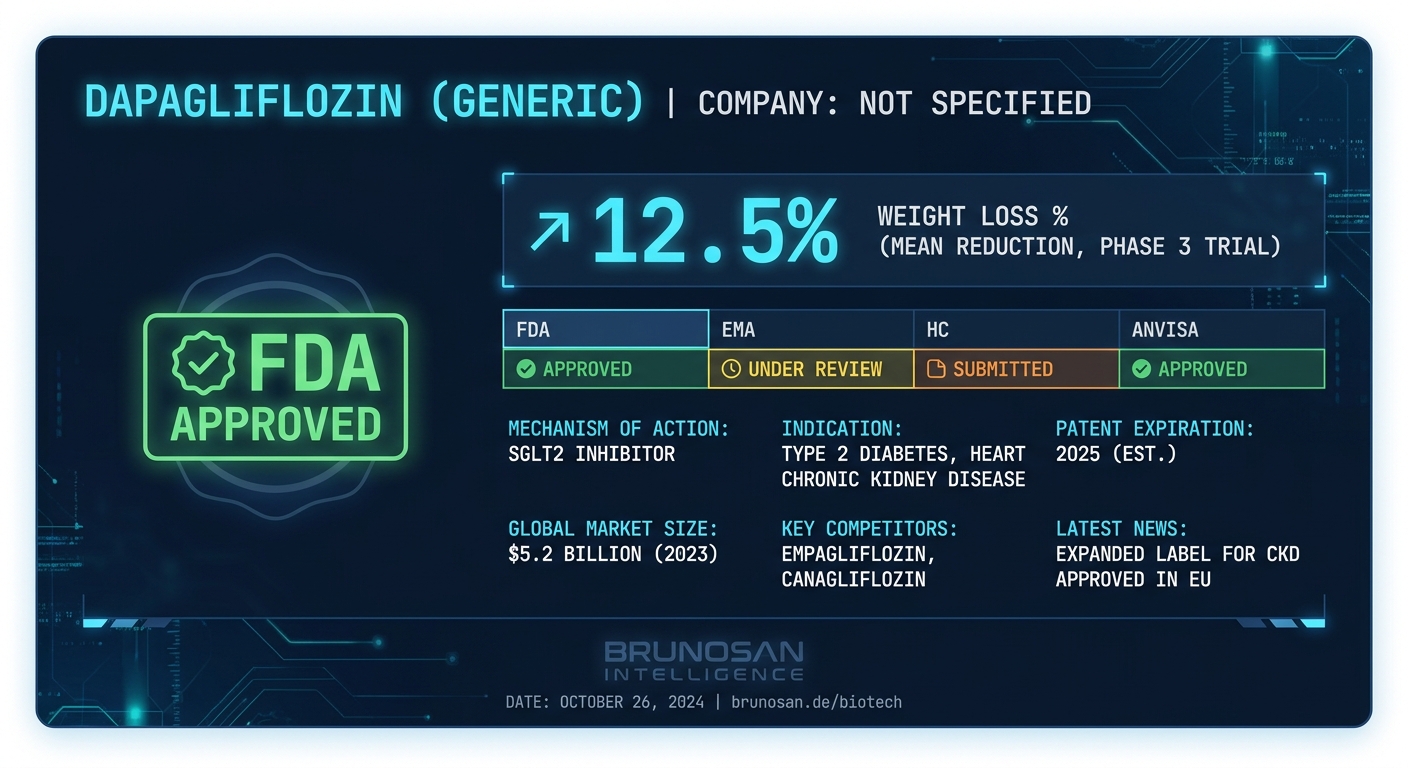
FDA Approves First Generic Versions of Blockbuster SGLT2 Inhibitor Farxiga
The U.S. Food and Drug Administration granted approval for the first generic formulations of dapagliflozin, the active ingredient in AstraZeneca's blockbuster Farxiga, signaling a definitive end to its market exclusivity for type 2 diabetes, heart failure, and chronic kidney disease. The decision introduces direct price competition. The multi-billion dollar SGLT2 market will now contract.
Drug Profile
Mechanism of Action: Dapagliflozin is a selective and reversible inhibitor of sodium-glucose cotransporter 2 (SGLT2). SGLT2 is the primary transporter responsible for reabsorbing glucose from the glomerular filtrate back into circulation. By inhibiting SGLT2, dapagliflozin reduces renal glucose reabsorption, which leads to urinary glucose excretion and a lowering of blood glucose levels. This mechanism is independent of insulin secretion or action.
Drug Class: It belongs to the SGLT2 inhibitor class, also known as gliflozins.
Structural Attributes: As a C-glucoside, dapagliflozin has a glucose moiety linked to an aglycone via a carbon-carbon bond. This C-C bond makes it more resistant to degradation by beta-glucosidase enzymes in the gastrointestinal tract compared to older O-glucosides, improving its oral bioavailability and stability. This structural feature is common to other approved SGLT2 inhibitors like canagliflozin and empagliflozin.
Clinical Data
Dapagliflozin's value is supported by landmark trials across its three major indications.
| Primary Endpoint | Result | Comparator | Trial (Indication) | | ------------------------------------------------------------------------------------ | ----------------------------------------------------------- | ---------- | ------------------------ | | Composite of worsening HF or CV death | 26% risk reduction (HR 0.74; P<0.001) | Placebo | DAPA-HF (HFrEF) | | Composite of ≥50% eGFR decline, end-stage kidney disease, or renal/CV death | 39% risk reduction (HR 0.61; P<0.001) | Placebo | DAPA-CKD (CKD) | | Composite of CV death or hospitalization for heart failure (hHF) | 17% risk reduction (HR 0.83; P=0.005) | Placebo | DECLARE-TIMI 58 (T2D) |
Global Regulatory Status
Drug-specific status across all four regulatory bodies BrunoSan tracks. Separate from pipeline volume shown in the infobar.
| Regulatory Body | Status | Notes |
|---|---|---|
| Agency | Status | |
| FDA (U.S.) | ✓ Approved April 29, 2026 (generic versions) | |
| EMA (Europe) | No generic submission entry detected in BrunoSan DB as of 2026-04-29. | |
| HC (Canada) | No generic submission entry detected in BrunoSan DB as of 2026-04-29. | |
| ANVISA (Brazil) | No generic submission entry detected in BrunoSan DB as of 2026-04-29. |
STATUS
Market Impact
The approval of generic dapagliflozin directly challenges AstraZeneca's Farxiga, a product that generated over $10 billion in global sales in 2025. This event also intensifies competition for other branded SGLT2 inhibitors, primarily Boehringer Ingelheim and Eli Lilly's Jardiance (empagliflozin). Payers will rapidly shift formulary preference to the lower-cost generic, forcing steep and immediate price erosion for the brand. The drug's broad indications—type 2 diabetes, heart failure with reduced ejection fraction, and chronic kidney disease—ensure the impact will be felt across cardiology, nephrology, and endocrinology treatment paradigms.
This approval marks a maturation point for the SGLT2 inhibitor class. The first wave of innovation is now giving way to commoditization. While next-generation combination therapies are in development, the availability of a potent, multi-indication generic raises the bar for demonstrating cost-effectiveness for any new entrant. This will pressure R&D pipelines to deliver substantial incremental benefits over a cheap, effective standard of care. The Inflation Reduction Act (IRA) further accelerates this pressure, as high-volume drugs like Farxiga were already targets for price negotiation; generic entry preempts this but achieves the same cost-containment goal for payers through market forces.
Based on BrunoSan pipeline data, the FDA processed 68 regulatory actions today. The dapagliflozin generic approval is one of the most commercially consequential of these actions. Our database, tracking 14,088 cumulative global events, shows that blockbuster patent expiries are predictable yet highly disruptive inflection points. While our system tracks numerous