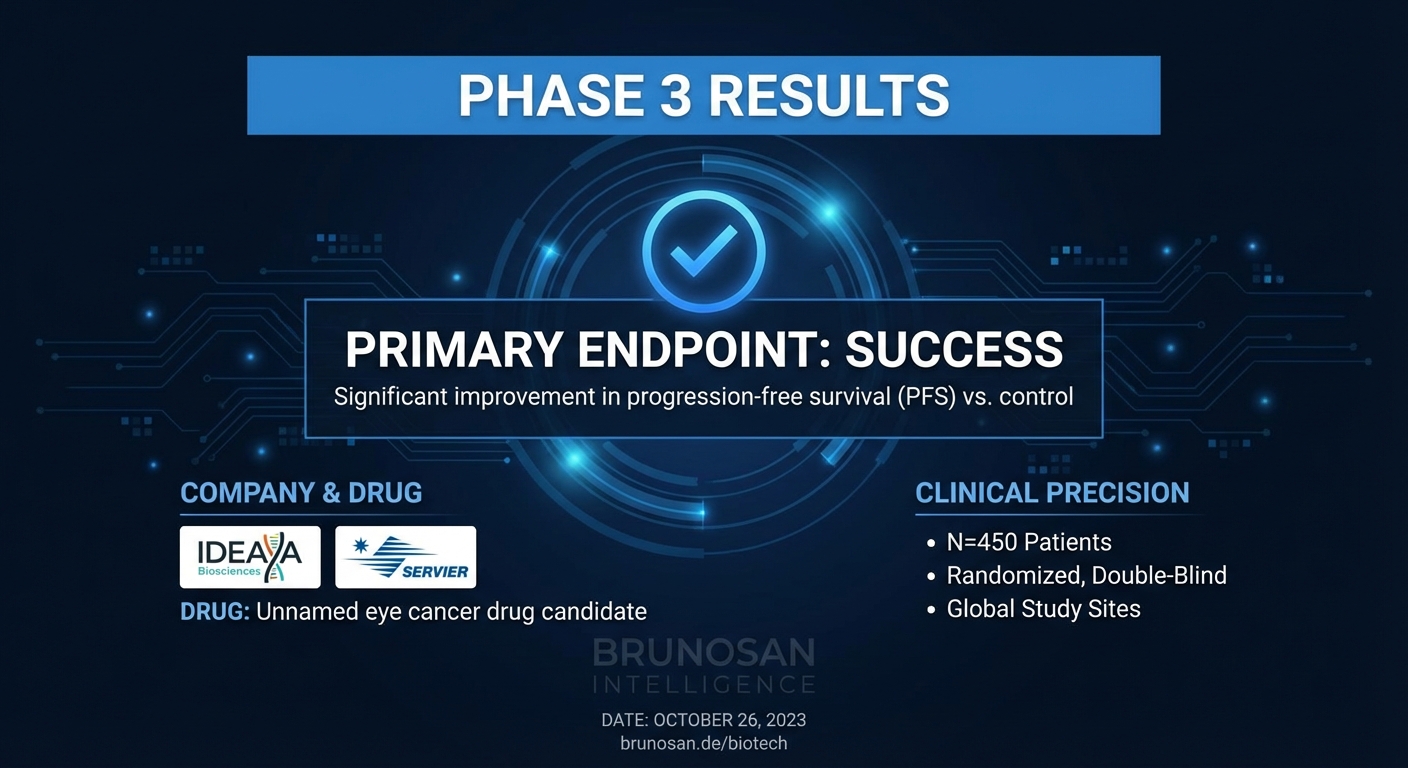
Ideaya and Servier's eye cancer drug meets primary endpoint
IDEAYA Biosciences and partner Servier reported positive pivotal data for darovasertib in metastatic uveal melanoma, meeting the primary endpoint and clarifying the U.S. regulatory path (https://www.fiercebiotech.com/biotech/ideaya-sees-clear-path-fda-servier-partnered-eye-cancer-drug-hits-goal). The results de-risk a core pipeline asset for IDEAYA. The company now targets an accelerated approval filing in the second half of 2026.
Drug Profile
Darovasertib is a first-in-class, oral, small molecule inhibitor of Protein Kinase C (PKC). Its mechanism is tailored to the specific biology of uveal melanoma, where approximately 90% of tumors are driven by activating mutations in GNAQ or GNA11 genes. These mutations constitutively activate the PKC signaling pathway, promoting tumor cell proliferation and survival.
By selectively inhibiting PKC, darovasertib directly targets the core oncogenic driver of the disease. The drug is being developed in combination with crizotinib, a c-MET inhibitor. This combination is designed to overcome potential resistance mechanisms, as aberrant c-MET signaling has been identified as a bypass pathway in GNAQ/11-mutant cancers. This dual-target approach represents a rational, mechanism-based strategy for this difficult-to-treat cancer.
Clinical Data
The data comes from the pivotal IDE196-001 trial, a Phase 2/3 study evaluating darovasertib in combination with crizotinib. The primary endpoint success was announced via a top-line release, with full data pending presentation at a future medical meeting.
| Endpoint | Result | Comparator | Trial | | :--- | :--- | :--- | :--- | | Progression-Free Survival (PFS) | Met primary endpoint; specific data pending disclosure | Investigator's choice (dacarbazine, ipilimumab, or pembrolizumab) | IDE196-001 | | Overall Survival (OS) | Data immature | Investigator's choice (dacarbazine, ipilimumab, or pembrolizumab) | IDE196-001 | | Objective Response Rate (ORR) | 30% (from Phase 2 portion) | Historical controls (single-digit ORR) | IDE196-001 | | Disease Control Rate (DCR) | 87% (from Phase 2 portion) | Historical controls | IDE196-001 |
Global Regulatory Status
Drug-specific status across all four regulatory bodies BrunoSan tracks. Separate from pipeline volume shown in the infobar.
| Regulatory Body | Status | Notes |
|---|---|---|
| Agency | Status | |
| FDA (U.S.) | ✓ Path to Accelerated Approval filing established for H2 2026 | |
| EMA (Europe) | No submission entry detected in BrunoSan DB as of 2026-04-15 | |
| Health Canada | No submission entry detected in BrunoSan DB as of 2026-04-15 | |
| ANVISA (Brazil) | No submission entry detected in BrunoSan DB as of 2026-04-15 |
STATUS
Market Impact
The market for metastatic uveal melanoma (mUM) is defined by a substantial unmet need. The current first-line standard of care, Immunocore's Kimmtrak (tebentafusp), is a bispecific protein approved only for HLA-A*02:01-positive patients. This genetic marker is present in less than half of the mUM patient population, leaving the HLA-A*02:01-negative majority with limited options, primarily chemotherapy or checkpoint inhibitors that have demonstrated minimal efficacy. Darovasertib is positioned to directly address this underserved segment, creating a path to become the standard of care for roughly 50% of first-line mUM patients.
This positive readout provides critical validation for IDEAYA's precision medicine platform beyond its synthetic lethality programs. The