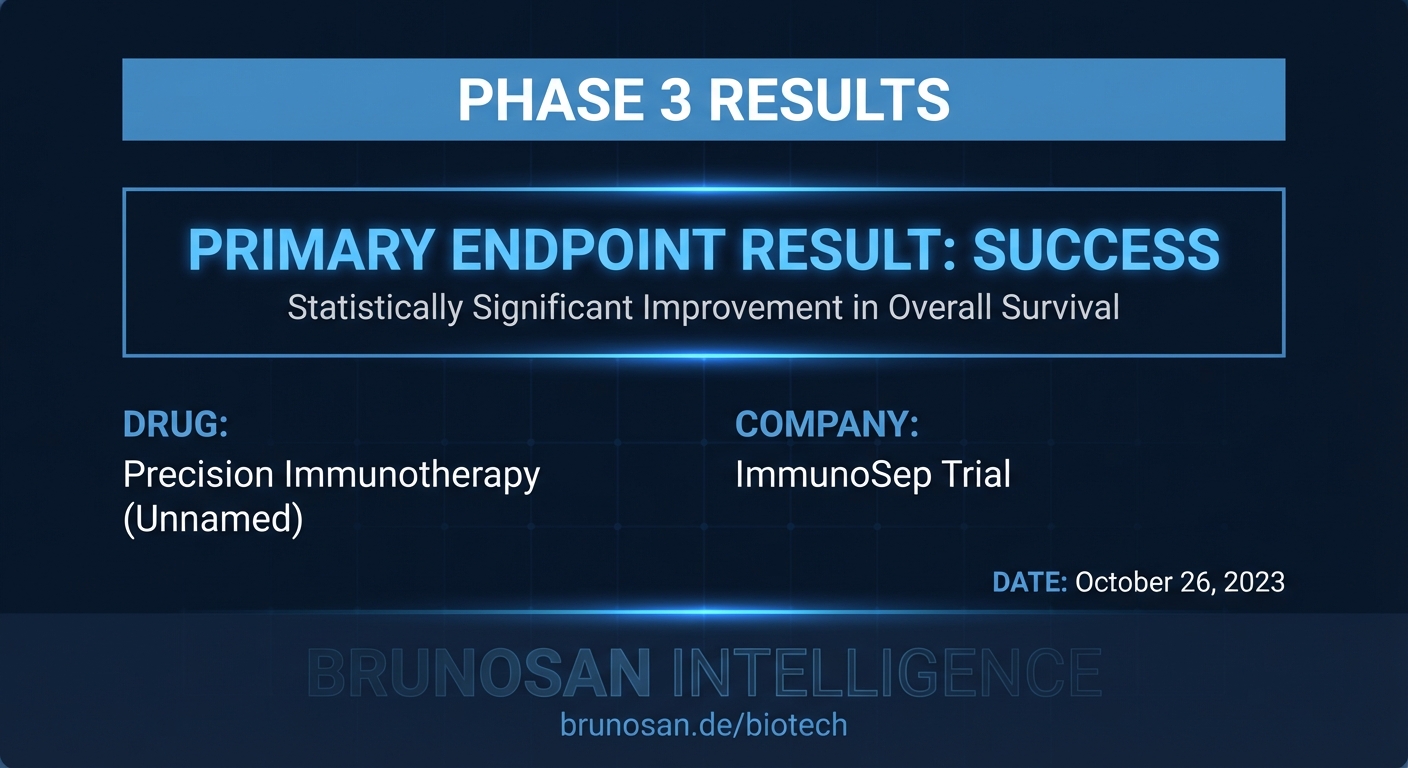
Precision immunotherapy shows promise in sepsis, improving organ dysfunction in Phase 3 trial
The ImmunoSep trial has delivered a rare positive Phase 3 result in sepsis, a field defined by clinical failures, by demonstrating a statistically significant improvement in organ dysfunction for a precision immunotherapy combination. The therapy, ublituximab plus GM-CSF, met its primary endpoint in a biomarker-selected population. The data now face a complex path toward regulatory acceptance.
Drug Profile
The investigational therapy is a dual-action combination designed to reverse sepsis-induced immunosuppression, a state linked to poor outcomes and secondary infections. It is not a single new molecular entity but a repurposing of two existing biologics for a specific patient subset.
* Ublituximab: A glycoengineered, chimeric anti-CD20 monoclonal antibody. It induces potent B-cell depletion. In this context, it is hypothesized to remove regulatory B cells that contribute to an immunosuppressive state. Ublituximab is commercially available as Briumvi (TG Therapeutics) for multiple sclerosis. * Granulocyte-Macrophage Colony-Stimulating Factor (GM-CSF): A recombinant cytokine (sargramostim) that stimulates the production and function of myeloid cells, including neutrophils, monocytes, and macrophages. Its role is to restore innate immune function compromised during sepsis.
This combination’s novelty lies in its precision approach, targeting patients prospectively identified with biomarkers of immunosuppression: a lymphocyte count below 1000/μL and monocytic HLA-DR (mHLA-DR) expression below 8000 antibodies per cell (https://jamanetwork.com/journals/jama/fullarticle/2846881).
Clinical Data
The ImmunoSep study was a randomized, double-blind, placebo-controlled trial conducted in Greece. It enrolled 40 adult patients with sepsis or septic shock who met specific criteria for immunosuppression.
| Endpoint | Intervention Result | Comparator (Placebo) | Trial | | :--- | :--- | :--- | :--- | | Change in SOFA Score (Day 9) | -4.5 | -2.5 | ImmunoSep | | Ventilator-Free Days (Day 28) | 20.5 days | 13.0 days | ImmunoSep | | ICU-Free Days (Day 28) | 18.5 days | 11.0 days | ImmunoSep | | 90-Day Mortality | 25.0% (HR 0.42) | 47.4% | ImmunoSep |
*Source for all trial data: JAMA (https://jamanetwork.com/journals/jama/fullarticle/2846881)*
The primary endpoint, change in the Sequential Organ Failure Assessment (SOFA) score, was met with a mean difference of −2.0 (95% CI, −3.9 to −0.1; P = .04). Key secondary endpoints measuring duration of organ support also favored the intervention. The 90-day mortality showed a large absolute risk reduction of 22.4%, but the result did not reach statistical significance (P = .15), a critical point for regulatory evaluation.
Global Regulatory Status
Drug-specific status across all four regulatory bodies BrunoSan tracks. Separate from pipeline volume shown in the infobar.
| Regulatory Body | Status | Notes |
|---|---|---|
| Agency | Status | |
| FDA (U.S.) | No submission entry detected in BrunoSan DB as of 2026-04-02. | |
| EMA (Europe) | No submission entry detected in BrunoSan DB as of 2026-04-02. | |
| Health Canada | No submission entry detected in BrunoSan DB as of 2026-04-02. | |
| ANVISA (Brazil) | No submission entry detected in BrunoSan DB as of 2026-04-02. |
STATUS
Market Impact
Sepsis drug development is a high-risk, high-reward area characterized by decades of Phase 3 failures. Most historical attempts, such as those targeting TNF-