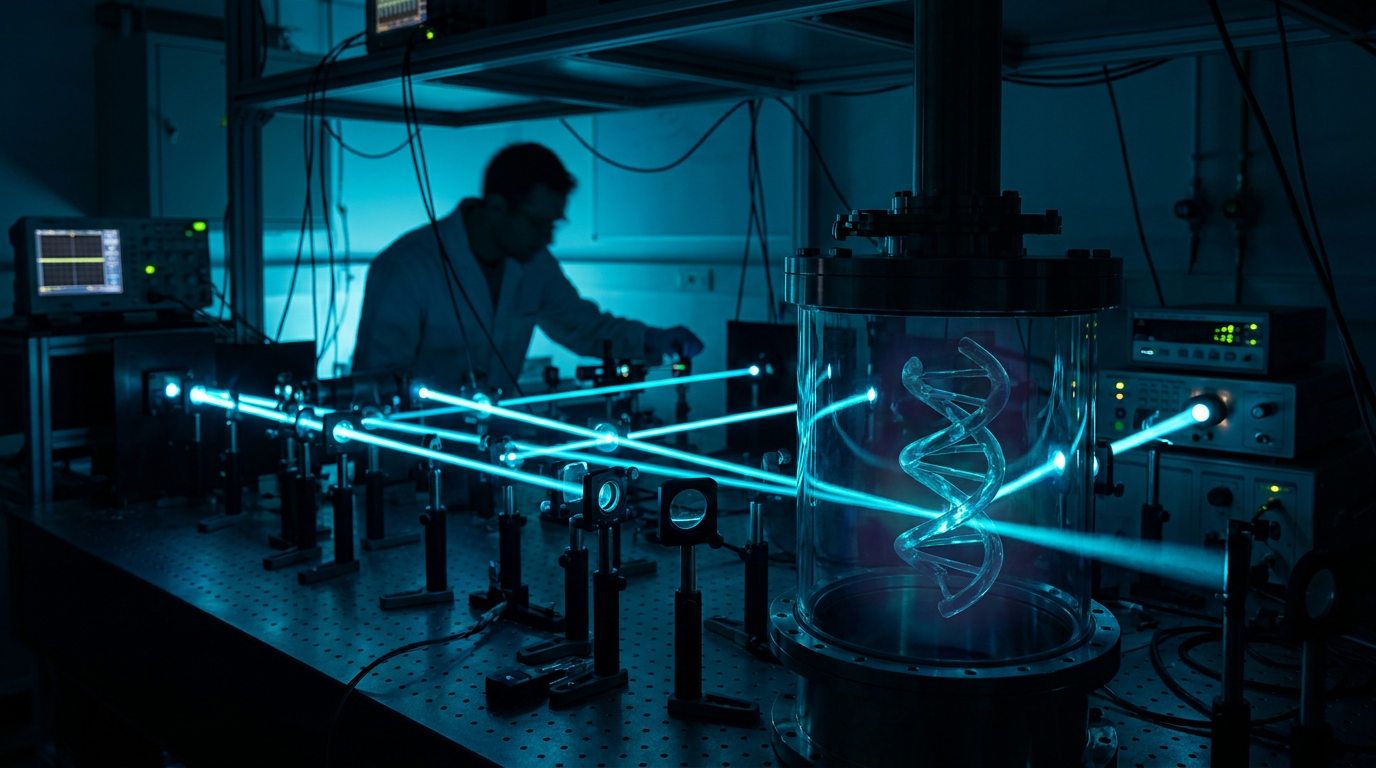
The arXiv paper Quantum-enhanced estimation of stimulated Raman optical activity ([arXiv:2606.23722v1]), posted June 24, 2026, proposes using two-mode squeezed vacuum (TMSV) states to push measurements of molecular chirality below the classical shot-noise limit. The authors derive the quantum Fisher information and the quantum Cramér-Rao bound (QCRB) for stimulated ROA, showing that photon-number correlations between the two modes suppress common intensity fluctuations. No commercial partner, experimental demonstration, or funding source is identified in the preprint.
The work is theoretical. The contribution is the application of established quantum estimation machinery to a specific spectroscopy problem, with a derivation showing where the precision gain comes from. The abstract is truncated, so full method details and any reported numerical gains are not visible in the announcement.
What the paper actually proposes
Raman optical activity measures the small difference in Raman scattering between left- and right-circularly polarized light. The signal reveals absolute configuration, conformation, and stereochemistry of chiral molecules — a property that determines whether a drug molecule has the desired biological effect or a harmful mirror-image effect. The signal is weak. Stimulated ROA uses a second probe beam to amplify it, but the measurement precision remains limited by shot noise: the Poissonian intensity fluctuations of any classical light source.
The paper proposes replacing the classical probe with two-mode squeezed vacuum, a non-classical state where photons in two modes are quantum-correlated. The mechanism is straightforward. When the two modes share correlated intensity fluctuations, the difference signal — which carries the chiral information — has reduced noise. Balanced detection, partially described in the truncated abstract, exploits this correlation to extract sub-shot-noise sensitivity.
The authors use quantum estimation theory, the standard framework for quantifying the ultimate precision of parameter estimation given a quantum state. The quantum Fisher information bounds how well a parameter can be estimated from a quantum measurement, and the QCRB is the corresponding classical bound that any estimator must respect. By computing these quantities for the TMSV probe state, the paper establishes what is theoretically possible.
Winners and Losers
If validated experimentally and engineered into instruments, the approach would benefit pharmaceutical R&D groups that need rapid chiral analysis of drug candidates and biosensing labs working with low-concentration chiral samples. Quantum sensing vendors — including Q-CTRL, AOSense, and M Squared — could integrate the protocol into existing product lines.
The threat runs in the opposite direction for classical ROA instrument makers such as BioTools, Jasco, and Bruker's ROA product family. Their instruments are shot-noise limited. A quantum-enhanced version that delivers better signal-to-noise in the same integration time would erode the value proposition of the installed base, though the price and complexity of squeezed-light sources will slow adoption for years.
Adjacent markets are not directly affected. Cloud quantum computing vendors — IBM, Google, IonQ, Rigetti — sell gate-based machines for algorithmic workloads, not analog sensing. The closest commercial overlap is in quantum illumination and quantum LIDAR, where squeezed-light protocols are under active development for defense and remote sensing applications.
The Bigger Picture
Quantum sensing is the most commercially mature branch of quantum technology. Squeezed light has been operational in LIGO since 2019, contributing directly to gravitational-wave detections. Quantum magnetometers are sold by multiple vendors for medical and geological applications. The two-mode squeezed vacuum protocol described in this paper sits inside this broader wave of quantum-enhanced metrology, alongside atomic clocks, quantum gyroscopes, and quantum gravimeters.
For calibration, comparable 2026 milestones include NIST's continuing work on squeezed-light atomic sensors, ICFO's quantum spectroscopy publications, and the UK's £2.5 billion National Quantum Strategy, which lists biosensing as a target application area. Pharmaceutical industry investment in chiral analysis remains substantial: roughly 60% of small-molecule drugs in development are chiral, and regulatory requirements for enantiomeric purity have tightened since 2020.
On the supply side, the photon-pair sources needed for TMSV are not exotic. They exist in laboratories at NIST, in the AOSense catalog, and in academic quantum optics groups worldwide. The barrier to commercial ROA enhancement is not the source — it is integrating squeezed-light generation and balanced detection into a turnkey instrument that pharma chemists can operate without a quantum optics PhD.
The Signal
The signal here is a derivation, not a demonstration. The paper applies the standard quantum estimation framework — Fisher information, Cramér-Rao bound — to a specific case the authors chose. The methodology is rigorous; the contribution is mapping out a precision ceiling for a particular protocol. The most useful next step would be an experiment showing a measured QFI approaching the derived bound on a real chiral sample, ideally with a number exceeding the shot-noise-limited value by a quantifiable factor. Until that paper appears, this preprint is a theoretical benchmark rather than a product pathway.
What this reveals is the steady accretion of quantum sensing techniques into spectroscopy subfields. ROA, circular dichroism, and infrared absorption are all candidates for the same treatment. Each application paper extends the scope of quantum advantage in metrology without requiring new hardware — a low-cost, low-risk expansion path for the field, and a useful on-ramp for vendors who already sell squeezed-light components into research markets.
Quantum sensing with two-mode squeezed vacuum yields sub-shot-noise bounds for stimulated Raman optical activity, with the quantum Cramér-Rao bound quantifying the precision gain — pending experimental validation.