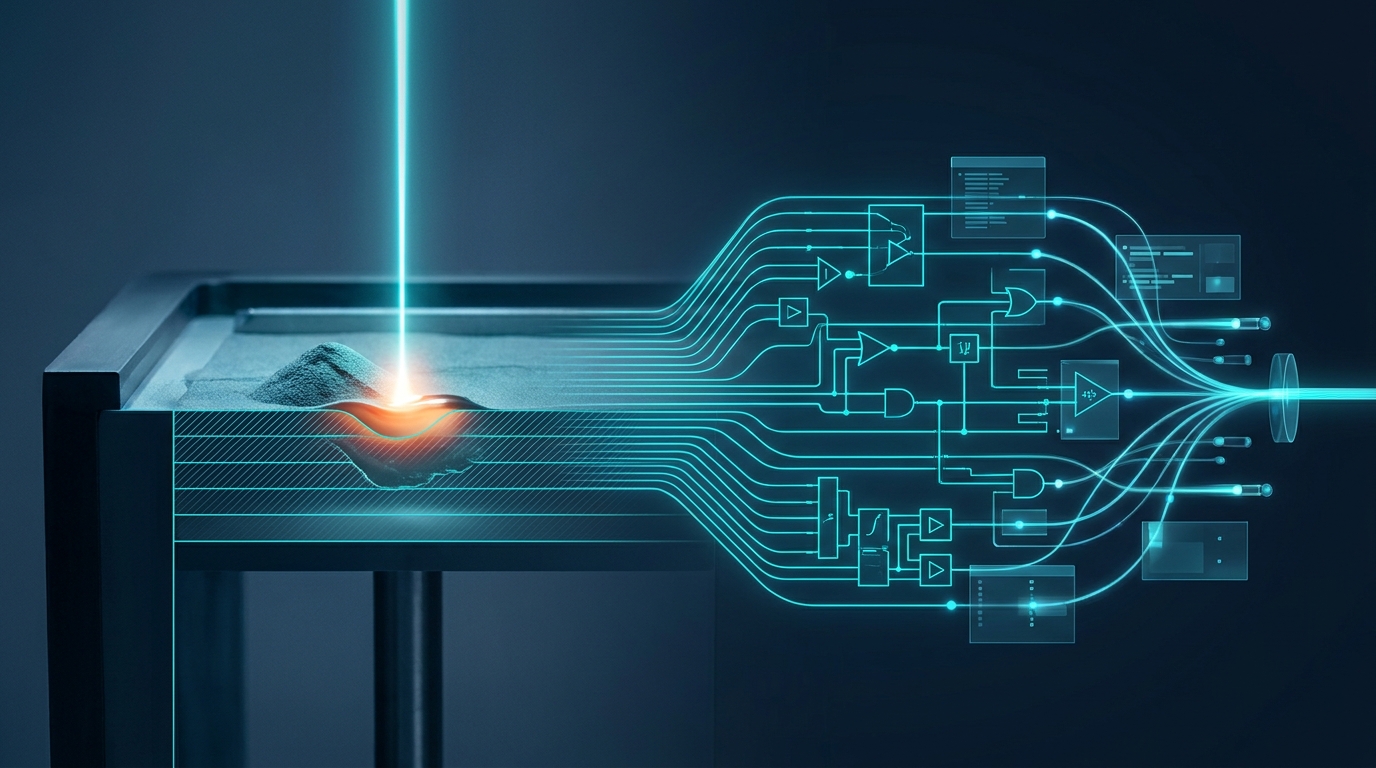
On June 24, 2026, researchers published a hybrid quantum-classical machine learning framework designed to predict melt pool morphology in laser powder bed fusion (LPBF) additive manufacturing. The paper, indexed as [arXiv:2606.23719v1], details a method that combines a quantum feature encoder with classical clustering and neural networks to bypass the high computational cost of pure quantum evaluations. This development targets the $10 billion additive manufacturing quality assurance market, where real-time defect detection remains an unsolved computational bottleneck.
What They're Actually Building
The research addresses a physics-heavy engineering problem: predicting the geometry of the liquid metal "melt pool" created by a laser during 3D metal printing. In LPBF, improper melt pool dimensions lead to structural porosity and component failure. Traditional classical approaches rely on finite element analysis (FEA), which is highly accurate but too computationally expensive for real-time control, or classical deep neural networks (DNNs), which require massive training datasets to generalize well.
The proposed hybrid architecture attempts to leverage the high-dimensional Hilbert space of quantum systems to improve feature extraction. The pipeline operates in three distinct phases. First, a classical clustering algorithm groups similar process parameters (such as laser power, scan speed, and powder layer thickness) to reduce the volume of data. Second, a quantum feature encoder maps these cluster centroids into quantum states. Third, these quantum-enhanced features are fed into a classical neural network to predict melt pool depth, width, and length.
By using classical clustering to limit the number of quantum circuit executions, the researchers address a critical limitation of modern Noisy Intermediate-Scale Quantum (NISQ) systems: high latency and execution costs. However, this approach does not utilize error-corrected logical qubits. Instead, it is designed for low-qubit-count simulators or physical NISQ processors, placing it far behind the fault-tolerant roadmaps of hardware developers like IBM, which targets 100,000 qubits by 2033, or Quantinuum, which continues to scale its trapped-ion systems with physical error rates below 10⁻⁵.
Winners and Losers
If this hybrid approach scales, the most threatened entities are legacy Computer-Aided Engineering (CAE) software giants like Ansys, Altair, and Hexagon. These companies have spent billions developing classical physics-informed machine learning (PINN) solvers. A proven quantum advantage in high-dimensional feature extraction would force these incumbents to rapidly acquire quantum software capabilities or risk obsolescence in high-end aerospace and defense manufacturing simulation.
Conversely, the immediate beneficiaries are quantum software startups specializing in industrial simulation, such as Multiverse Computing, QC Ware, and Pasqal. These companies can integrate similar clustering-quantum-classical pipelines into their existing enterprise software suites. Cloud quantum computing providers, including Amazon Braket and Microsoft Azure Quantum, also stand to benefit from the increased hybrid workload volume, even as the paper's reliance on classical clustering highlights a concerted effort by users to minimize expensive quantum cloud API calls.
The Bigger Picture
In the mid-2026 quantum landscape, the industry is transitioning away from raw qubit-count marketing toward algorithmic utility and error mitigation. While hardware developers push toward early fault-tolerance, software developers are forced to find pragmatic workarounds for the "data loading problem"—the severe bottleneck encountered when translating large classical datasets into quantum states.
The reliance on classical clustering to make this quantum model computationally feasible is a stark admission of the current economic and technical limitations of NISQ-era hardware.
This research aligns with recent 2025 and 2026 initiatives from the European Quantum Flagship and US manufacturing consortia, which are heavily funding projects that merge quantum computing with advanced materials science. However, unlike pure quantum simulation of molecular structures—which has a clear path to quantum advantage—hybrid machine learning for macroscopic classical physics remains highly speculative.
The Signal
The signal here is that quantum machine learning remains shackled by the data loading bottleneck, forcing researchers to use classical heuristics to shield quantum processors from large datasets. While the paper demonstrates a functional hybrid pipeline, it is fundamentally an academic exploration rather than a commercial threat to classical GPU-accelerated deep learning. To validate this approach as a viable commercial technology, developers must demonstrate a quantum feature encoder that can process high-dimensional datasets without classical downsampling, while outperforming classical transformer-based physics models running on standard Nvidia H100 or B200 hardware.