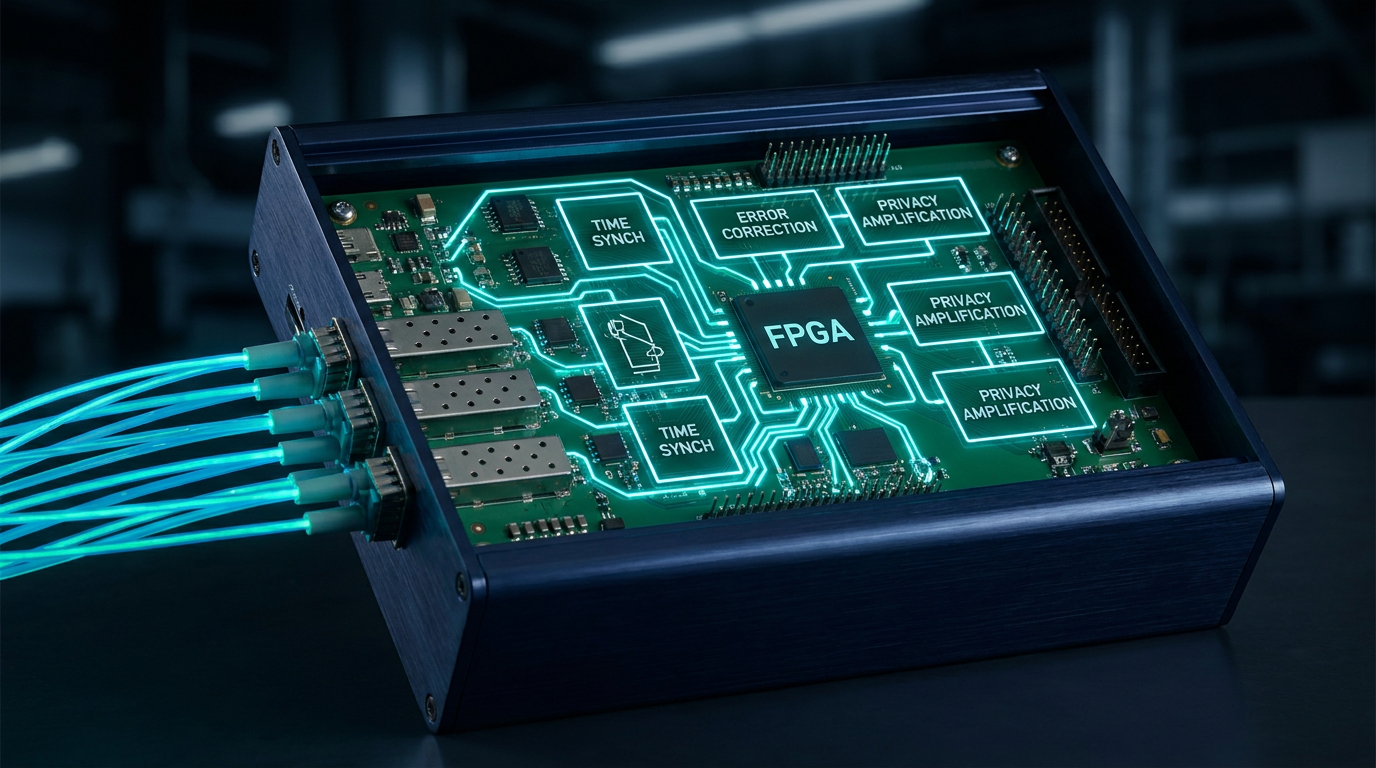
An arXiv paper published June 24, 2026 compares repetition-based information reconciliation against dedicated low-rate codes for continuous-variable quantum key distribution (CV-QKD), finding that the simpler approach cuts decoding complexity by 2x while incurring only a moderate error-rate penalty. The result, posted as [arXiv:2606.23726v1], targets the ultra-low-rate regime where CV-QKD systems operate over long-distance or high-loss channels.
What the Paper Actually Shows
Information reconciliation is the post-processing stage where Alice and Bob correct errors in their raw quantum-correlated bit strings to extract a shared secret key. At ultra-low signal-to-noise ratios, the channel is so noisy that dedicated codes — typically LDPC or polar codes — are pushed to their theoretical limits, requiring long block lengths and iterative decoding that strains embedded hardware.
The authors benchmark repetition coding, where each bit is simply transmitted multiple times and majority-vote decoded, against purpose-built ultra-low-rate codes. The trade-off: repetition coding delivers a moderate increase in residual bit error rate but halves decoding complexity. For implementation-constrained systems — FPGA-based receivers, satellite payloads, or battery-powered nodes — that 2x reduction in decoder workload is the headline number.
The paper does not claim repetition coding is universally superior. It is a targeted finding for the ultra-low-rate corner of the design space, where dedicated codes offer diminishing returns relative to their implementation cost.
Winners and Losers
The beneficiaries are CV-QKD system integrators building hardware under tight power, latency, or silicon budgets. ID Quantique, which ships both discrete-variable and CV-QKD products, and Toshiba's Cambridge Research Laboratory, a long-standing CV-QKD player, both face decoder-design pressure in long-haul and metro deployments. A 2x complexity reduction at the reconciliation stage translates directly into lower FPGA gate counts, reduced thermal load, and faster key generation per watt — all material for commercial rollouts.
Vendors that have invested heavily in custom LDPC decoder IP for QKD — including niche silicon providers and academic spinouts — face a less favorable picture. If repetition coding is "good enough" at ultra-low rates, the premium for dedicated-code decoder silicon shrinks. The paper does not threaten these vendors' core business in higher-rate regimes, but it narrows the addressable market for ultra-low-rate dedicated-code IP.
Adjacent markets — quantum random number generation, classical post-processing accelerators, and QKD network management software — are unaffected. The finding is narrow but consequential for the specific hardware-constrained segment.
The Bigger Picture
CV-QKD has matured into a commercially deployed technology, with field trials from Tokyo to Geneva and satellite demonstrations from China's Micius mission in 2017 onward. The bottleneck has shifted from photon sources and detectors to the classical post-processing pipeline, where information reconciliation consumes the majority of compute time and energy in real systems.
Government investment remains the primary demand driver. The EU's Quantum Flagship program, China's national quantum communication backbone, and U.S. Department of Energy funding for QKD testbeds have collectively underwritten hundreds of millions of dollars in deployment. Within that context, any technique that halves decoder complexity at the edge of the rate-distance trade-off curve has procurement implications.
Comparable recent milestones: ID Quantique's 2025 announcement of a 200 Gbps classical encryption co-processor paired with QKD key management, and the 2024 demonstration of CV-QKD over deployed telecom fiber in the Madrid metropolitan network. Both efforts highlight that reconciliation efficiency — not raw key rate — is the gating constraint for commercial scaling.
The signal here is that the CV-QKD community is converging on a pragmatic engineering consensus: at the lowest signal-to-noise ratios, the marginal gain from sophisticated error-correcting codes does not justify the silicon cost. Repetition coding is the new baseline for ultra-low-rate hardware.
What would validate this claim: independent replication on field-deployed fiber with real atmospheric or thermal noise, and a head-to-head benchmark against state-of-the-art rate-adaptive LDPC codes on the same FPGA platform. The paper's authors do not yet report such a deployment.
In Short
CV-QKD information reconciliation at ultra-low rates can be done with repetition coding at half the decoding complexity of dedicated codes, accepting a moderate error-rate penalty — a finding that favors hardware-constrained system builders over custom-code silicon vendors.
FAQ
Q: What is CV-QKD information reconciliation?
It is the classical error-correction step in continuous-variable quantum key distribution where Alice and Bob reconcile discrepancies in their raw key bits to produce a shared secret. It typically consumes the majority of compute resources in a CV-QKD system.
Q: How does repetition coding compare to LDPC codes for QKD?
Repetition coding is simpler to implement and, per [arXiv:2606.23726], halves decoding complexity at ultra-low rates, but it leaves more residual errors than dedicated LDPC or polar codes. Dedicated codes remain preferable at moderate signal-to-noise ratios.
Q: Is CV-QKD ready for enterprise deployment?
Commercial CV-QKD products exist from ID Quantique and others, but deployment is concentrated in government, defense, and financial-sector pilots. Enterprise adoption outside regulated industries remains limited as of mid-2026.
Q: Who are the main CV-QKD vendors?
ID Quantique (Switzerland), Toshiba (UK research lab), QuantumCTek (China), and NTT (Japan) are the most active commercial and research players. Huawei has published CV-QKD research but does not sell standalone products.
Q: What QKD milestones matter most in 2026?
Key milestones include satellite-to-ground CV-QKD demonstrations, chip-integrated reconciliation decoders, and standardization progress at ITU-T and ETSI on QKD network interfaces.