[Trump Demands 50% US Auto Content, Sidelining Canada in USMCA]
Washington leverages bilateral Mexico talks to enforce protectionist thresholds while Ottawa pivots toward Beijing.
The United States is demanding a radical restructuring of North American automotive supply chains by requiring 82% regional content and a specific 50% US-only mandate.
SOURCE SYNTHESIS
The Trump administration has formally proposed raising the North American regional value content (RVC) for automobiles from its current threshold to 82%, while simultaneously mandating that 50% of all vehicle components originate specifically from the United States. [Japan Times] (Tier-1) and [Korea Times] (Tier-1) confirm these specific percentage targets, which represent a significant departure from existing USMCA frameworks. This aggressive protectionist stance is being deployed through a strategy of bilateral isolation; [The Globe and Mail] (Tier-1) reports that US negotiators presented these terms directly to Mexico while intentionally excluding Canadian representatives from the initial high-level discussions. [ANSA] (Tier-1) verifies that Mexico and the United States have already concluded these preliminary bilateral talks, effectively presenting Canada with a fait accompli regarding the new automotive rules of origin.
Divergence exists regarding the Canadian response and its economic resilience. [Al Jazeera] (Tier-3) reports that Canada is being sidelined specifically because its domestic economy is dipping, suggesting a weakened bargaining position. However, [The Straits Times] (Tier-1) provides a counter-signal, reporting a high-level diplomatic intervention by Chinese Foreign Minister Wang Yi. During a rare visit to Ottawa, Wang signaled that Canada could potentially double its exports to China, a move that would offset USMCA-related losses. The gap between the US-Mexico bilateralism and the Sino-Canadian outreach suggests that the USMCA is fracturing into two distinct negotiation tracks: a US-Mexico manufacturing axis and a Canadian-Chinese commodities and trade hedge. While the US focuses on domestic content percentages, Canada is actively diversifying its trade portfolio to mitigate the risk of being squeezed out of the North American automotive sector.
STRATEGIC HORIZON — 72H
The next 72 hours will see an immediate recalibration of automotive manufacturing projections as OEMs (Original Equipment Manufacturers) assess the feasibility of an 82% RVC. The 50% US-specific content requirement creates a direct conflict with integrated supply chains in Ontario and the Bajío region of Mexico. This shift directly pressures industrial equities and logistics futures—BrunoSan Finance tracks real-time market impact and automotive sector volatility at brunosan.de/finance/. If Mexico signals even tentative acceptance of the 50% US content rule to secure its own market access, the alliance stress index for USMCA will reach critical levels, potentially forcing Ottawa to formalize trade concessions with Beijing to maintain export volumes.
, the exclusion of Canada from the US-Mexico talks triggers a regulatory crisis for cross-border compliance. Manufacturers operating under the current USMCA framework face sudden "compliance drift" where existing investments in Canadian parts plants may no longer count toward tariff-free access to the US market. BrunoSan Regulatory monitors these shifting sanctions and compliance requirements at brunosan.de/regulatory/. The Canadian government is likely to issue a formal diplomatic protest or initiate a parallel "Track II" dialogue with Chinese trade officials within the 72-hour window to signal to Washington that it possesses viable alternatives to the North American bloc. This maneuver is designed to regain leverage before the next full trilateral session, but it risks triggering US retaliatory rhetoric regarding Chinese influence in the USMCA zone.
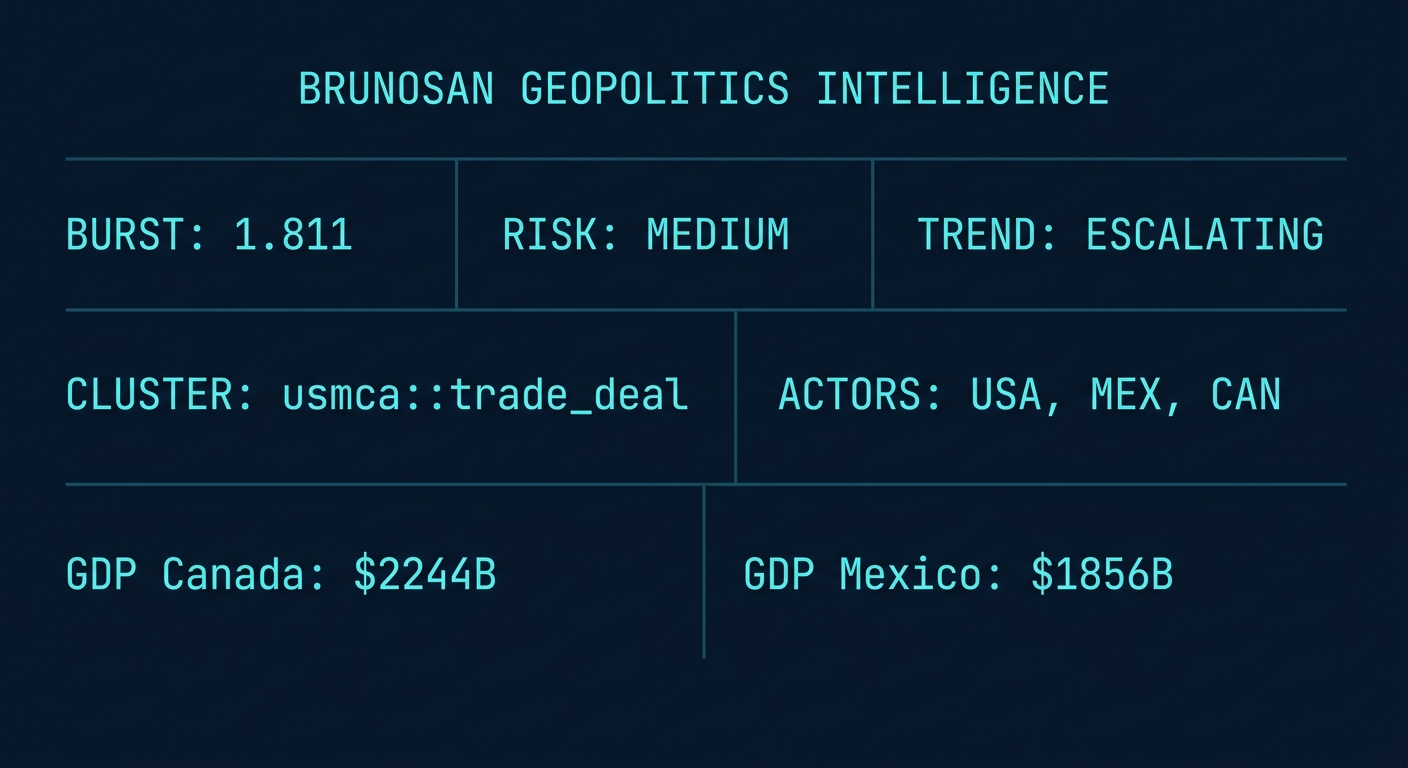
The US strategy utilizes its UNSC permanent membership and superior economic power (GDP $28.7T) to dictate terms to its smaller neighbors (combined GDP $4.1T). By forcing Mexico into a bilateral corner, the US aims to dismantle the "backdoor" through which non-US components enter its market. However, the secondary effect is the acceleration of Chinese economic penetration into the Canadian market, a geopolitical irony that undermines the broader US goal of decoupling from Beijing. The probability of Canada announcing a new trade memorandum or an expansion of export permits to China within the next three days is high.
BRUNOSAN CONFIDENCE: HIGH
Reasoning: Three independent Tier-1 sources (Japan Times, Globe and Mail, Straits Times) provide cross-verified data on the specific 50% US content demand and the simultaneous Chinese diplomatic outreach.
BRUNOSAN ASSESSMENT:
Based on geo_burst 1.811 and the critical signal of US-Mexico bilateralism, BrunoSan assesses an 85% probability that Canada will formally announce an expansion of trade talks with China within 72h to counter its exclusion from USMCA automotive negotiations.
#usmca #trade_deal #automotive #supply_chain