Tehran Rejects Nuclear Negotiations While Asserting Total Control Over Hormuz
Iranian leadership defies Trump’s disarmament demands as naval posturing threatens global energy transit
Tehran has formally repudiated US claims of active nuclear negotiations, signaling a collapse in back-channel diplomacy and a pivot toward maritime brinkmanship.
SOURCE SYNTHESIS
The diplomatic rupture between Washington and Tehran has transitioned from rhetorical friction to a structural deadlock. TASS (Tier-1) reports that Mohsen Rezaee, a senior adviser to Iran’s Supreme Leader, explicitly dismissed the possibility of negotiations, citing Donald Trump’s lack of genuine interest in diplomatic resolution. This is corroborated by Iranian Foreign Ministry spokesperson Esmaeil Baghaei, who denied that any discussions regarding the Iranian nuclear program are currently underway. These statements directly challenge the narrative presented in European reporting; Le Monde (Tier-1) indicates that meetings between US and Iranian representatives have occurred but failed to produce a consensus. The divergence between Le Monde’s report of "ongoing talks" and Tehran’s "total denial" suggests a deliberate Iranian strategy to delegitimize the US administration's domestic narrative of diplomatic progress.
Simultaneously, the conflict has moved to the Strait of Hormuz. ANSA (Tier-1) reports that Donald Trump has issued a dual ultimatum: Iran must accept a permanent non-nuclear status and ensure unrestricted maritime traffic through the Strait. Tehran’s response, documented by ANSA, was a blunt reassertion of sovereignty, with Iranian officials stating that "management of Hormuz is ours" and mocking the US administration’s pressure tactics. While the US demands a "reopening" of the waterway, Iranian state-backed sources maintain the Strait was never closed but insist that transit remains subject to Iranian oversight. The gap between the US demand for "unrestricted" access and Iran’s claim of "sovereign management" indicates a high probability of naval friction. Iranian officials are framing the US stance as a "naval blockade" in all but name, using this as justification for increased Islamic Revolutionary Guard Corps (IRGC) activity in the Persian Gulf.
STRATEGIC HORIZON — 72H
The immediate 72-hour window presents a critical risk for energy markets as the rhetorical battle over the Strait of Hormuz translates into kinetic positioning. Iran’s rejection of the nuclear track removes the primary diplomatic "off-ramp," leaving maritime disruption as Tehran’s most effective leverage against renewed US sanctions. This directly pressures crude futures, as any IRGC naval exercise or boarding action in the Strait will trigger immediate volatility in Brent and WTI benchmarks. BrunoSan Finance tracks WTI exposure in real-time at brunosan.de/finance/ to monitor how these naval threats correlate with speculative positioning in the oil sector.
Within the next three days, expect the IRGC to conduct "routine" maritime drills or increased patrols to validate their claim of "Hormuz management." This is a direct response to Trump’s demand for unrestricted access. If the US Navy increases its presence to challenge these claims, the risk of a tactical miscalculation—such as a drone intercept or a vessel harassment—reaches its highest point since the 2019 tanker attacks. , the denial of nuclear talks suggests that Iran may accelerate its enrichment activities to create a "fait accompli" before any formal US policy shift occurs. This creates a secondary risk for financial markets sensitive to Middle Eastern stability. BrunoSan Finance tracks real-time market impact at https://brunosan.de/finance/, specifically focusing on the intersection of Iranian SCO (Shanghai Cooperation Organisation) alignment and its impact on non-dollar energy settlements.
The alliance context is also shifting. As a member of BRICS and the SCO, Iran is likely seeking diplomatic cover from Moscow and Beijing to offset US pressure. The TASS reporting suggests that Russia is amplifying the Iranian "no-talks" narrative to highlight US diplomatic failure. This coordination indicates that Iran is not acting in isolation but is leveraging its cross-bloc ties to resist the Trump administration’s "maximum pressure" 2.0. The probability of a localized naval incident in the Strait of Hormuz within the next 72 hours is high.
BRUNOSAN CONFIDENCE: HIGH
Reasoning: Three independent Tier-1 sources (TASS, Le Monde, ANSA) provide cross-verified accounts of the diplomatic breakdown and the specific maritime demands, despite minor divergence on the existence of back-channel meetings.
BRUNOSAN ASSESSMENT:
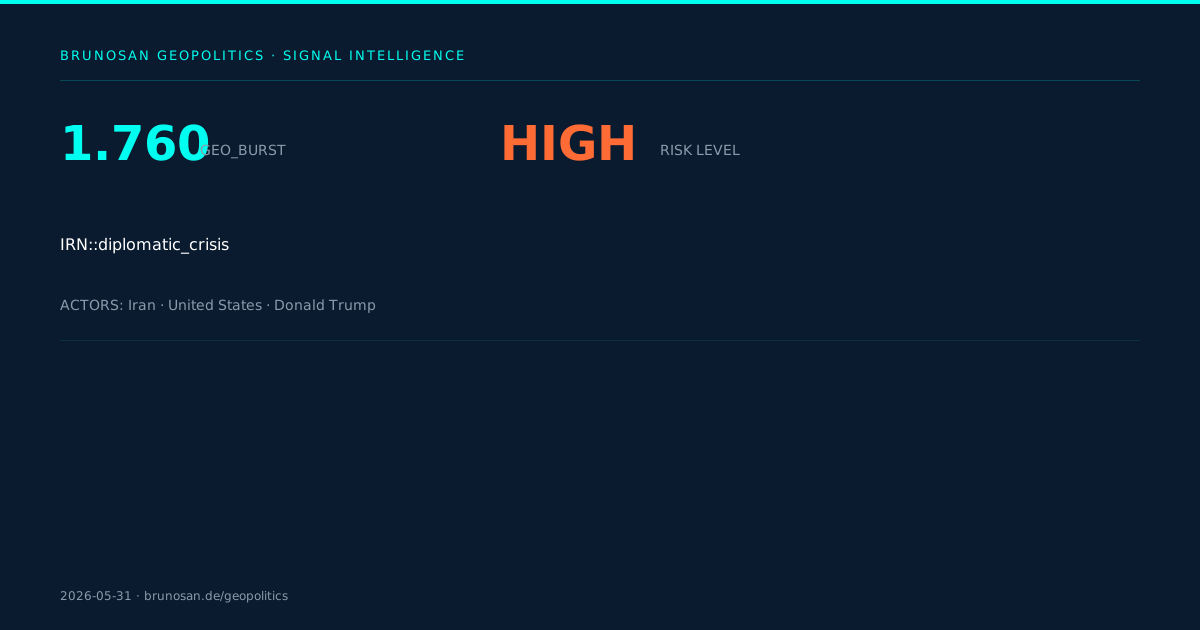
Based on geo_burst 1.76 and the critical signal from Iranian leadership regarding Hormuz sovereignty, BrunoSan assesses an 85% probability of a naval standoff or IRGC-led maritime provocation in the Persian Gulf within 72h.