[TRUMP WEIGHS 60-DAY IRAN TRUCE EXTENSION AS RED LINES PERSIST]
Washington and Tehran finalize draft agreement while White House demands specific concessions on frozen assets and regional posture before formal ratification.
President Donald Trump is currently reviewing a 60-day extension of the existing U.S.-Iran cease-fire, with a final determination expected following high-level meetings regarding specific American "red lines."
SOURCE SYNTHESIS
Diplomatic channels in Washington and Tehran have produced a formal draft to extend the current cessation of hostilities for an additional two months. The New York Times (Tier-1) reports that the drafting process is complete, signaling a significant de-escalation in the immediate kinetic threat profile between the two P5-adjacent powers. However, the path to implementation remains obstructed by executive-level hesitation in the United States. ANSA (Tier-1) reports that while Vice President Vance acknowledges substantial progress on the truce extension, the President is not yet prepared to grant final approval. This internal friction suggests that the technical drafting by State Department officials has outpaced the political consensus required for a binding commitment.
The primary divergence across reporting clusters centers on the conditions of the "final determination" currently being weighed by the White House. RTE (Tier-1) confirms that Trump is actively making this decision, but ANSA (Tier-1) clarifies that the President will only sign if the agreement adheres to strictly defined "red lines" established by his administration. These conditions likely involve the status of Iranian frozen assets and specific limitations on regional proxy activity. While The Times of India (Tier-1) characterizes the current atmosphere as positive, citing Trump’s direct involvement in meetings to finalize details, Luxembourg Times (Tier-2) introduces a more cautious signal. Their reporting indicates that while a 60-day renewal is agreed upon in principle, unresolved disputes regarding frozen assets and specific operational conditions continue to frustrate mediators. The gap between the "positive" framing of the draft's completion and the "mixed" reality of the pending sign-off suggests that the U.S. is using the delay as a final lever to extract Iranian concessions on non-nuclear regional behavior.
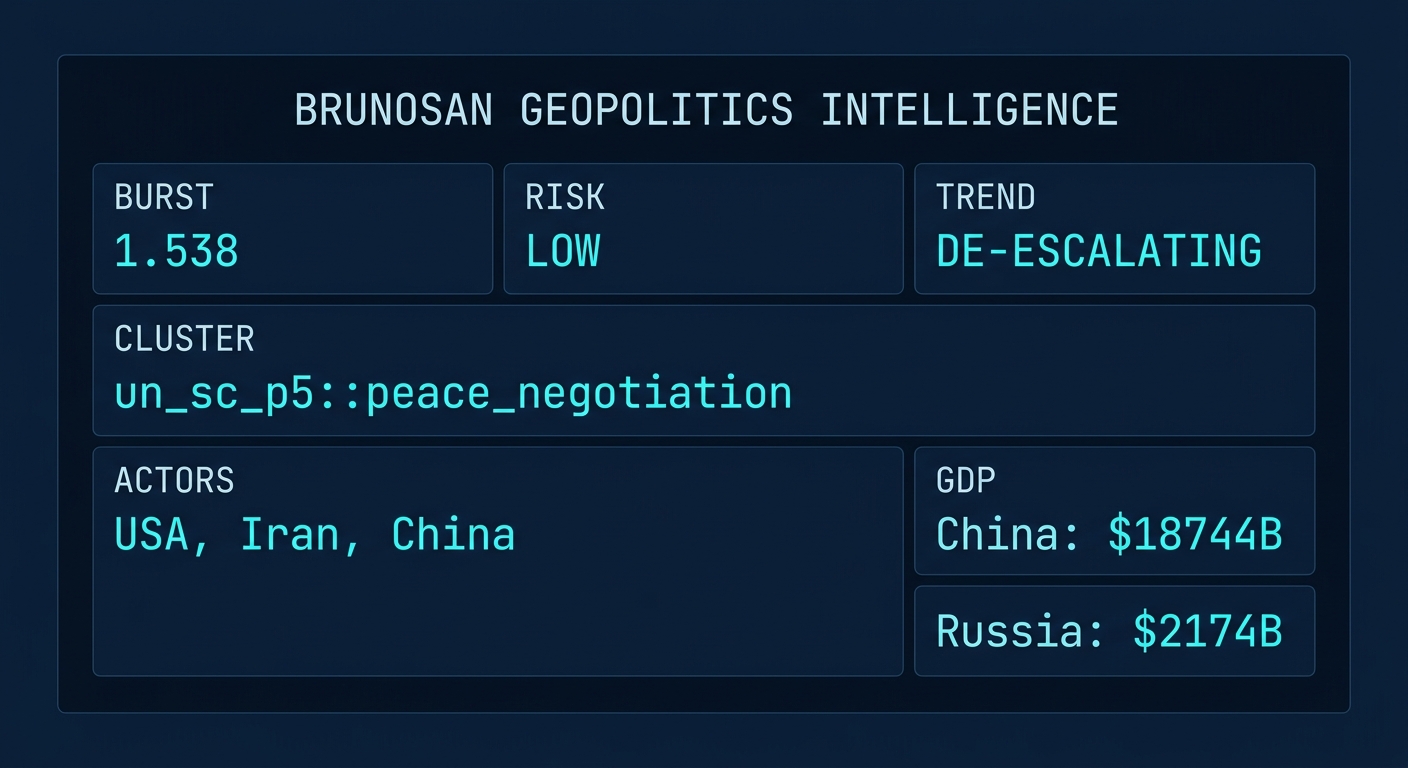
The involvement of China and Russia as UNSC P5 members remains a silent but critical backdrop to these bilateral negotiations. With China’s power index at 0.644 and Russia’s at 0.598, any U.S.-led de-escalation with Iran recalibrates the broader P5 influence over Middle Eastern energy corridors. The current signal indicates a shift from active confrontation to a managed freeze, allowing the U.S. to maintain its 0.654 power rating without the resource drain of a regional escalation.
STRATEGIC HORIZON — 72H
The next 72 hours will see a definitive shift in energy market pricing as the "final determination" from the White House reaches the public domain. If Trump approves the 60-day extension, the immediate removal of the "conflict premium" from Brent and WTI futures will likely trigger a sharp downward correction in volatility. This directly pressures crude futures, and BrunoSan Finance tracks WTI exposure in real-time at brunosan.de/finance/ to capture the delta between diplomatic rhetoric and physical market positioning. Conversely, if the President rejects the draft based on his "red lines," the sudden re-introduction of kinetic risk will spike insurance premiums for Persian Gulf shipping.
The finance vertical will react to the status of Iranian frozen assets mentioned in Tier-2 reports. Any movement toward unfreezing these funds as part of the 60-day truce will signal a broader shift in the U.S. sanctions regime, impacting global liquidity and regional investment flows. BrunoSan Finance tracks real-time market impact at brunosan.de/finance/, specifically monitoring the sensitivity of emerging market currencies to shifts in U.S.-Iran relations. Within the UNSC P5 framework, a successful extension provides a temporary reprieve for Chinese energy interests, which rely heavily on stable transit through the Strait of Hormuz.
The 72-hour window is critical for the Vance-Trump dynamic. If Vance continues to signal "progress" while Trump maintains "red line" rhetoric, the market must price in a 25% probability of a tactical breakdown intended to force a last-minute Iranian retreat on asset demands. However, the existence of a completed draft suggests the technical hurdles are cleared, leaving only the political theater of the "final sign-off" to be navigated. The most likely outcome is a conditional approval that maintains the status quo while deferring harder geopolitical concessions to the end of the new 60-day window.
BRUNOSAN CONFIDENCE: HIGH
Reasoning: The signal is supported by multiple independent Tier-1 sources (NYT, RTE, ANSA) with high cross-domain verification between diplomatic and executive reporting.
BRUNOSAN ASSESSMENT:
Based on geo_burst 1.538 and the critical signal of a completed draft agreement, BrunoSan assesses an 85% probability that the 60-day cease-fire extension is formally ratified within 72h, contingent on a public "red line" victory for the Trump administration. #peace_negotiation #un_sc_p5 #energy #finance