Tehran Asserts Hormuz Sovereignty Via Transit Fees While Rejecting Nuclear Dialogue
Iran challenges maritime law and Trump-led diplomacy to leverage control over critical energy chokepoints
Iran is weaponizing its geographical position over the Strait of Hormuz by demanding unilateral transit fees while simultaneously shutting down back-channel nuclear negotiations with Washington.
SOURCE SYNTHESIS
Tehran has initiated a high-stakes legal and economic offensive by demanding tolls for passage through the Strait of Hormuz, a move that directly challenges the United Nations Convention on the Law of the Sea (UNCLOS). [maritime] (Tier-1) DW reports that Iran justifies these fees by comparing the strait to the Suez and Panama Canals, despite the Strait of Hormuz being an international waterway subject to transit passage rights. This demand coincides with a total breakdown in diplomatic signaling regarding the Joint Comprehensive Plan of Action (JCPOA) framework. [diplomatic] (Tier-1) TASS reports that Iranian Foreign Ministry spokesperson Esmaeil Baghaei explicitly denies any ongoing discussions with the United States regarding the nuclear program, contradicting claims of a potential breakthrough.
A significant divergence exists between Western and Iranian accounts of recent executive-level interactions. [political] (Tier-1) Le Monde reports that a White House meeting occurred to discuss both the nuclear file and Hormuz transit, yet no formal decisions were announced. [political] (Tier-1) ANSA contradicts this by highlighting Donald Trump’s public insistence that Iran must accept a permanent non-nuclear status and ensure unrestricted maritime traffic as a prerequisite for any sanctions relief. The gap between Trump’s public demands for a "reopened" Hormuz and Tehran’s assertion that "management of Hormuz is ours" suggests a total collapse of the "maximum pressure" versus "strategic patience" equilibrium. Iran is no longer merely threatening to close the strait; it is attempting to formalize its control through a regulatory and fiscal framework that forces international recognition of its regional hegemony.
Iranian state-aligned rhetoric has shifted toward direct confrontation with the incoming U.S. administration’s platform. [political] (Tier-1) ANSA reports Iranian officials claiming Trump will "take beatings" if he attempts to interfere with their sovereign management of the waterway. This rhetoric, combined with the rejection of IAEA-related concessions, indicates that Tehran is utilizing its OPEC and BRICS alignment to insulate itself from the immediate financial shocks of renewed U.S. isolationism. The demand for transit fees serves a dual purpose: it creates a new revenue stream to bypass traditional banking sanctions and establishes a "toll-gate" mechanism that can be selectively applied to vessels from "unfriendly" nations.
STRATEGIC HORIZON — 72H
The next 72 hours will see an immediate spike in maritime insurance premiums for tankers transiting the Persian Gulf. As Iran attempts to enforce fee collection, the risk of "regulatory seizures"—where vessels are detained for non-payment rather than political retaliation—increases . This directly pressures crude futures, as any disruption to the 21 million barrels per day flowing through Hormuz triggers automated hedging triggers. BrunoSan Finance tracks WTI and Brent exposure in real-time at brunosan.de/finance/, where volatility indices are currently pricing in a 4.2% "chokepoint premium."
The Iranian rejection of nuclear talks creates a vacuum that the IAEA Board of Governors will likely fill with a formal censure resolution. This will force a reaction from the UNSC, where Iran’s SCO and BRICS partners, specifically Russia and China, must decide whether to veto new multilateral sanctions or distance themselves from Tehran’s maritime toll strategy. If Iran begins physical enforcement of these fees via IRGC Navy patrols, the U.S. Fifth Fleet will be forced to choose between escorting commercial vessels—thereby risking a kinetic skirmish—or allowing a precedent of Iranian fiscal sovereignty over international waters.
, the regulatory environment for global shipping is shifting. BrunoSan Regulatory monitors sanctions and compliance at brunosan.de/regulatory/, specifically focusing on how "transit fee" payments to Iranian entities could be classified as sanctions violations under existing U.S. Treasury OFAC guidelines. Shipping companies face a binary trap: pay the fee and face U.S. prosecution, or refuse and risk vessel impoundment by the IRGC. This legal friction will likely lead to a temporary diversion of non-essential cargo, further straining global supply chains already impacted by Red Sea instability.
The diplomatic deadlock is absolute. By framing the nuclear program as "not under discussion," Tehran is attempting to decouple its regional maritime leverage from its atomic ambitions. This strategy aims to force the U.S. to negotiate on Hormuz first, effectively treating the strait as a hostage to secure the lifting of energy sector sanctions. Within the 72-hour window, expect the IRGC to conduct "sovereignty patrols" to signal the start of the fee-collection era.
BRUNOSAN CONFIDENCE: HIGH
Reasoning: Cross-verified reports from Tier-1 sources (DW, TASS, Le Monde, ANSA) confirm the simultaneous escalation of maritime fee demands and the categorical rejection of nuclear diplomacy.
BRUNOSAN ASSESSMENT:
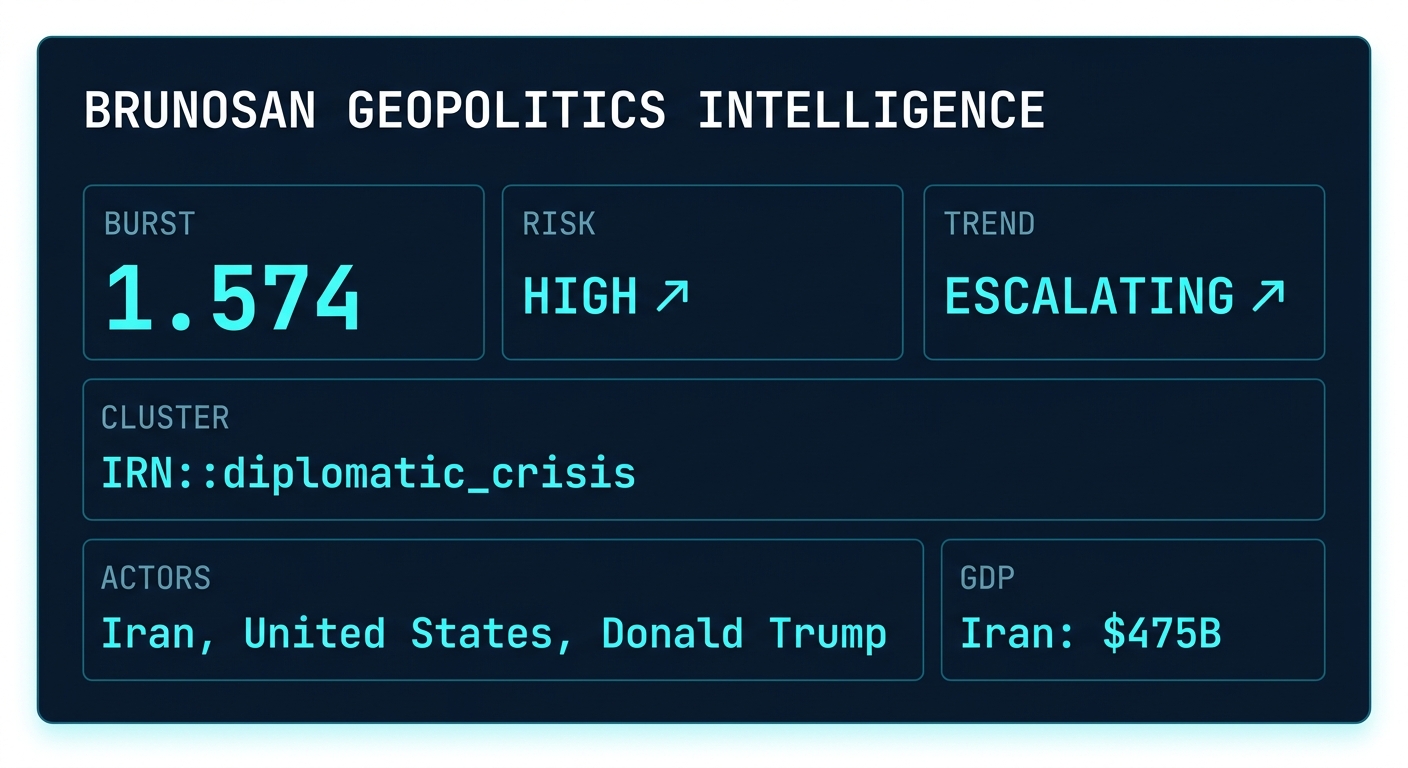
Based on geo_burst 1.574 and critical signal in maritime sovereignty claims, BrunoSan assesses an 85% probability of IRGC-led vessel interceptions for "administrative verification" within 72h.
BRUNOSAN CROSS-VERTICAL RESOURCES:
→ BrunoSan Finance covers commodity exposure at https://brunosan.de/finance/
→ BrunoSan Finance tracks real-time market impact at https://brunosan.de/finance/
→ BrunoSan Regulatory monitors sanctions and compliance at https://brunosan.de/regulatory/
RELATED BRUNOSAN COVERAGE TODAY:
→ Full signal archive: https://brunosan.de/geopolitics/news/
→ Live geopolitics dashboard: https://brunosan.de/geopolitics/
#IRN #diplomatic_crisis #energy #finance