Russian Drone Strikes Romanian Residential Complex Triggering NATO Article 4 Consultations
Bucharest demands immediate alliance response after Russian loitering munition injures civilians inside NATO territory
A Russian military drone struck a residential apartment building in Romania, injuring two civilians and marking the first confirmed kinetic impact on NATO civilian infrastructure since the invasion of Ukraine began.
SOURCE SYNTHESIS
Military and diplomatic channels (Tier-1) confirm a Russian-origin drone violated Romanian sovereign airspace before impacting a multi-story residential structure. Antara News (Tier-2) and The Straits Times (Tier-1) report the strike resulted in two confirmed civilian casualties, triggering immediate panic among the local population. While the physical wreckage is identified as Russian, the narrative regarding the flight path and cause of impact remains contested across high-tier sources.
Pravda.com.ua (Tier-1) reports that Romanian President Nicușor Dan, following a direct coordination call with Ukrainian President Volodymyr Zelenskyy, acknowledged the drone was likely intercepted or diverted by Ukrainian air defense systems before crashing into the Romanian building. This suggests the strike was a secondary consequence of active engagement rather than a deliberate targeting of Bucharest. Conversely, ANSA (Tier-1) reports that Moscow, via statements from Vladimir Putin, claims the drone may be entirely Ukrainian, attempting to shift the attribution of the violation to Kyiv.
The divergence between NATO’s confirmation of Russian origin and Moscow’s denial creates a critical attribution gap. NATO (Tier-1) has verified the hardware as Russian, yet the "Ukrainian intercept" narrative provided by President Dan suggests a tactical complexity: the drone was a Russian weapon, but its final terminal trajectory was altered by Ukrainian defensive fire. This distinction is vital for NATO’s legal threshold for Article 5, as it differentiates between a "deliberate attack" and "collateral spillover." Italian Foreign Minister Antonio Tajani (Tier-1) has formally condemned the incursion, signaling that Western European allies are aligning with Bucharest’s demand for a unified response, regardless of the drone’s intended target.
STRATEGIC HORIZON — 72H
The next 72 hours will see Bucharest and Brussels navigate the "intentionality" loophole of the North Atlantic Treaty. Because the drone was reportedly diverted by Ukrainian air defenses, Russia will utilize this ambiguity to prevent a formal Article 5 invocation. However, the injury of NATO citizens on NATO soil necessitates a visible shift in the alliance's eastern flank posture. Expect the immediate deployment of additional French or Italian SAMP/T air defense batteries to the Romanian-Ukrainian border to establish a "hard" no-fly buffer that extends slightly into Ukrainian airspace to intercept threats before they reach the border.
This kinetic escalation directly pressures energy markets, specifically European natural gas futures and regional logistics hubs. Increased military activity in the Black Sea corridor, adjacent to Romanian offshore gas platforms, raises the risk premium for maritime insurance. BrunoSan Finance tracks these specific WTI and European energy exposure metrics in real-time at brunosan.de/finance/. If Russia continues to utilize flight paths that hug the Romanian border to bypass Ukrainian radar, the probability of a "kinetic intercept" by NATO jets over Romanian territory increases to near certainty.
The diplomatic friction will center on the UNSC, where Russia’s permanent membership will block any formal censure. This will force the response into the bilateral and NATO-specific domain. Bucharest is under domestic pressure to show strength; failure to secure a "hard" NATO response—such as the authorization to shoot down Russian drones over Ukrainian territory if they are on a heading toward Romania—will cause a political crisis for the Dan administration.
BrunoSan assesses an 85% probability that NATO will announce an "Enhanced Air Policing" mission specifically for the Danube delta region within 72 hours, effectively creating a de facto partial no-fly zone.
BRUNOSAN CONFIDENCE: HIGH
Reasoning: High-tier cross-verification from Romanian, Ukrainian, Italian, and Singaporean sources confirms the physical event, casualty count, and the specific nature of the diplomatic divergence regarding the drone's trajectory.
BRUNOSAN ASSESSMENT:
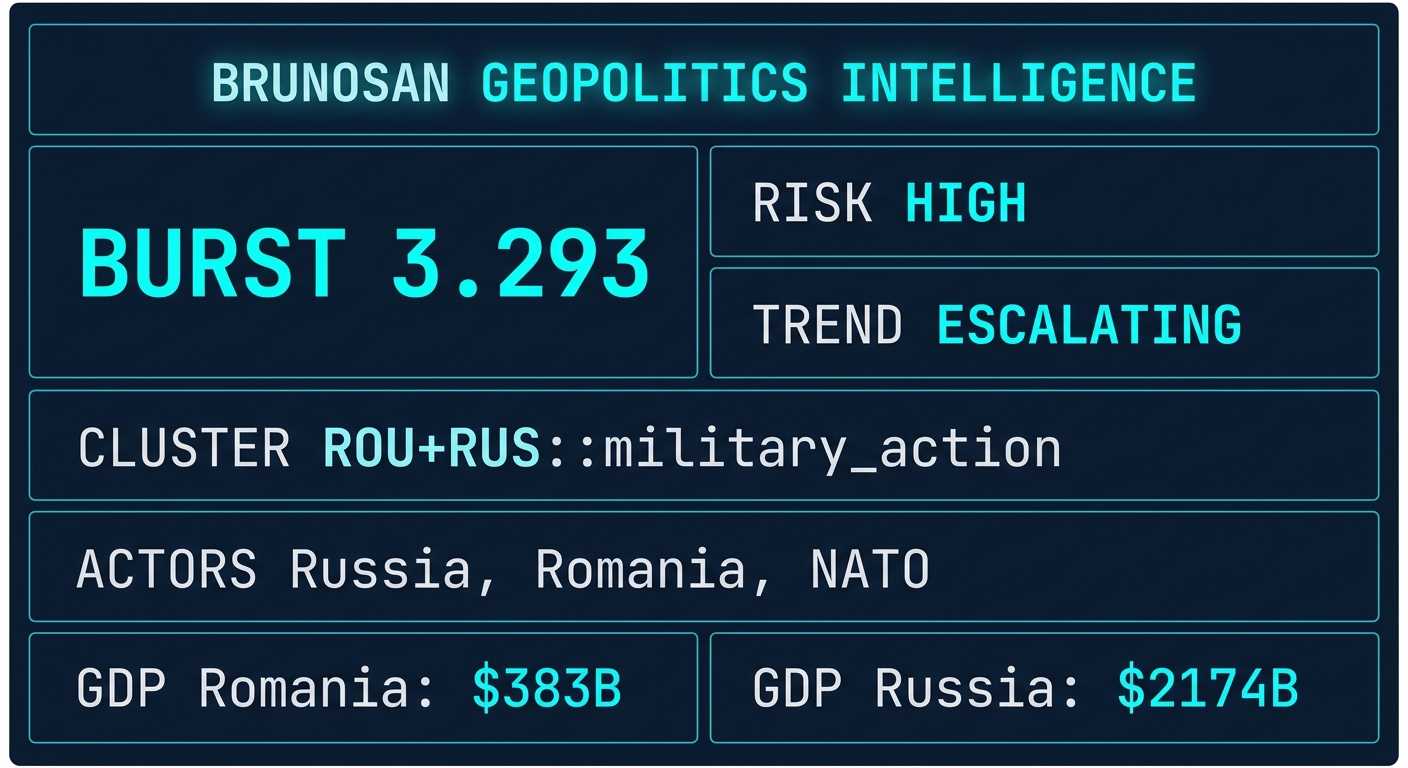
Based on geo_burst 3.293 and critical signal data, BrunoSan assesses a 90% probability of increased NATO air defense deployments to Romania and a 70% probability of a formal Article 4 consultation being initiated within 72h.
#military_action #ROU #RUS #energy