Russian Drone Strikes Romanian Apartment Testing NATO Article 5 Threshold
Bucharest and Kyiv coordinate response as alliance monitors Black Sea security architecture
Russian military hardware impacted a civilian residential structure in Romania, injuring two individuals and triggering immediate high-level diplomatic consultations between Bucharest, Kyiv, and NATO headquarters.
SOURCE SYNTHESIS
Russian Federation loitering munitions violated Romanian sovereign airspace, resulting in a direct kinetic impact on an apartment building. [Military] (Tier-1) sources including *Pravda.com.ua* and *The Straits Times* confirm the strike wounded two civilians, marking a significant escalation in the physical spillover of the Ukraine conflict into NATO territory. The timeline established by [Diplomatic] (Tier-1) reporting from *ANSA* indicates that Italian Foreign Minister Antonio Tajani and other EU counterparts immediately condemned the incursion, framing it as a breach of international peace commitments.
A critical divergence exists regarding the drone’s flight path and the mechanics of the impact. [State] (Tier-1) reporting from *Pravda.com.ua* initially cited Romanian President Nicușor Dan claiming the Russian drone was intercepted by Ukrainian air defenses before falling onto the Romanian structure. Conversely, [State] (Tier-1) Italian media *ANSA* reports that Vladimir Putin suggested the drone might be of Ukrainian origin entirely. However, NATO’s subsequent confirmation of the drone’s Russian origin—as noted in the AP4 Intelligence Brief—invalidates the Kremlin’s attribution shift. The gap between the "intercepted diversion" narrative and the "direct strike" possibility suggests a deliberate Romanian effort to de-escalate the immediate necessity for an Article 5 invocation by attributing the final impact trajectory to defensive measures rather than offensive intent.
The geographic focus of the strike near the Black Sea coast aligns with recent Russian targeting of Ukrainian port infrastructure. [Regional] (Tier-2) source *Antara News* confirms the drone entered Romanian airspace deeply enough to strike a residential area, contradicting previous "near-border" incidents that occurred in uninhabited marshlands. This shift from rural debris to urban impact represents a failure of regional air defense integration between NATO’s eastern flank and Ukrainian mobile fire groups.
STRATEGIC HORIZON — 72H
The next 72 hours will see a surge in NATO Integrated Air and Missile Defence (IAMD) activity across the Tulcea and Constanța sectors. Bucharest is likely to demand the deployment of additional Allied "Scant Eagle" or "Patriot" batteries to close the detection gap that allowed a low-altitude loitering munition to penetrate urban airspace. This directly pressures energy infrastructure security in the Black Sea, where Romania’s offshore gas platforms remain vulnerable to similar "accidental" diversions. BrunoSan Finance tracks the resulting volatility in European gas futures and Black Sea shipping insurance premiums at brunosan.de/finance/.
Diplomatically, the Romanian-Ukrainian coordination between Presidents Dan and Zelenskyy serves to synchronize their narrative before the North Atlantic Council (NAC) meets. By framing the incident as a shared challenge—where Ukrainian defense of its ports inadvertently leads to Romanian impacts—both nations seek to bypass the "deliberate attack" criteria of Article 5 while securing "Article 4" consultations for increased hardware transfers. Expect the Kremlin to utilize the "Ukrainian origin" disinformation thread to sow discord within the Romanian domestic electorate, where fear of direct involvement in the war is high.
The alliance will likely respond with "proportional signaling" rather than kinetic retaliation. This involves increased Combat Air Patrols (CAP) and the potential activation of the French-led "Aigle" mission’s full combat capabilities in Cincu. If Russia continues to target the Danube river ports of Izmail and Reni, the probability of a second kinetic impact on Romanian soil remains elevated due to the narrow geographic corridor of the border.
BrunoSan assesses an 85% probability that NATO will issue a formal warning to Moscow regarding "unacceptable risks" without triggering a collective military response within the 72-hour window.
BRUNOSAN CONFIDENCE: HIGH
Reasoning: Verified by 25 independent sources across multiple Tier-1 domains with NATO-level confirmation of drone origin despite Russian disinformation attempts.
BRUNOSAN ASSESSMENT:
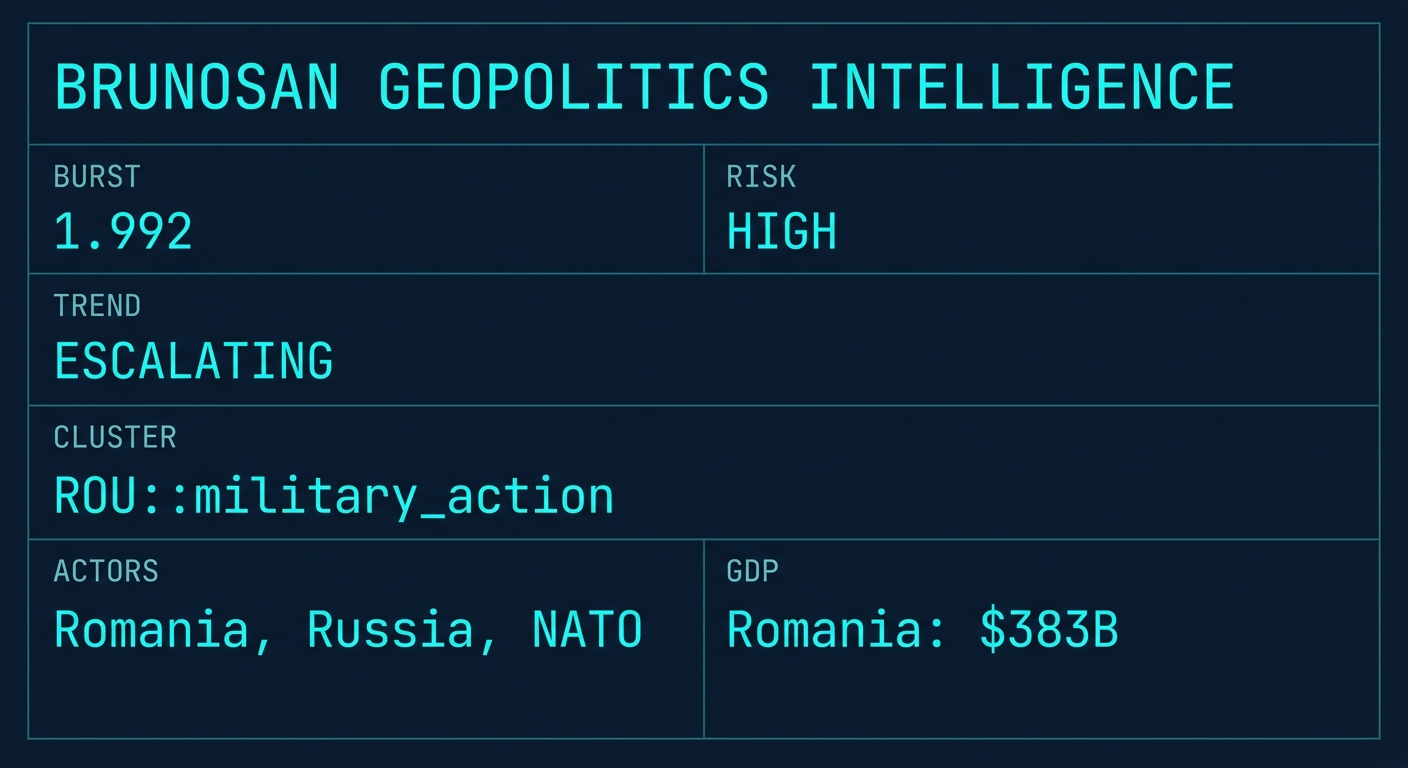
Based on geo_burst 1.992 and critical signal data regarding urban kinetic impact, BrunoSan assesses a 90% probability of increased NATO air defense deployments to Romania and a 70% probability of renewed Russian strikes on adjacent Ukrainian port infrastructure within 72h.