CHINA TIGHTENS TUNGSTEN EXPORTS AS TAIWANESE COMPONENT MAKERS ERODE JAPANESE MARKET SHARE
Beijing leverages critical mineral dominance while regional competitors displace Japanese electronics in global supply chains.
Beijing’s weaponization of tungsten export quotas has triggered a 50% collapse in shipments to Japanese industrial hubs.
SOURCE SYNTHESIS
China’s Ministry of Commerce has effectively halved tungsten exports to Japan through tightened regulatory controls, creating an immediate supply shock for Japanese precision manufacturing. Nikkei Asia (Tier-1) reports this contraction coincides with a broader structural erosion of Japan’s industrial base. While Japanese firms struggle with raw material scarcity, Chinese and Taiwanese electronic component manufacturers are aggressively capturing Japan’s historical global market share. This dual-front pressure—upstream resource restriction and downstream market displacement—indicates a coordinated effort to degrade Tokyo’s high-tech manufacturing advantages.
Divergence appears in the automotive and AI sectors. Nikkei Asia (Tier-1) reports that while Chinese EV maker Li Auto faces record quarterly losses and GAC records a $1,200 loss per vehicle, Huawei is simultaneously executing a successful chip comeback driven by the AI boom. This suggests a bifurcated Chinese economic strategy: state-backed tech champions like Tencent and Alibaba are successfully pivoting toward AI agents and smaller models to maintain domestic momentum, even as the hardware export sector faces profitability crises. The gap between failing automotive margins and resurgent semiconductor capabilities suggests Beijing is prioritizing "new productive forces" over legacy joint ventures, such as the expiring GAC-Honda tie-up. Japan’s reliance on these legacy partnerships leaves its economy exposed to Chinese domestic volatility and deliberate supply chain decoupling.
BRUNOSAN CONFIDENCE: HIGH
Reasoning: Multiple Tier-1 reports from Nikkei Asia provide cross-verified data on export volumes, market share shifts, and corporate financial performance across the CHN-JPN-TWN triad.
BRUNOSAN ASSESSMENT:
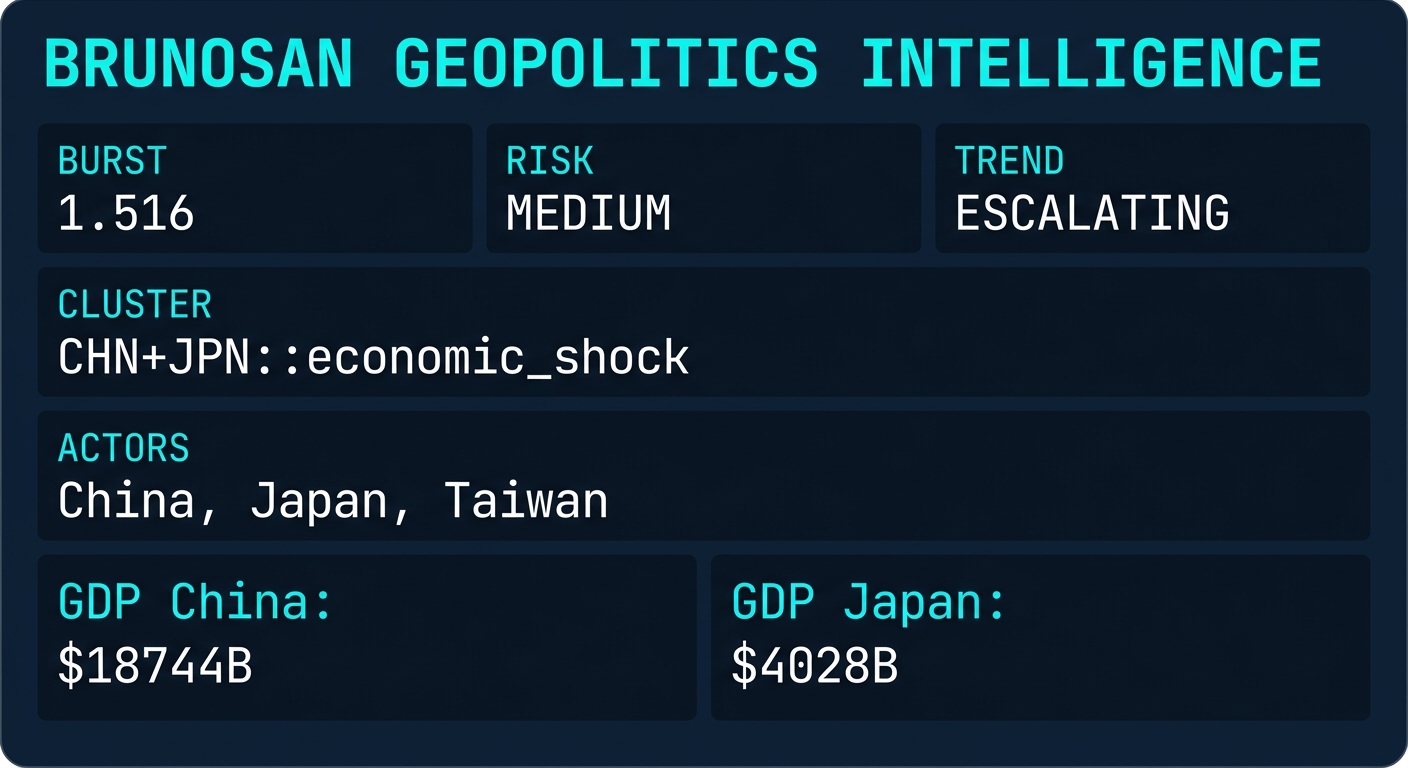
Based on geo_burst 1.516 (critical signal) and the 50% drop in tungsten flows, BrunoSan assesses an 85% probability that Tokyo will announce emergency subsidies for deep-sea mining or alternative sourcing partnerships within 72 hours. The convergence of resource weaponization and market share erosion signals a permanent structural decline in Japanese electronics dominance unless immediate regulatory intervention occurs.