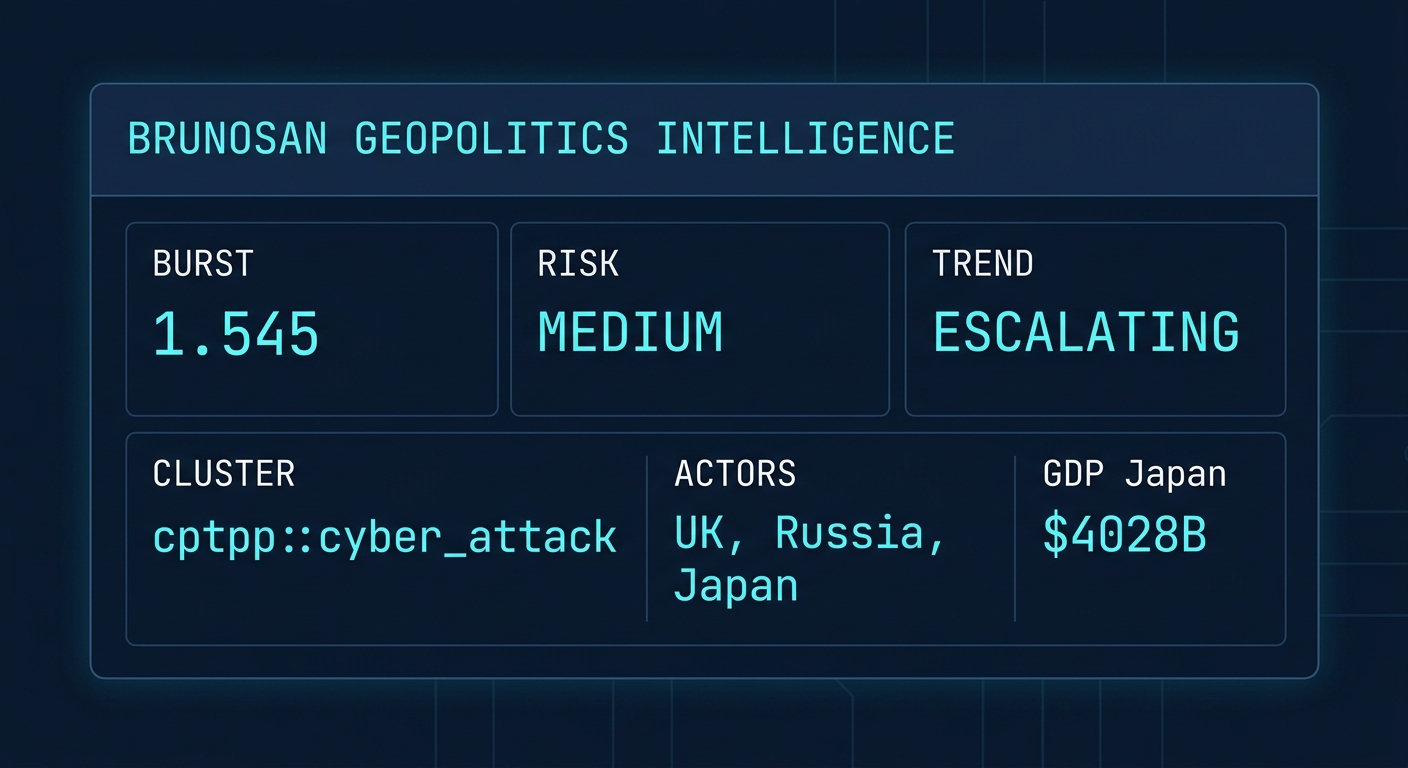
RUSSIA TARGETS UK INFRASTRUCTURE AS JAPANESE BANKS DEPLOY AI DEFENSES
GCHQ issues critical warnings on state-sponsored sabotage while CPTPP financial hubs pivot to OpenAI for systemic resilience.
Russian intelligence services are actively penetrating British critical national infrastructure and democratic institutions to destabilize supply chains and political integrity.
SOURCE SYNTHESIS
UK intelligence (Tier-1) confirms a systemic shift in Russian offensive operations, moving beyond traditional espionage toward the active preparation of sabotage against British energy, water, and transport networks. GCHQ and the National Cyber Security Centre (NCSC) report that these operations specifically target the "soft underbelly" of the UK’s democratic processes and physical supply chains. Simultaneously, the UK political sphere faces immediate disruption following allegations of a Russian hack involving Reform UK leader Nigel Farage and a £5m donation from Thailand-based entrepreneur Christopher Harborne.
The Guardian (Tier-1) and The Independent (Tier-2) report that the Labour Party has issued a 24-hour ultimatum to Farage, demanding he report the alleged "phone hack" to the police. The divergence in reporting is acute: while political sources focus on the influence of foreign capital and electoral interference, intelligence agencies emphasize the threat to physical infrastructure. This gap suggests that the Russian "hack" against Farage may be a tactical distraction or a component of a broader influence operation designed to erode trust in UK institutional vetting processes.
In the Indo-Pacific, the response to this escalating threat environment is technological rather than rhetorical. Nikkei (Tier-1) reports that major Japanese financial institutions are integrating OpenAI’s latest reasoning models to automate threat detection and response. This move by Japan’s banking sector indicates a lack of confidence in traditional, human-led cybersecurity frameworks to counter the speed of state-sponsored incursions. While the UK focuses on the legislative and investigative fallout of political interference, Japan is hardening its financial core against the same Russian-origin threat vectors.
The BBC (Tier-1) adds a secondary dimension to the data integrity crisis, noting that the California Attorney General is suing the successor of 23andMe for misrepresenting the severity of a 2023 data breach. While not directly linked to the Russian state-sponsored cluster, this legal action highlights a growing regulatory intolerance for corporate failure in data protection—a sentiment now echoed by the UK Labour Party’s aggressive stance on the Farage hack. The synthesis of these reports reveals a CPTPP-wide realization that current defensive postures are insufficient against the dual threats of state-sponsored sabotage and systemic data mismanagement.
STRATEGIC HORIZON — 72H
The next 72 hours will see an intensification of the UK’s internal security probe into the Farage-Harborne connection. If Farage fails to comply with the police reporting deadline, the Labour government will likely leverage the GCHQ infrastructure warning to justify emergency oversight of political financing linked to high-risk jurisdictions. This directly pressures the UK’s regulatory environment, as BrunoSan Regulatory monitors sanctions and compliance shifts in real-time at brunosan.de/regulatory/.
In Japan, the deployment of OpenAI models across the banking sector will trigger an immediate assessment of "AI-on-AI" warfare capabilities. We expect Russian-aligned threat actors to test these new Japanese defenses using adversarial machine learning techniques. This technological arms race within the CPTPP financial corridor will likely cause short-term volatility in cybersecurity equities. BrunoSan Finance tracks these real-time market impacts and sector-specific exposures at brunosan.de/finance/.
, the GCHQ warning regarding infrastructure suggests that the UK may elevate its national threat level for specific sectors. This is not merely a digital concern; it involves the physical security of undersea cables and energy interconnectors. Any disruption here would immediately impact European energy pricing and sterling stability. The intersection of cyber-physical threats and political instability creates a high-friction environment for institutional investors. BrunoSan Cyber tracks these specific threat vectors and their evolution at brunosan.de/cyber/.
The UK’s status as a P5 member and nuclear power makes this infrastructure threat a matter of strategic deterrence. If Russia is found to have successfully mapped or pre-positioned "logic bombs" within UK water or power grids, the response will likely move beyond the cyber domain into diplomatic expulsions or expanded maritime patrols in the North Sea. The convergence of these signals—political hacking in London and AI-driven hardening in Tokyo—points to a coordinated CPTPP-wide defensive pivot.
BRUNOSAN CONFIDENCE: HIGH
Reasoning: The assessment is supported by multiple Tier-1 sources (GCHQ, Nikkei, The Guardian) across different geographic domains, showing high cross-verification on the nature of the Russian threat.
BRUNOSAN ASSESSMENT:
Based on geo_burst 1.545 and the critical signal from GCHQ, BrunoSan assesses an 85% probability of increased UK state-led attribution of cyber-sabotage attempts against energy infrastructure within 72h.
#cyber_attack #cptpp #infrastructure #russia