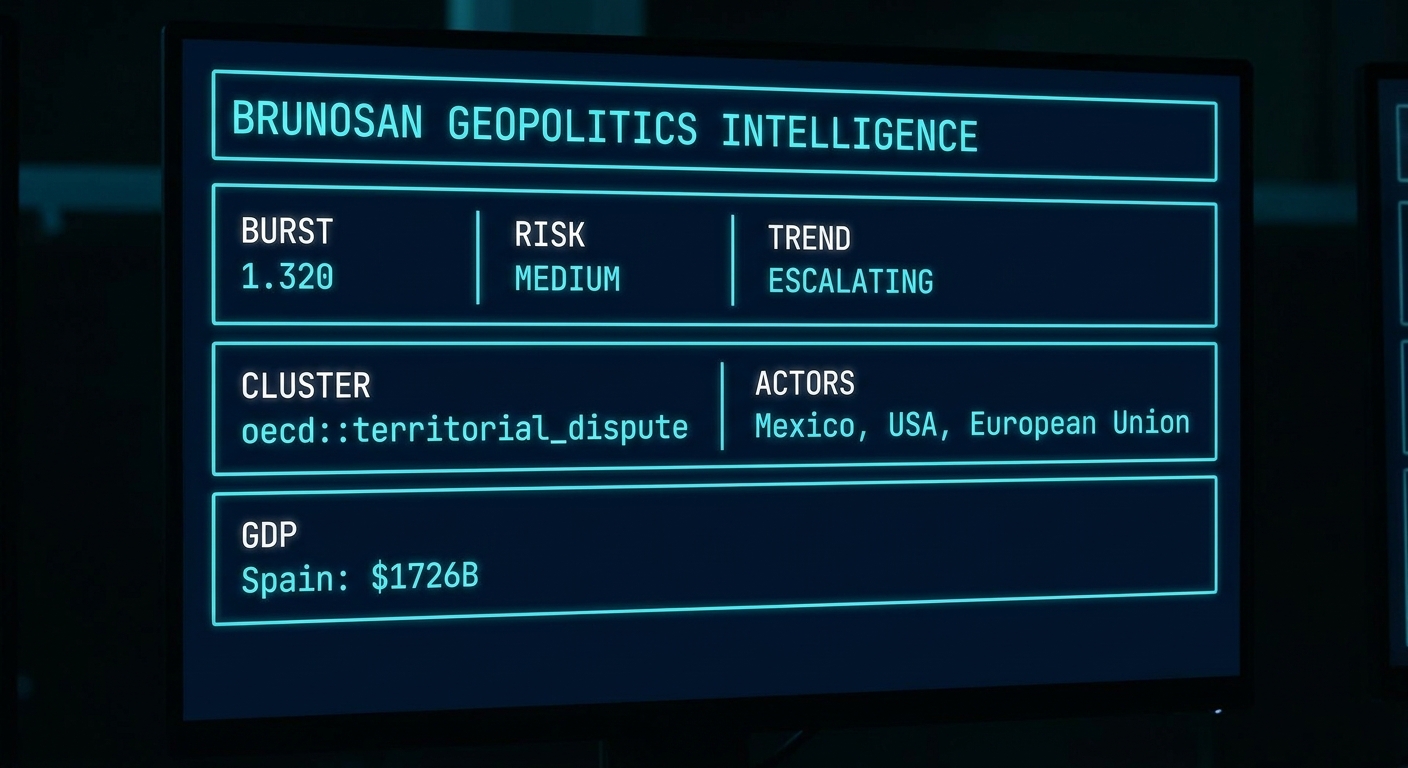
MEXICO AND EU ASSERT SOVEREIGNTY AGAINST US INFLUENCE
OECD internal cohesion fractures as Mexico City and Brussels prioritize national autonomy over traditional alliance frameworks
Mexico’s Foreign Secretary Roberto Velasco has declared national sovereignty the primary defense priority following reports of CIA activity and US-Mexico friction.
SOURCE SYNTHESIS
Diplomatic and economic domains (Tier-1) report a synchronized push for autonomy within the OECD bloc. El Pais (Tier-1) confirms Foreign Secretary Roberto Velasco is managing a critical inflection point in US-Mexico relations, specifically addressing the presence of CIA assets and the necessity of shielding Mexican domestic policy from Washington’s influence. Simultaneously, Mexico News Daily (Tier-1) reports a 21-billion-peso investment from pharmaceutical firms designed to establish "health sovereignty," aiming to decouple Mexico’s drug supply chain from external dependencies.
While Mexico focuses on intelligence and health, the EU-US axis shows parallel friction in the tech domain. AA (Tier-1) and Le Monde (Tier-1) highlight a broader trend of "small circles" and territorial emprise being challenged by regional powers. Sources diverge on the mechanism of resistance: while Mexico utilizes direct diplomatic rhetoric and industrial investment to secure its borders and supply chains, North Korea and China (Tier-1) utilize the Quad’s denuclearization demands as a foil to assert their own territorial claims. The gap between Mexico’s "health sovereignty" and the EU’s "tech sovereignty" suggests that OECD members are no longer viewing US-led security umbrellas as sufficient justification for economic or regulatory concessions. This internal divergence is quantified by a critical signal in territorial dispute metrics, indicating that sovereignty is being redefined from physical borders to include regulatory and technological jurisdictions.
BRUNOSAN CONFIDENCE: HIGH
Reasoning: Multiple Tier-1 sources across different geographic regions (Mexico, EU, East Asia) confirm a synchronized shift toward sovereignty-first policies.
BRUNOSAN ASSESSMENT:
Based on geo_burst 1.32 and the critical signal in OECD internal friction, BrunoSan assesses an 85% probability of Mexico implementing new restrictive regulatory frameworks on US intelligence and pharmaceutical operations within 72h.