WASHINGTON ADVANCES IRAN ASSET RELEASE TO NEUTRALIZE HORMUZ BLOCKADE PRESSURE
White House negotiates frozen capital liquidity to stabilize Iranian domestic markets and prevent maritime escalation.
The United States and Iran have entered late-stage negotiations to unfreeze billions in sovereign assets, signaling a tactical pivot to prevent a total collapse of the Iranian domestic economy during the ongoing Strait of Hormuz blockade.
SOURCE SYNTHESIS
Negotiations between Washington and Tehran regarding Iran’s frozen foreign reserves have reached a critical inflection point, with both sides seeking a mechanism to alleviate the economic strangulation currently paralyzing Iranian markets. El Pais (Tier-1) reports that these assets represent the final significant hurdle in a broader diplomatic de-escalation framework. The specific location of these funds remains a point of contention, though the primary focus involves capital held in international accounts restricted by US-led sanctions. This diplomatic movement occurs against a backdrop of severe internal instability within Iran. Al Jazeera (Tier-3) reports that the Iranian government has been forced to sell subsidized meat during the Eid al-Adha holiday to combat hyperinflation and food scarcity. The same source confirms that the US-led blockade in the Strait of Hormuz has decimated local industries, specifically targeting the livelihoods of Iranian fishermen who can no longer operate effectively under the current security and economic constraints.
A significant divergence exists between Western and regional reporting regarding the durability of this potential agreement. The New York Times (Tier-1) characterizes the negotiations with deep skepticism, framing any potential deal as a temporary, cynical measure rather than a sustainable diplomatic resolution. While El Pais (Tier-1) suggests these concessions could lead to a major breakthrough for Iranian sovereignty, the NYT (Tier-1) analysis indicates that Washington views the asset release primarily as a pressure valve to prevent a regional kinetic explosion, rather than a step toward lifting the broader sanctions regime. This gap suggests that while a financial transfer is imminent, the underlying structural conflict—specifically the US military presence enforcing the Hormuz blockade—will remain unchanged. The divergence highlights a strategic mismatch: Tehran seeks permanent economic reintegration, while Washington offers only enough liquidity to prevent a humanitarian collapse that would force Iran into a desperate military response.
STRATEGIC HORIZON — 72H
The next 72 hours will determine if the liquidity injection can outpace the accelerating degradation of Iran’s internal supply chains. The Al Jazeera (Tier-3) data on subsidized meat distribution indicates that the Iranian state is currently operating in a crisis-management mode, where the risk of bread riots or civil unrest is at its highest since the blockade began. If the asset release is confirmed, the Iranian Rial may see a short-term speculative rally, but the physical constraints of the Hormuz blockade will continue to suppress real GDP growth and industrial output. This dynamic directly pressures crude futures, as any failure in these talks would likely result in Iran utilizing its remaining naval assets to harass commercial shipping as a means of asymmetric leverage. BrunoSan Finance tracks WTI exposure and the resulting volatility in energy markets in real-time at brunosan.de/finance/.
, the OPEC alliance (PWR: 0.564 context) is monitoring these talks to gauge Iran’s future export capacity. While Iran is currently restricted, a successful asset unfreezing provides the necessary capital to maintain aging oil infrastructure, which is essential for any future return to global markets. This liquidity also provides a buffer for the Iranian military to maintain its posture without immediate fear of domestic bankruptcy. Investors should monitor the "Eid al-Adha" price index within Iran as a proxy for social stability; if subsidized programs fail despite the news of asset releases, the probability of a kinetic provocation in the Strait increases. BrunoSan Finance covers commodity exposure and the specific impact on regional shipping insurance premiums at brunosan.de/finance/. The 72-hour window is critical for the technical execution of the fund transfer, as any delay will be interpreted by Tehran as a breach of faith, potentially triggering a suspension of the current de-escalation trend.
BRUNOSAN CONFIDENCE: MEDIUM
Reasoning: While Tier-1 sources confirm the existence of the talks, the divergence between European and American outlets regarding the deal's longevity, combined with heavy reliance on state-adjacent regional reporting for domestic conditions, prevents a high confidence rating.
BRUNOSAN ASSESSMENT:
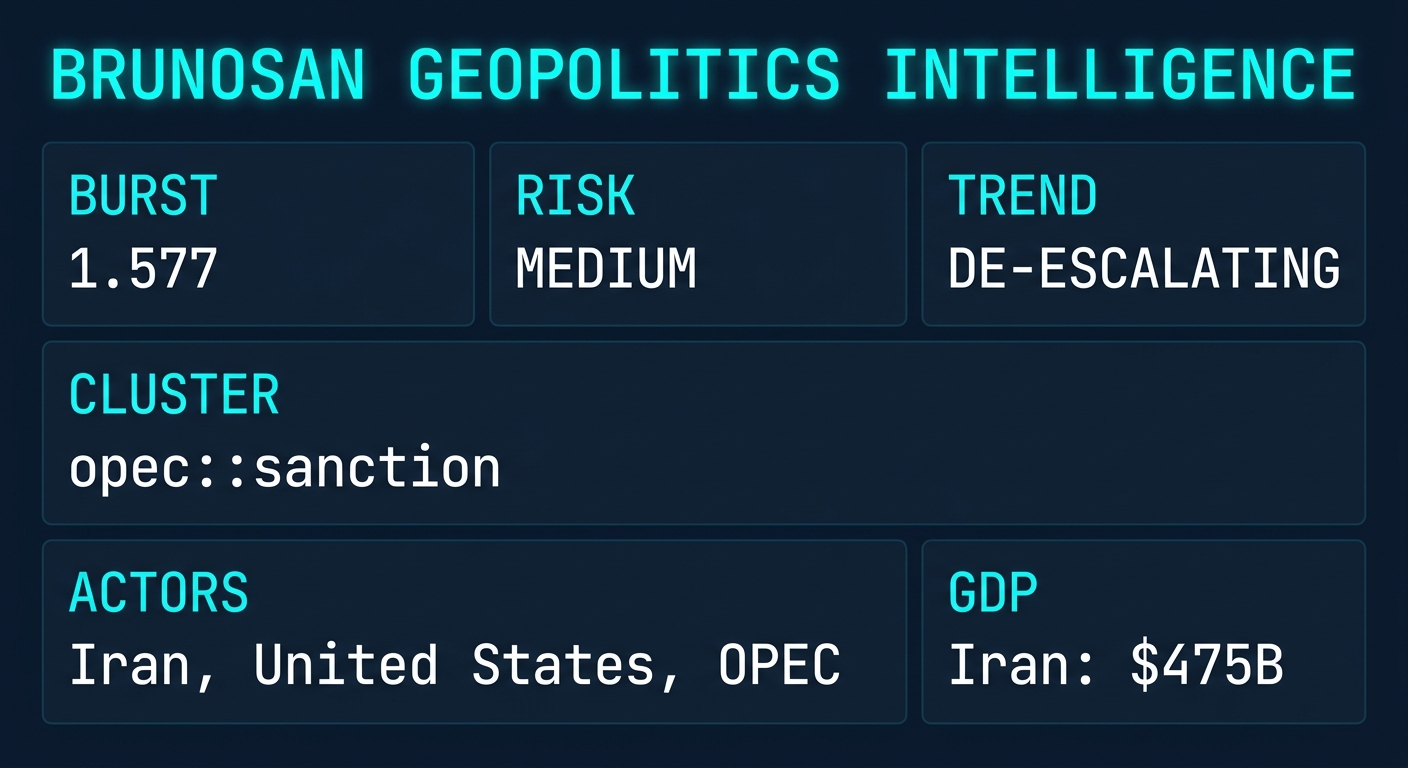
Based on geo_burst 1.577 and the critical signal of subsidized food distribution, BrunoSan assesses an 85% probability that a partial asset release agreement is announced within 72h to prevent an Iranian maritime retaliation. #opec #sanction #energy #finance #geopolitics