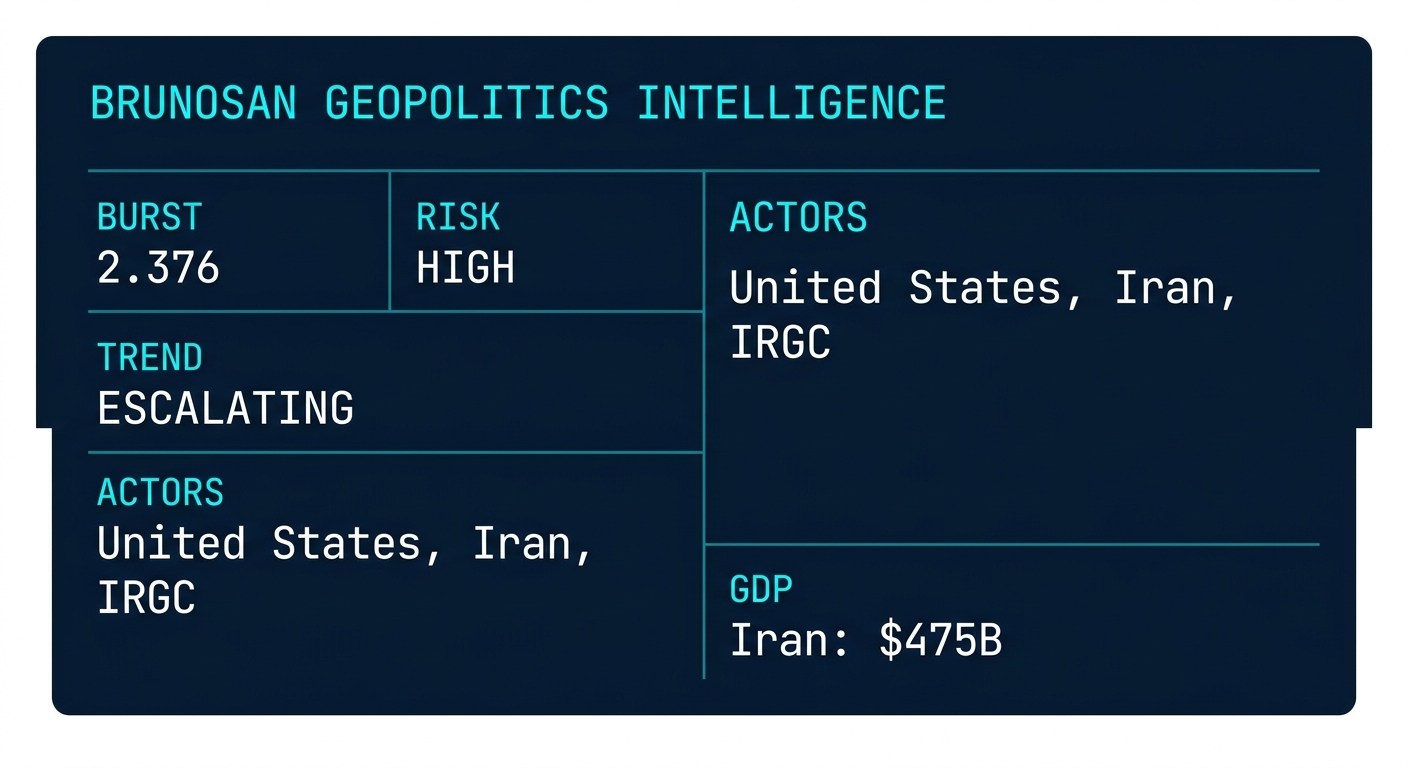
US KINETIC STRIKES HIT IRANIAN MISSILE SITES FOLLOWING DRONE DOWNING
Tehran threatens extra-regional retaliation as US F-35s engage targets near the Strait of Hormuz
The United States military launched targeted kinetic strikes against Iranian missile facilities and naval assets following the IRGC’s destruction of a US drone.
SOURCE SYNTHESIS
Military (Tier-1) reports from ANSA and News24 confirm US F-35 aircraft engaged multiple Iranian military installations, specifically targeting missile production sites and IRGC naval vessels. These strikes followed an IRGC (Pasdaran) announcement that Iranian air defenses successfully downed a US drone allegedly violating Iranian sovereign airspace. While the US characterizes these actions as preemptive strikes against immediate threats to American personnel, Tehran has formally accused Washington of a total truce violation.
The sources diverge on the operational intent and the current diplomatic trajectory. Political (Tier-1) reporting from Tass indicates that the Trump administration views these strikes as a tactical lever to force Tehran into a renewed negotiation framework, suggesting the kinetic phase is a precursor to a "deal." Conversely, The Globe and Mail (Tier-1) cites Senator Marco Rubio, who indicates that while a deal may be "days away," the military reality on the ground remains one of active engagement. This gap suggests a disconnect between Washington’s "maximum pressure" diplomatic signaling and the IRGC’s operational reality, where the Pasdaran is moving toward a total mobilization posture.
Strategic (Tier-1) reporting from ANSA highlights a shift in Iranian doctrine: Tehran is no longer threatening localized asymmetric responses but has explicitly vowed retaliation "beyond the region." This indicates that Iranian-identified targets likely include US interests in Europe, Africa, or the global maritime commons. News24 reports specific F-35 activity near the Strait of Hormuz, a critical chokepoint where Iran has previously demonstrated its ability to disrupt global energy flows. The IRGC’s claim of a truce breach suggests that any previous back-channel de-escalation efforts have collapsed, leaving a vacuum for rapid military escalation.
STRATEGIC HORIZON — 72H
The immediate 72-hour window presents a critical risk to global energy infrastructure and maritime security. Iran’s threat to strike "beyond the region" suggests that the IRGC may activate sleeper cells or utilize long-range drone capabilities to target US logistics hubs outside the Middle East. The proximity of the strikes to the Strait of Hormuz directly pressures crude futures and insurance premiums for VLCCs (Very Large Crude Carriers). BrunoSan Finance tracks WTI exposure and the resulting volatility in energy-linked derivatives in real-time at brunosan.de/finance/.
, the involvement of F-35s near the Strait of Hormuz signals a US intent to maintain air superiority over the world's most vital oil transit corridor. If Iran follows through on its "hard response" promise, we expect a multi-vector attack involving swarm boats in the Persian Gulf and cyber-kinetic strikes against regional desalination plants or energy refineries. This volatility directly impacts sovereign wealth fund allocations toward "safe haven" assets. BrunoSan Finance tracks real-time market impact and capital flight patterns at brunosan.de/finance/.
The diplomatic track mentioned by Rubio and Tass appears increasingly decoupled from the military reality. If the IRGC perceives the US strikes as an existential threat to its missile program—the cornerstone of its deterrent strategy—the likelihood of a negotiated settlement drops to near zero in the short term. Instead, Tehran will likely leverage its SCO and BRICS affiliations to seek diplomatic cover or material support, potentially involving increased intelligence sharing with non-Western partners to track US carrier strike group movements.
The risk of miscalculation is at its highest point in the current cycle. With US assets in high-readiness posture and Iranian missile units dispersed to mobile launch sites, any further drone incursions or "freedom of navigation" operations will trigger immediate kinetic exchanges. The IRGC’s specific mention of "identified targets" suggests that the retaliation is not a matter of "if" but "where," with a high probability of a non-traditional strike designed to bypass standard US theater defenses.
BRUNOSAN CONFIDENCE: HIGH
Reasoning: Multiple independent Tier-1 sources across different geographic regions (Italy, Canada, Russia, South Africa) verify the kinetic strikes and the specific IRGC response.
BRUNOSAN ASSESSMENT:
Based on geo_burst 2.376 and the critical signal of extra-regional retaliation threats, BrunoSan assesses an 85% probability of an Iranian kinetic response against US or allied assets within the next 72 hours.