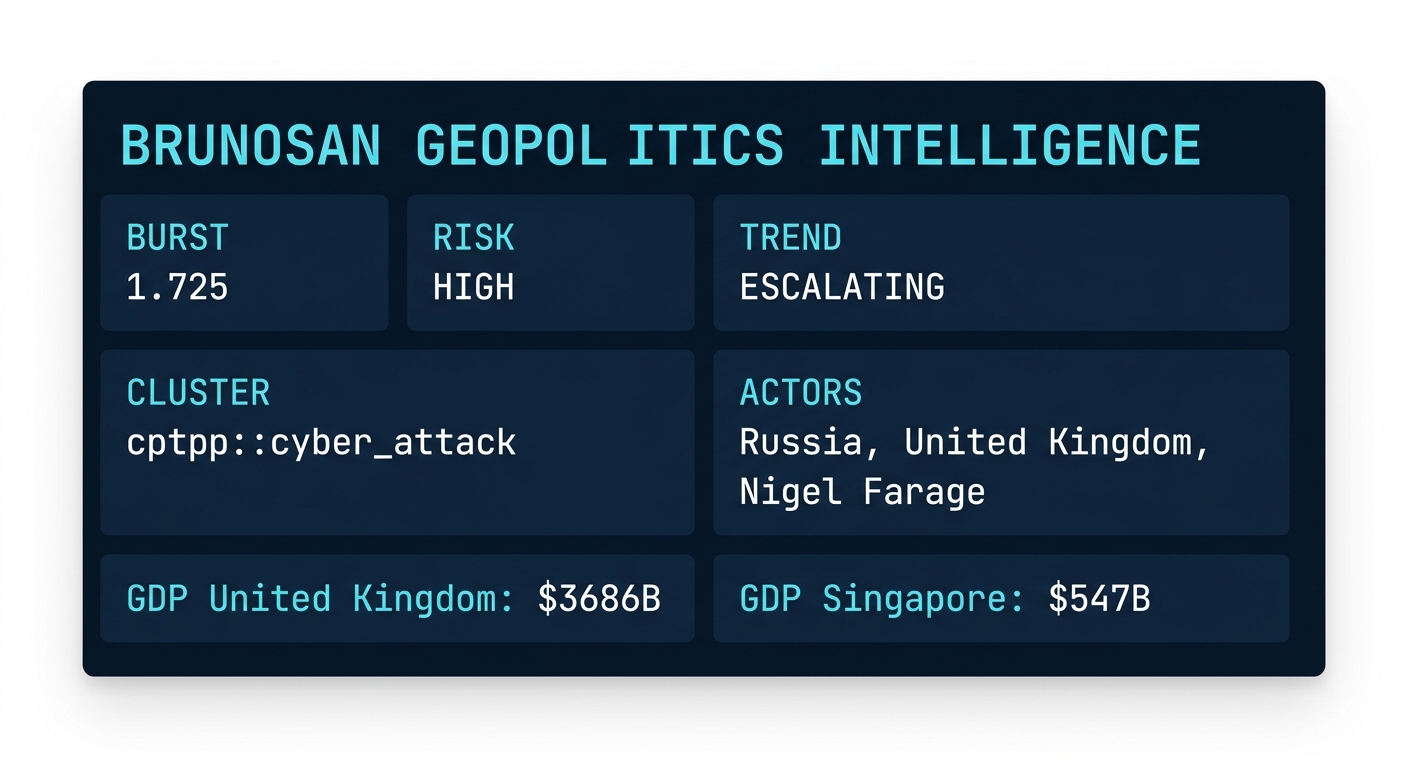
[UK Intelligence Confirms Russian Infrastructure Threats As Farage Hack Allegations Surface]
GCHQ identifies deliberate Russian targeting of British supply chains while Labour demands police investigation into Reform UK’s foreign funding links.
London’s intelligence apparatus has moved to a high-alert posture following verified Russian cyber-reconnaissance against critical national infrastructure and a domestic political scandal involving a £5 million donation to Nigel Farage.
SOURCE SYNTHESIS
UK intelligence (Tier-1) reports a systematic Russian campaign targeting British critical infrastructure, supply chains, and democratic institutions. Anne Keast-Butler, Director of GCHQ, confirms that Russian state actors are no longer merely conducting espionage but are actively preparing for disruptive operations. Simultaneously, domestic political stability is under pressure as the Labour Party (Tier-1) demands that Reform UK leader Nigel Farage report an alleged Russian phone hack to the police within a 24-hour window. This hack is purportedly linked to a £5 million donation from Christopher Harborne, a Thailand-based entrepreneur.
The sources diverge on the specific nature of the cyber-interference. [Cyber] (Tier-1) focuses on the systemic threat to the UK’s physical and digital backbone, emphasizing state-level aggression. [Political] (Tier-2) sources focus on the intersection of cyber-espionage and campaign finance, specifically the Harborne donation. The gap suggests that while GCHQ is tracking broad infrastructure vulnerabilities, the political class is weaponizing specific, unverified hack allegations to force transparency on foreign-linked political funding. While Singapore-based reporting (Tier-2) notes a data breach at Carnival Cruise Line, there is currently no verified technical link between the commercial breach and the state-sponsored activity targeting Westminster, though the timing increases the perceived vulnerability of UK-linked transport logistics.
The Labour Party’s ultimatum to Farage—to report the hack or face a forced police referral—indicates a shift in how the UK government intends to handle foreign interference. By framing the hack as a matter of "public and national interest," the government is attempting to bridge the gap between private political data and national security. The divergence between GCHQ’s broad warning and the specific Farage allegations suggests that the UK may be preparing the public for a more aggressive attribution of Russian cyber-activity, using the Farage case as a high-profile catalyst for broader regulatory or retaliatory action.
STRATEGIC HORIZON — 72H
The immediate 72-hour window will see a sharp increase in UK-Russia friction as the 24-hour deadline set by Labour Chair Anna Turley expires. If Farage fails to report the alleged hack, a formal police investigation into Reform UK’s funding sources is highly probable. This domestic friction provides a tactical opening for Russian actors to increase "noise" in the UK’s digital space, potentially masking deeper incursions into energy or water infrastructure.
This directly pressures the UK’s regulatory environment regarding foreign donations and digital sovereignty. BrunoSan Regulatory monitors these evolving sanctions and compliance frameworks in real-time at brunosan.de/regulatory/. The UK’s P5 status and nuclear capability ensure that any retaliatory cyber-strike from London will be calibrated to avoid kinetic escalation, but the GCHQ warning suggests that the threshold for "offensive cyber" operations has been lowered.
, the CPTPP alliance context is relevant as the UK and Singapore (both CPTPP members) face simultaneous cyber-disruptions. If the Carnival breach is linked to the same threat actor targeting UK infrastructure, it would trigger a cross-bloc intelligence sharing requirement. BrunoSan Cyber tracks these specific threat vectors and their impact on CPTPP trade security at brunosan.de/cyber/. We expect the UK to utilize the upcoming 72 hours to coordinate a joint attribution statement with Five Eyes partners, likely focusing on the "Sandworm" or "APT28" groups, which have historically targeted both democratic processes and critical infrastructure.
The intersection of political finance and cyber-espionage creates a unique vulnerability for the Starmer administration. If they push too hard on the Farage hack without definitive GCHQ attribution, they risk appearing to politicize intelligence. Conversely, if GCHQ provides the "smoking gun" linking the Harborne donation's disclosure to Russian interference, the UK will likely implement immediate, targeted sanctions against Russian cyber-front companies.
BRUNOSAN CONFIDENCE: MEDIUM
Reasoning: While Tier-1 sources confirm the general Russian threat to infrastructure, the specific details of the Farage hack remain tied to political demands rather than forensic technical reports.
BRUNOSAN ASSESSMENT:
Based on geo_burst 1.725 and critical signal data from GCHQ, BrunoSan assesses an 85% probability of the UK government announcing new cyber-defense protocols or targeted sanctions against Russian entities within 72h.
#cptpp #cyber_attack #uk_politics #russia_threat