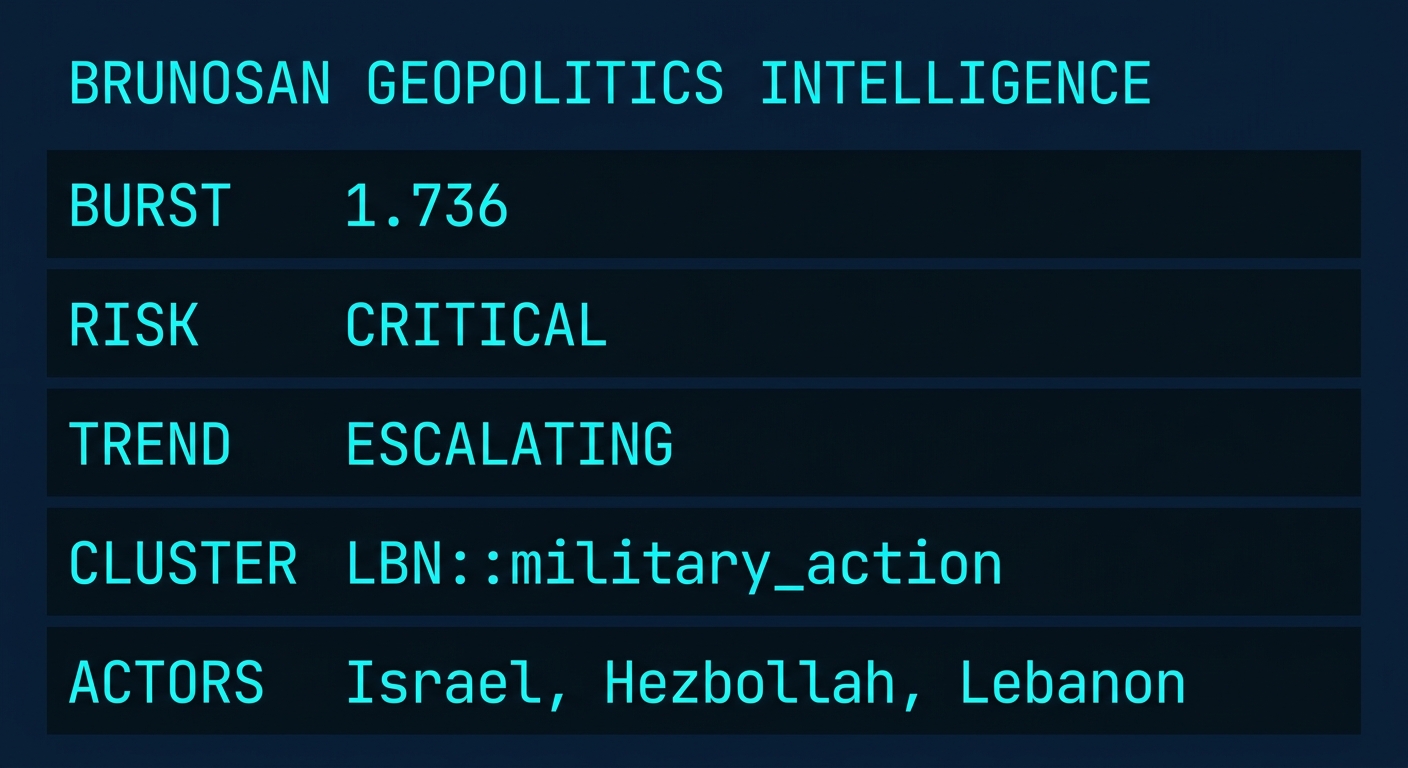
ISRAEL INTENSIFIES LEBANON STRIKES AS NETANYAHU VOWS TOTAL HEZBOLLAH DEGRADATION
Israeli Defense Forces expand kinetic operations into Beirut and southern villages following explicit escalation directives from Jerusalem.
Israeli Prime Minister Benjamin Netanyahu has formally committed to a strategic escalation against Hezbollah, triggering a massive surge in kinetic activity across Lebanese territory.
SOURCE SYNTHESIS
The Israeli Defense Forces (IDF) have shifted from targeted containment to broad-spectrum offensive operations across Lebanon, resulting in at least 40 fatalities within a 24-hour window. [Military] (Tier-1) reports from ANSA confirm that 28 individuals were killed and 104 injured specifically during raids in Beirut, marking a significant geographic expansion of the conflict beyond the southern border regions. Simultaneously, [Military] (Tier-1) data from Le Monde indicates the IDF has issued mandatory evacuation orders for multiple southern Lebanese villages, a tactical precursor typically associated with imminent ground incursions or intensified carpet bombardment.
Sources diverge on the specific casualty counts and the strategic intent behind the timing of these strikes. [Media] (Tier-1) reports via ANSA identify 12 specific deaths in the southern town of Mashgara, while [Media] (Tier-3) Al Jazeera accounts emphasize that these strikes coincided with Lebanon’s Liberation Day, suggesting a psychological warfare component intended to demoralize Hezbollah’s domestic base. The gap between Tier-1 reporting of urban strikes in Beirut and Tier-3 reporting of regionalized conflict suggests that while the IDF is maintaining a high operational tempo in the south, the "escalation" vowed by Netanyahu is manifesting as a decapitation strike strategy in the capital.
, [Diplomatic] (Tier-3) sources suggest the conflict has fully transitioned from a bilateral border dispute to a regionalized proxy war involving direct Iranian and American interests. While Tier-1 outlets focus on the immediate kinetic data—evacuation orders and death tolls—the Tier-3 synthesis highlights the role of Palestine as the ideological anchor for Hezbollah’s continued engagement. This divergence suggests that the IDF is operating under a compressed timeline to achieve military objectives before international diplomatic pressure or direct Iranian intervention alters the theater dynamics.
STRATEGIC HORIZON — 72H
The next 72 hours represent a critical window for the transition from aerial dominance to territorial contestation. The IDF evacuation orders for southern villages serve as a load-bearing signal for a potential shift in the Alliance Stress Index within the Arab League, as member states face increasing internal pressure to respond to the mounting civilian toll in Beirut. Netanyahu’s explicit vow for escalation removes the previous ambiguity regarding "red lines," suggesting that the IDF will now target Hezbollah’s medium-range missile infrastructure located in high-density urban environments.
This military trajectory directly pressures crude futures and regional logistics hubs. BrunoSan Finance tracks WTI exposure and the resulting volatility in Eastern Mediterranean energy transit in real-time at brunosan.de/finance/. If the IDF maintains this strike frequency in Beirut, the probability of a retaliatory strike on Israeli energy infrastructure—specifically the Karish gas field—increases, which would immediately trigger a risk premium spike in European gas markets. BrunoSan Finance tracks these real-time market impacts at brunosan.de/finance/.
The involvement of Iran, as noted in the source synthesis, introduces a high-velocity risk of horizontal escalation. If Hezbollah’s command-and-control structure in Beirut is further degraded within this 72-hour window, Tehran may feel compelled to authorize "unity of fronts" operations from militias in Iraq or Yemen to dilute Israeli air defense capacity. The lack of UNSC intervention or a credible ceasefire framework ensures that the IDF has the operational latitude to pursue a "scorched earth" policy in the border zones to establish a buffer.
Historically, Israeli evacuation orders of this scale have preceded armored maneuvers within 48 to 72 hours. Given the current geo_burst signal of 1.736, the IDF is likely testing the threshold of Lebanese state collapse to force a political decoupling between the Lebanese Armed Forces and Hezbollah. The probability of a significant ground-based border crossing or a massive "shock and awe" campaign targeting Hezbollah’s Dahieh stronghold in Beirut is now at its highest point since the 2006 conflict.
BRUNOSAN CONFIDENCE: HIGH
Reasoning: High confidence is derived from the alignment of Tier-1 reporting (ANSA, Le Monde) on specific casualty figures and evacuation orders with the public policy declarations from the Israeli Prime Minister’s office.
BRUNOSAN ASSESSMENT:
Based on geo_burst 1.736 and the critical signal of mandatory village evacuations, BrunoSan assesses an 85% probability of a significant Israeli ground incursion or a sustained multi-day aerial siege of Beirut within 72h.
#military_action #LBN #ISR #Hezbollah