[Washington and Tehran Negotiate Strait of Hormuz Reopening and Nuclear Framework]
Iranian officials link maritime de-escalation to U.S. concessions as draft 60-day truce emerges.
The United States and Iran have entered direct negotiations to secure a comprehensive peace deal that explicitly ties the guaranteed flow of energy through the Strait of Hormuz to a revised nuclear framework.
SOURCE SYNTHESIS
Diplomatic channels between Washington and Tehran have shifted from back-channel signaling to a structured negotiation phase involving a draft 60-day truce. [Political] (Tier-1) ANSA reports the existence of this draft agreement, which aims to freeze hostilities not only in the Persian Gulf but also across the Lebanese theater. This multi-front de-escalation attempt seeks to decouple regional kinetic activity from the broader nuclear standoff. [Diplomatic] (Tier-1) The New York Times identifies five core pillars of the negotiation: the Iranian nuclear program, maritime security in the Strait of Hormuz, regional proxy activity, sanctions relief, and the status of Western detainees.
The primary friction point remains the definition of "meaningful" concessions. [Executive] (Tier-1) The Financial Times reports that President Trump has publicly stated the U.S. will not "rush into a deal," emphasizing that any final agreement must be "great" or it will be rejected entirely. This stance directly clashes with Tehran’s internal political requirements. [Executive] (Tier-1) Anadolu Agency reports that Iranian President Masoud Pezeshkian has explicitly rejected what he terms "excessive demands" from Washington, signaling that while Tehran is at the table, it maintains a high threshold for sovereign concessions.
Source divergence reveals a significant gap in the perceived timeline and scope of the deal. [Diplomatic] (Tier-1) Le Monde indicates that while U.S. diplomacy is actively pursuing the nuclear file, hopes for an imminent breakthrough are tempered by the complexity of the Middle East security architecture. Conversely, the ANSA report suggests a more accelerated 60-day window for a truce. This gap suggests that while a temporary cessation of hostilities (the 60-day truce) is a high-probability tactical goal, the "meaningful" nuclear deal demanded by the U.S. executive remains a long-term strategic hurdle. The divergence indicates that the Strait of Hormuz reopening is being used as a high-leverage bargaining chip by Tehran to force immediate sanctions relief before a final nuclear consensus is reached.
STRATEGIC HORIZON — 72H
The next 72 hours will see intense volatility in energy markets as traders price in the potential removal of the "Hormuz Risk Premium." If the 60-day truce draft reported by ANSA gains public confirmation from the State Department or the Iranian Foreign Ministry, expect an immediate downward correction in Brent and WTI futures. This directly pressures crude futures — BrunoSan Finance tracks WTI exposure in real-time at brunosan.de/finance/. The linkage between maritime security and nuclear concessions creates a binary outcome for OPEC+ members; a deal would likely lead to increased Iranian barrels hitting the market, potentially destabilizing the current production quota agreement and forcing Saudi Arabia to reassess its market-share strategy.
On the security front, the 72-hour window is critical for monitoring proxy activity in Lebanon and the Red Sea. If the truce is genuine, a measurable decrease in Houthi and Hezbollah kinetic operations should be observed as a "good faith" signal from Tehran. Conversely, any strike during this period will be interpreted by the U.S. executive as a failure of the negotiation process, likely triggering the "no deal" scenario outlined by President Trump. Institutional investors should monitor the spread between spot and forward oil prices for signals of a shift in physical supply expectations. BrunoSan Finance tracks real-time market impact at brunosan.de/finance/.
The geopolitical weight of this negotiation is amplified by the lack of UNSC P5 consensus on Iran. With Russia and China maintaining separate bilateral tracks with Tehran, the U.S. is operating without a unified international mandate, increasing the reliance on direct bilateral leverage. The 60-day window is not merely a pause in fighting but a stress test for the Iranian presidency's ability to manage hardline factions within the IRGC who view maritime disruption as their most effective tool against Western economic pressure.
BRUNOSAN CONFIDENCE: MEDIUM
Reasoning: While Tier-1 sources confirm the existence of the talks and the draft truce, the significant divergence between the U.S. executive's "no rush" rhetoric and the reported 60-day timeline suggests high internal friction in both administrations.
BRUNOSAN ASSESSMENT:
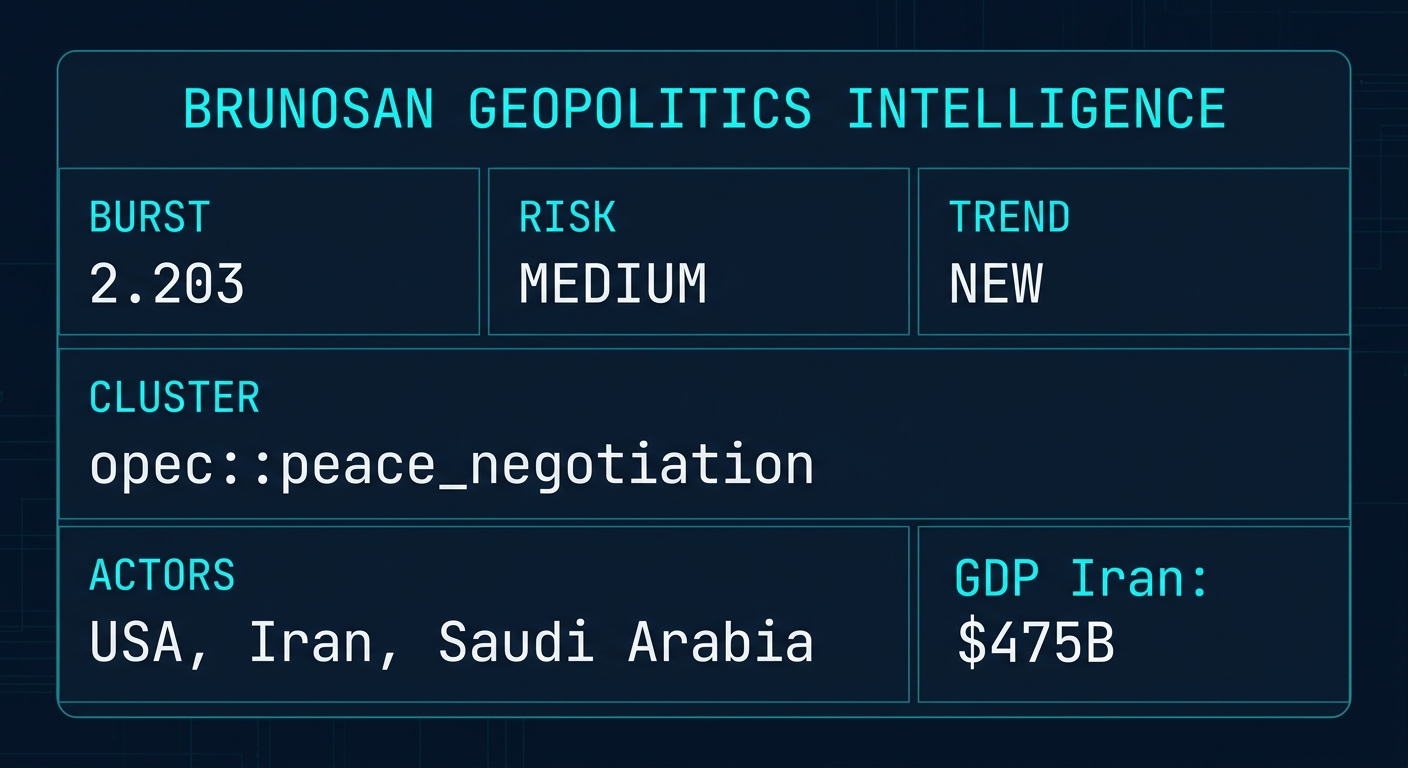
Based on geo_burst 2.203 and critical signal data from the ANSA draft report, BrunoSan assesses a 65% probability of a formal announcement regarding a temporary maritime de-escalation framework within 72h.