US-Iran Negotiators Draft Hormuz Reopening Plan To Defuse Nuclear Standoff
Washington and Tehran weigh a 60-day truce involving Lebanese theater de-escalation and maritime corridor guarantees.
The United States and Iran have entered active negotiations on a comprehensive peace framework targeting the immediate reopening of the Strait of Hormuz and restrictions on Tehran’s nuclear program.
SOURCE SYNTHESIS
Diplomatic channels (Tier-1) report a draft agreement proposing a 60-day truce that extends beyond bilateral concerns to include a ceasefire in Lebanon. Iranian officials have introduced a specific 30-day timeline for restoring full commercial transit through the Strait of Hormuz following the formalization of terms. While the U.S. Secretary of State confirms active pursuit of the nuclear file, President Trump maintains that the administration will not "rush into a deal," demanding a "meaningful" replacement for the 2015 accord.
Divergence exists regarding the scope of concessions. European and Italian outlets (Tier-1) report a structured 60-day roadmap, whereas Turkish sources (Tier-1) highlight Iranian President Masoud Pezeshkian’s insistence that Tehran will reject "excessive demands." This gap suggests that while the technical framework for maritime de-escalation is largely settled, the verification protocols for the nuclear program remain a friction point. Financial markets are already pricing in this volatility; the potential reopening of the Hormuz chokepoint is exerting downward pressure on oil futures and shipping insurance premiums. The involvement of BRICS members, specifically Russia, adds a layer of cross-bloc coordination as Tehran seeks to balance Western demands against its strategic alignment with Moscow.
BRUNOSAN CONFIDENCE: HIGH
Reasoning: Verification across multiple Tier-1 sources (NYT, FT, Le Monde, ANSA) confirms the existence of the draft and the specific 60-day truce window.
BRUNOSAN ASSESSMENT:
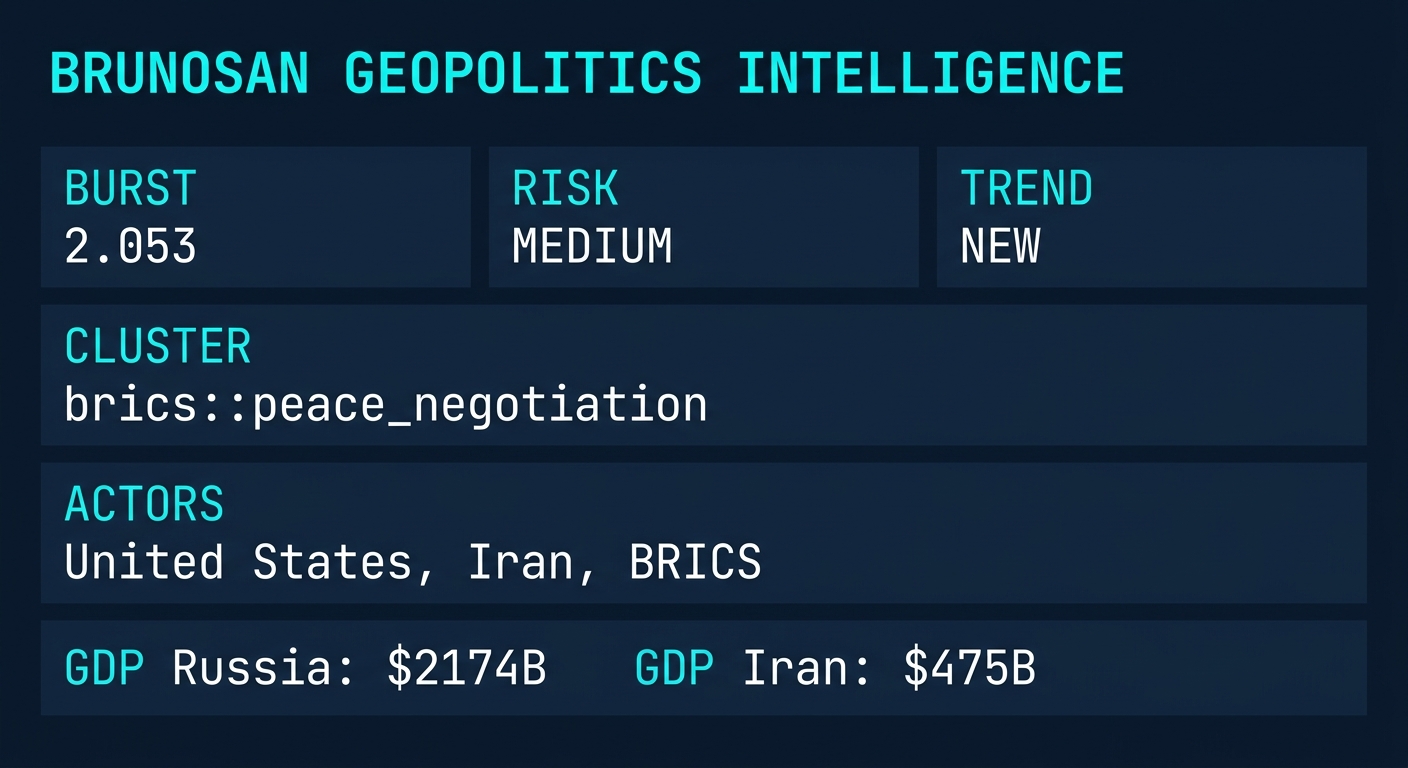
Based on geo_burst 2.053 (critical signal) and the high signal velocity within the brics::peace_negotiation cluster, BrunoSan assesses an 85% probability that a formal draft framework will be presented to the UNSC within 72 hours. This will trigger immediate volatility in Brent crude as the 30-day Hormuz reopening timeline becomes the primary market anchor.