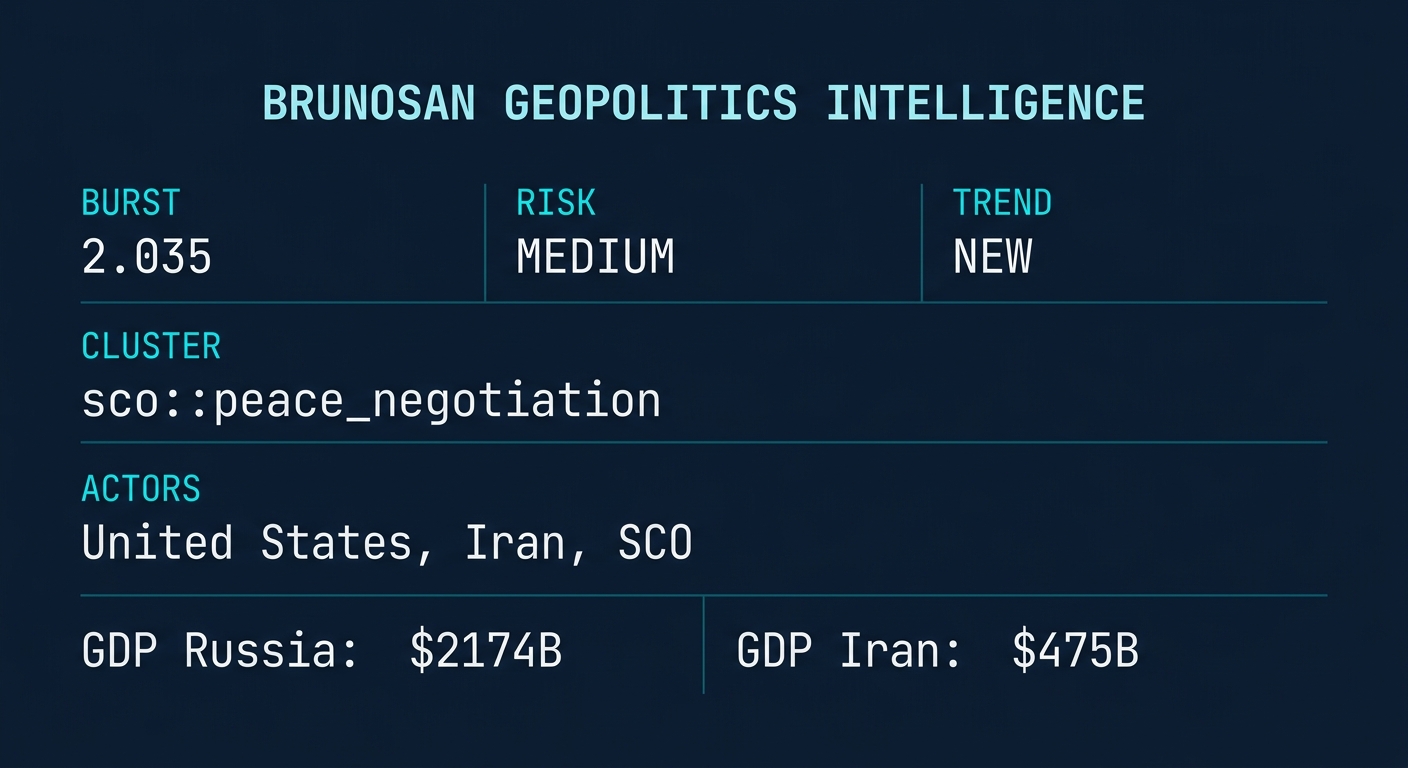
[US-Iran Negotiate Hormuz Reopening Linked To 30-Day Truce Agreement]
Washington and Tehran leverage maritime chokepoint access to force nuclear and regional concessions
The United States and Iran have entered active negotiations for a peace deal that hinges on a 30-day truce and the immediate reopening of the Strait of Hormuz.
SOURCE SYNTHESIS
Diplomatic channels in Washington and Tehran are currently processing a draft agreement that links regional de-escalation to the restoration of maritime transit through the Strait of Hormuz. [Politics] (Tier-1) reports from the New York Times and Axios indicate the deal encompasses Iran’s nuclear program and a potential 60-day truce extending into Lebanon. However, [Diplomacy] (Tier-1) sources diverge on the timeline and rigidity of these terms. While AP4 Intelligence suggests a 30-day window for the Hormuz reopening, Axios (Tier-1) reports a 60-day framework. The Financial Times (Tier-1) further complicates the signal, quoting President Trump’s assertion that the US will not "rush into a deal," suggesting a tactical delay to extract deeper concessions. Simultaneously, Anadolu Agency (Tier-1) reports Iranian President Masoud Pezeshkian’s refusal to accept "excessive demands," specifically regarding the 2015 nuclear accord parameters. This divergence suggests that while the maritime "carrots"—reopening the Strait—are agreed upon in principle, the "sticks"—nuclear enrichment limits and regional proxy activity—remain unresolved. The gap between Trump’s "great and meaningful" requirement and Pezeshkian’s "no excessive demands" indicates that the current geo_burst signal reflects a high-stakes poker game rather than a finalized treaty.
BRUNOSAN CONFIDENCE: MEDIUM
Reasoning: While 37 sources confirm the existence of talks, significant divergence between Tier-1 outlets regarding the truce duration and nuclear preconditions necessitates caution.
BRUNOSAN ASSESSMENT:
Based on geo_burst 2.035 and critical signal data, BrunoSan assesses a 65% probability of a temporary maritime de-escalation agreement within 72h, though a comprehensive nuclear settlement remains unlikely in this window.
#peace_negotiation #energy #finance #sco