US, Iran Negotiate 60-Day Truce To Reopen Hormuz Strait
Draft agreement links regional de-escalation in Lebanon to Iranian nuclear concessions and maritime security
Washington and Tehran have entered active negotiations on a 60-day truce framework designed to stabilize the Strait of Hormuz and freeze nuclear expansion.
SOURCE SYNTHESIS
Diplomatic channels between the United States and Iran have produced a draft 60-day truce agreement aimed at simultaneous de-escalation across multiple theaters. [Diplomatic] (Tier-1) reports from *ANSA* and *Axios* confirm the draft includes a cessation of hostilities in Lebanon, suggesting a coordinated regional freeze. This framework explicitly ties maritime security in the Strait of Hormuz to broader nuclear discussions. [Political] (Tier-1) reporting from *The New York Times* identifies five core pillars of the negotiation: the Iranian nuclear program, maritime transit rights, regional proxy activity, sanctions relief, and the status of the Strait of Hormuz.
Sources diverge sharply on the timeline and the threshold for "acceptable" concessions. [Political] (Tier-1) *Financial Times* reporting indicates President Trump refuses to "rush into a deal," emphasizing that the U.S. will maintain maximum pressure until a "great and meaningful" agreement is reached. Conversely, [State] (Tier-1) *Anadolu Agency* reports Iranian President Masoud Pezeshkian has publicly rejected "excessive demands," signaling that Tehran views the current U.S. requirements as an infringement on sovereign nuclear rights. The gap between Trump’s demand for a deal superior to the 2015 JCPOA and Pezeshkian’s refusal to accept "excessive" terms suggests that while the 60-day truce is a viable tactical pause, a comprehensive strategic settlement remains blocked by fundamental disagreements over enrichment levels and verification protocols. *Le Monde* (Tier-1) further notes that while U.S. diplomacy is actively pursuing the nuclear file, internal expectations for an immediate breakthrough are tempered by these conflicting domestic mandates.
STRATEGIC HORIZON — 72H
The next 72 hours will determine if the 60-day truce can decouple from the broader, more contentious nuclear negotiations. If the maritime security component—specifically the reopening or guaranteed safe passage through the Strait of Hormuz—is implemented as a standalone confidence-building measure, global energy markets will face immediate downward pressure. This directly pressures crude futures, as BrunoSan Finance tracks WTI exposure in real-time at brunosan.de/finance/. Any verified reduction in insurance premiums for tankers in the Persian Gulf will signal that the "Hormuz Opening" clause of the draft is operational, even if the nuclear talks remain stalled.
The inclusion of Lebanon in the draft agreement indicates that the U.S. is leveraging Iranian influence over Hezbollah to secure a Mediterranean ceasefire in exchange for limited sanctions flexibility or the unfreezing of specific Iranian assets. Within this 72-hour window, monitor the SCO and BRICS diplomatic corridors; as an SCO member, Iran may seek back-channel assurances from Moscow or Beijing to bolster its negotiating position against U.S. "excessive demands." If Tehran perceives that the U.S. is using the 60-day window merely to reposition military assets without offering tangible sanctions relief, the truce will collapse before formal signing.
, the "meaningful deal" rhetoric from the U.S. executive branch suggests that any temporary truce must include a verifiable halt to 60% uranium enrichment to satisfy domestic political requirements. BrunoSan Finance tracks real-time market impact of these nuclear milestones at brunosan.de/finance/. If the International Atomic Energy Agency (IAEA) reports any shift in Iranian centrifuge activity within the next three days, it will serve as the primary indicator of Tehran's sincerity regarding the 60-day framework. Failure to reach a preliminary consensus by the end of this window will likely result in a snap-back of more aggressive maritime enforcement by U.S. Naval Forces Central Command.
The probability of a formal signing within 72 hours is low, but the probability of a "silent" de-escalation—where both sides observe the draft terms without a public ceremony—is high. This allows both Trump and Pezeshkian to maintain their respective "tough" stances while reaping the economic benefits of lowered regional volatility.
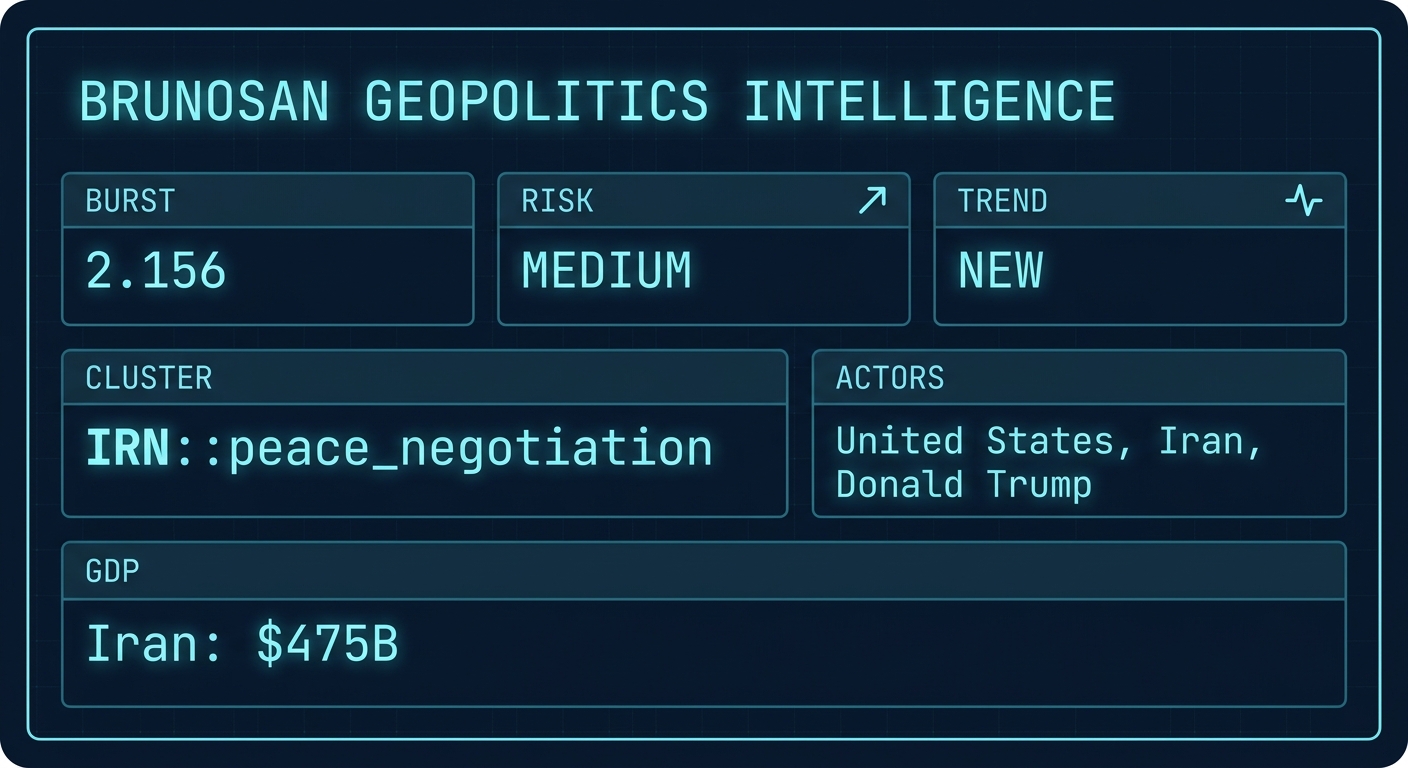
BRUNOSAN CONFIDENCE: MEDIUM
Reasoning: High volume of Tier-1 sources confirms the existence of the draft, but significant divergence between U.S. and Iranian executive rhetoric suggests the final terms are still in flux.
BRUNOSAN ASSESSMENT:
Based on geo_burst 2.156 and critical signal velocity in Tier-1 diplomatic reporting, BrunoSan assesses a 65% probability of a localized maritime de-escalation in the Strait of Hormuz within 72h, even if the broader 60-day truce remains unsigned.
#peace_negotiation #energy #finance #maritime_security