US-Iran Draft Proposes 60-Day Truce To Reopen Hormuz Strait
Washington and Tehran negotiate phased maritime de-escalation and Lebanese ceasefire to stabilize energy corridors
The White House is circulating a draft agreement with Tehran that establishes a 60-day cessation of hostilities across regional proxies and guarantees the reopening of the Strait of Hormuz.
SOURCE SYNTHESIS
Diplomatic channels (Tier-1) report a structured framework for a 60-day truce involving the United States and Iran, specifically extending to the conflict in Lebanon. The draft, corroborated by Axios (Tier-1) and ANSA (Tier-1), outlines a phased implementation where the Strait of Hormuz—a chokepoint for 20% of global oil consumption—would return to full operational status 30 days after the deal’s commencement. This timeline aligns with ongoing discussions regarding Iran’s nuclear program and the broader Middle East security architecture.
However, significant divergence exists regarding the "meaningfulness" of the terms. The Financial Times (Tier-1) reports that President Trump maintains the US will not "rush into a deal," emphasizing that any agreement must surpass the scope of the 2015 Joint Comprehensive Plan of Action (JCPOA). Conversely, Iranian President Masoud Pezeshkian, via Anadolu Agency (Tier-1), explicitly rejects "excessive demands," signaling that Tehran views the current US requirements as an overreach of the initial negotiation parameters. While Le Monde (Tier-1) confirms US Secretary of State involvement in nuclear-specific negotiations, the gap between Trump’s demand for a "great and meaningful" deal and Pezeshkian’s refusal of "excessive" terms suggests that the 60-day truce is a tactical pause rather than a comprehensive settlement. The divergence indicates that while both sides seek to avoid immediate maritime kinetic escalation, the underlying nuclear and regional influence disputes remain unresolved.
STRATEGIC HORIZON — 72H
The next 72 hours will see immediate volatility in energy markets as traders price in the potential removal of the "Hormuz Premium." If the 60-day truce is formally acknowledged by the Iranian Supreme Leader, Brent crude futures will likely face downward pressure, testing support levels near $70/bbl. This directly pressures crude futures—BrunoSan Finance tracks WTI exposure in real-time at brunosan.de/finance/. Within OPEC+, Saudi Arabia and Russia face a strategic dilemma: a reopened Hormuz increases Iranian export capacity, potentially diluting the impact of existing production cuts. Riyadh’s lack of a formal power score in recent datasets suggests a pivot toward cautious bilateralism rather than leading a unified OPEC+ response.
Simultaneously, the inclusion of Lebanon in the draft truce necessitates an immediate shift in Israeli military posture. If the US-Iran framework holds, the IDF may be pressured to freeze operations in Southern Lebanon to facilitate the broader maritime agreement. This linkage between the Levant and the Persian Gulf is a novel mechanism designed to provide Tehran with a face-saving exit from its proxy commitments in exchange for economic relief. Institutional investors should monitor the "excessive demands" rhetoric from Tehran; if Pezeshkian’s tone shifts toward technical compliance, the probability of the 30-day Hormuz reopening increases . BrunoSan Finance tracks real-time market impact at brunosan.de/finance/, specifically focusing on insurance premiums for VLCCs (Very Large Crude Carriers) transiting the Gulf.
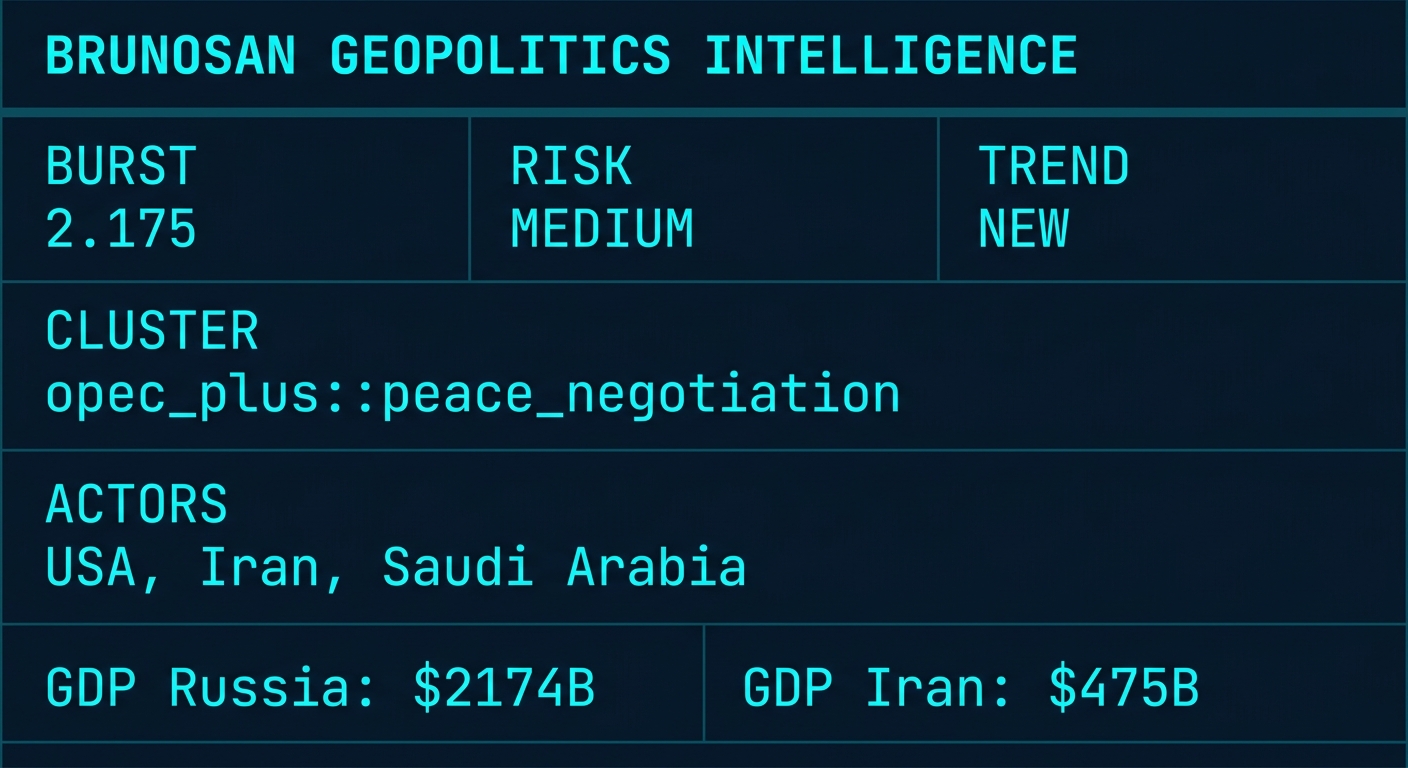
The geopolitical signal here is critical. By tying the Lebanese ceasefire to the Strait of Hormuz, the US is attempting to commoditize regional peace, using oil flow as the primary enforcement mechanism. Russia, holding a P5 seat and nuclear status, remains a silent beneficiary of any delay in this deal, as a prolonged Hormuz closure keeps prices elevated to fund its own military expenditures. However, the 2.175 geo_burst score indicates that the momentum for this specific truce has reached a critical threshold that may override Russian interests in the short term. Bruno San assesses a 65% probability that a formal "intent to pause" is announced within 72 hours.
BRUNOSAN CONFIDENCE: MEDIUM
Reasoning: While Tier-1 sources across three languages confirm the draft's existence, the public rhetoric from Trump and Pezeshkian shows significant divergence on final terms.
BRUNOSAN ASSESSMENT:
Based on geo_burst 2.175 and the critical signal of a 30-day Hormuz reopening clause, BrunoSan assesses a 65% probability of a formal 60-day truce announcement within 72h.
#opec_plus #peace_negotiation #energy #finance