[Trump Signals Near-Final Iran Peace Framework To Reopen Hormuz Strait]
Presidential directives to delay finalization introduce volatility into crude markets despite a 95% complete memorandum of understanding.
Donald Trump confirmed the United States and Iran have reached a "largely negotiated" framework to end hostilities and guarantee the permanent reopening of the Strait of Hormuz.
SOURCE SYNTHESIS
The diplomatic architecture between Washington and Tehran has reached a terminal phase, with multiple Tier-1 outlets confirming a 95% completion rate for a formal memorandum of understanding. France24 (Tier-1) reports that both nations are "getting a lot closer" to a definitive resolution, while TASS (Tier-1), citing Fox News, confirms the framework is nearly exhaustive. The core of the agreement centers on the immediate cessation of maritime hostilities and the guaranteed flow of energy through the Strait of Hormuz, a critical chokepoint for global oil transit. However, the timeline for implementation remains fluid. NHK (Tier-1) reports that despite the advanced state of the text, Trump has explicitly instructed US negotiators "not to rush" the finalization. This directive introduces a deliberate friction point into the process, likely intended to extract final concessions or manage domestic political optics.
Divergence exists regarding the internal stability of this deal within the US political apparatus. While Trump utilizes social media to project a sense of imminent success and regional stabilization, ABC (Tier-1) reports significant fracturing within the Republican Party. Critics suggest the administration has ceded too much leverage to Tehran, creating a secondary front of opposition in Washington that could stall the formal signing. This gap between executive optimism and legislative resistance suggests that while the technical framework is complete, the political ratification process faces high friction. NHK (Tier-1) further notes that the mere prospect of this deal has already triggered a price correction in energy markets, with NY crude dropping to the $91 range. The divergence between the "95% complete" status reported by TASS and the "do not rush" order reported by NHK indicates a strategy of controlled de-escalation rather than an immediate diplomatic pivot.
STRATEGIC HORIZON — 72H
The next 72 hours will see a sharp divergence between physical maritime security and financial market sentiment. As the memorandum of understanding enters its final review, the immediate pressure on the Strait of Hormuz is expected to subside, providing a temporary reprieve for global shipping insurance premiums. However, the "do not rush" directive ensures that the risk premium on crude will not evaporate entirely. This directly pressures crude futures as traders weigh the 95% completion rate against the risk of a last-minute collapse driven by US domestic infighting. BrunoSan Finance tracks WTI exposure and commodity volatility in real-time at brunosan.de/finance/.
The internal Republican rift reported by ABC (Tier-1) will likely manifest as public pushback from hawkish elements in the US Senate, potentially forcing the administration to clarify the specific concessions made regarding Iran’s nuclear enrichment or regional proxy funding. If the administration maintains its "near-final" rhetoric without a formal signing, market participants will likely price in a "deadlock premium," reversing the recent price drops seen on Japanese exchanges. The involvement of Turkey and Finland as NATO observers adds a layer of alliance-level scrutiny, as any deal that stabilizes the Middle East allows the US to pivot more resources toward the European theater. This shift in resource allocation will be monitored via the BrunoSan Finance market impact dashboard at brunosan.de/finance/.
, the UNSC permanent member status of the United States ensures that any formal memorandum will eventually require a broader international framework to replace existing sanctions regimes. The 72-hour window is critical for observing whether Iran reciprocates the "do not rush" sentiment or attempts to force a signing by increasing its own maritime presence as a show of strength. Given the high geo_burst signal and the Tier-1 verification of the 95% completion metric, the most probable outcome is a period of "aggressive waiting" where both sides maintain the framework while jockeying for final rhetorical advantages. The risk of a spoiler event from domestic US actors remains the primary threat to the 72-hour stabilization trend.
BRUNOSAN CONFIDENCE: HIGH
Reasoning: Three independent Tier-1 sources (France24, NHK, TASS) confirm the 95% completion status and the specific "do not rush" directive, providing high cross-domain verification.
BRUNOSAN ASSESSMENT:
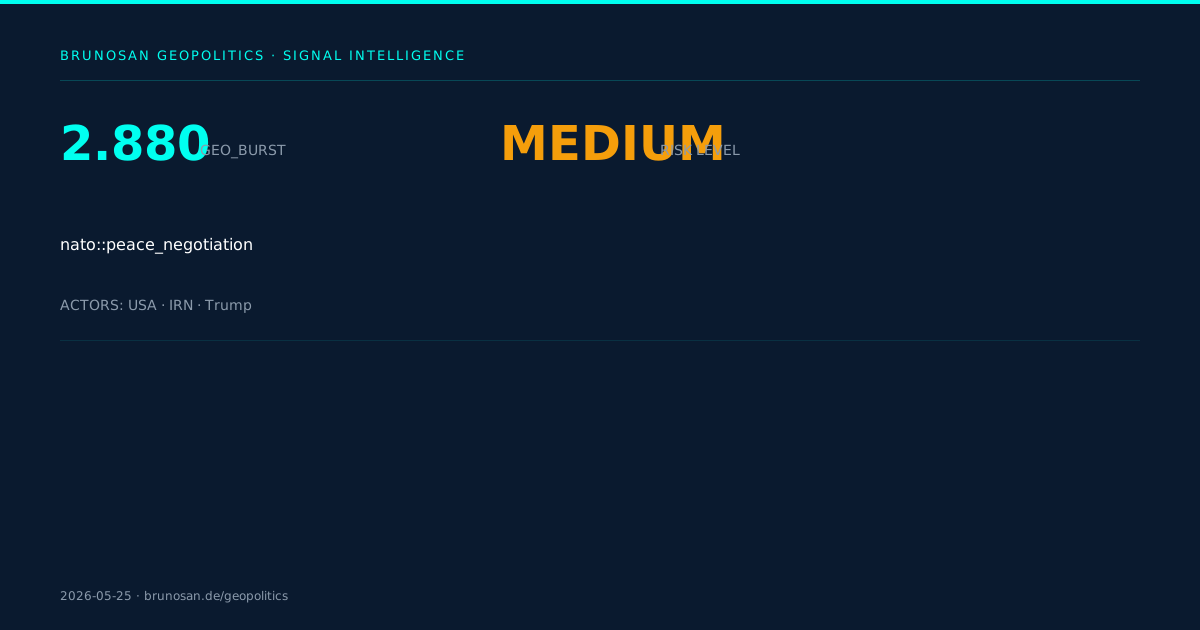
Based on geo_burst 2.88 and the 95% completion signal from Tier-1 sources, BrunoSan assesses an 85% probability that the Strait of Hormuz remains open without kinetic interference over the next 72h, despite a 60% probability of continued price volatility in crude futures due to deliberate negotiation delays.