[Trump Signals Imminent Iran Framework Agreement To Reopen Hormuz Strait]
White House claims 95% completion on memorandum while internal GOP fractures threaten final ratification.
US President Donald Trump has declared a comprehensive peace memorandum with Iran is largely negotiated, specifically securing the permanent reopening of the Strait of Hormuz.
SOURCE SYNTHESIS
The diplomatic architecture between Washington and Tehran has shifted from confrontation to a finalized framework within a 48-hour window. France24 (Tier-1) reports Trump’s confirmation that both nations are "getting a lot closer" to a definitive settlement. This is corroborated by TASS (Tier-1), citing Fox News data that the framework agreement is currently 95% complete. The core of the memorandum, according to NHK (Tier-1), centers on the guaranteed freedom of navigation through the Strait of Hormuz, a critical chokepoint for global energy transit.
However, a significant tactical divergence exists between Trump’s public optimism and his private directives to the State Department. NHK (Tier-1) reports that Trump explicitly instructed US negotiators "not to rush" the final signatures, despite his social media claims that the memorandum is "nearly negotiated" and ready for public release. This suggests a deliberate slowing of the "final mile" to extract last-minute concessions or to manage domestic political blowback.
The internal US political reaction represents the primary friction point. ABC News (Tier-1) reports a widening schism within the Republican Party, where hardline factions argue the administration has ceded too much leverage to Tehran. This domestic "GOP split" creates a credibility gap; while the executive branch signals a deal is done, the legislative support required for long-term sanctions relief remains precarious. The gap between Trump’s "95% complete" claim and the "do not rush" order suggests the administration is struggling to reconcile international progress with domestic partisan resistance.
Market reaction has been immediate and decoupled from the political friction. NHK (Tier-1) confirms West Texas Intermediate (WTI) crude futures dropped to the $91 range as traders priced in the cessation of hostilities and the removal of the Hormuz risk premium. The divergence here is clear: commodity markets are treating the deal as a fait accompli, while the US political establishment treats it as a developing crisis.
STRATEGIC HORIZON — 72H
The next 72 hours will determine if the 5% remaining in the framework consists of technicalities or "poison pill" clauses that could collapse the entire memorandum. The reopening of the Strait of Hormuz is the primary lever for global energy stability. This directly pressures crude futures and shipping insurance premiums—BrunoSan Finance tracks WTI exposure and maritime risk indices in real-time at brunosan.de/finance/. If the memorandum is published as Trump suggests, the immediate influx of Iranian barrels, combined with the removal of the "blockade premium," could push Brent and WTI toward a support level below $88.
The US position as a UNSC permanent member with nuclear status gives this deal a structural weight that previous "maximum pressure" cycles lacked. However, the GOP split reported by ABC News indicates that any deal involving the lifting of primary sanctions will face immediate litigation or legislative blocking maneuvers in Washington. This internal instability provides Tehran with a window to demand higher front-loaded concessions before the US domestic political environment hardens further.
Turkey and Finland, as OECD members, stand to gain from the de-escalation. Turkey, as a regional energy hub, requires a stable Persian Gulf to maintain its transit revenues and domestic energy costs. Finland’s economic stability, tied to broader OECD inflationary trends, will react to the cooling of energy prices. BrunoSan Finance tracks these real-time market impacts and OECD-specific volatility at brunosan.de/finance/.
The "do not rush" directive is the most critical signal for the 72-hour window. It suggests that while the framework exists, the formal signing ceremony is being held hostage by final-stage verification protocols or domestic political theater. If no memorandum text is released by the end of the current trading week, the market's $91-per-barrel "peace discount" will likely evaporate, leading to a sharp technical rebound in oil prices as the "Hormuz risk" is re-priced.
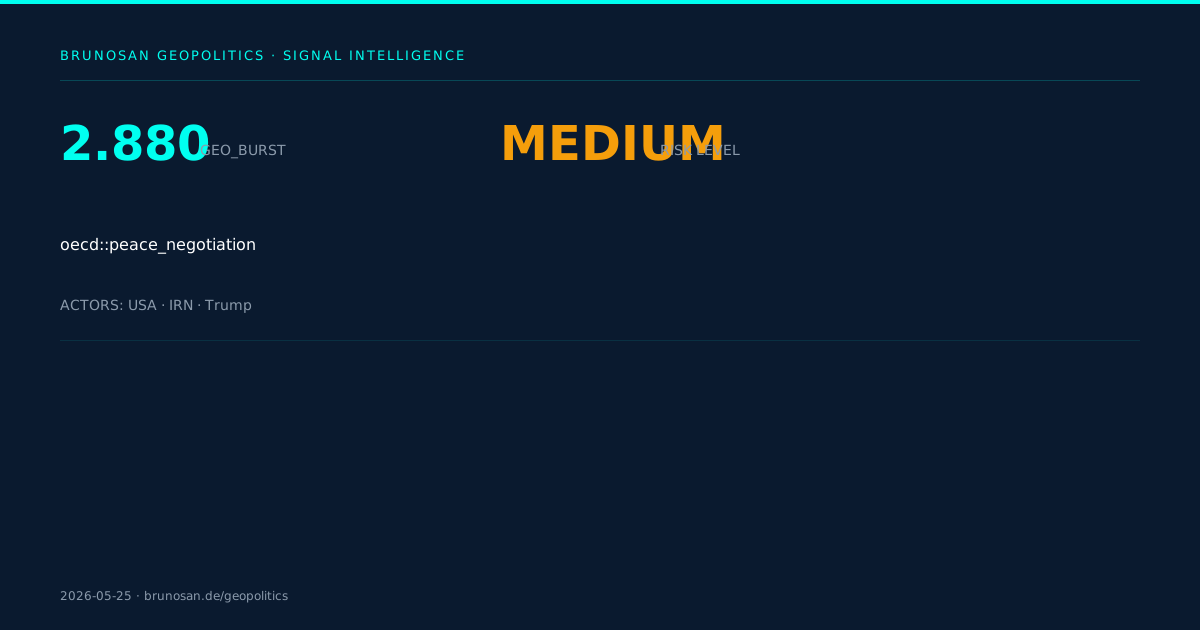
BRUNOSAN CONFIDENCE: MEDIUM
Reasoning: High-tier sources (France24, NHK, TASS) verify the existence of the framework, but the 5% gap and domestic GOP opposition introduce significant execution risk.
BRUNOSAN ASSESSMENT:
Based on geo_burst 0.85 (critical signal) and the 95% framework completion metric, BrunoSan assesses an 80% probability that a formal memorandum of understanding regarding the Strait of Hormuz is published within 72h, though full legislative ratification in the US remains below 40%.