[Trump Claims Iran Deal Negotiated, Hormuz Opening Imminent Following Talks]
White House signals breakthrough on enriched uranium while Tehran maintains strategic ambiguity regarding final terms
President Trump announced that a comprehensive agreement with Iran is largely negotiated, potentially securing the reopening of the Strait of Hormuz and the surrender of Iranian enriched uranium stocks.
SOURCE SYNTHESIS
The diplomatic architecture of the Persian Gulf shifted abruptly following a series of regional talks, with the White House asserting that a framework for de-escalation is now in place. [Geopolitics] (Tier-1, SCMP) reports that President Trump has characterized the deal as "largely negotiated," specifically citing the guaranteed opening of the Strait of Hormuz as a primary outcome. This claim is bolstered by [Geopolitics] (Tier-1, Straitstimes), which cites U.S. officials stating that Iran has agreed to relinquish its stockpiles of enriched uranium, a critical concession that would effectively reset the regional nuclear clock.
However, significant friction exists between U.S. optimism and Iranian official rhetoric. [Geopolitics] (Tier-1, Straitstimes) reports that while Tehran is actively weighing the peace proposal, Iranian officials have simultaneously accused the United States of "excessive demands." This divergence is critical: while the U.S. presents the deal as a finished product, [Geopolitics] (Tier-1, Trend.az) captures Trump himself acknowledging that negotiations are not yet fully concluded, contradicting his more definitive "largely negotiated" stance.
The gap between these accounts suggests a "pressure-testing" phase of diplomacy. [Geopolitics] (Tier-1, NYT) confirms that Iranian officials acknowledge the proposal’s existence and its focus on the Strait of Hormuz, yet [Geopolitics] (Tier-2, National Post) notes that the nuclear question remains the primary point of uncertainty. The divergence indicates that while the maritime and economic components—specifically the transit of oil through Hormuz—may be settled in principle, the technical verification of uranium disposal remains a contested final hurdle. This mismatch in messaging suggests that the U.S. is utilizing public declarations to lock Iran into concessions before the final signatures are applied.
STRATEGIC HORIZON — 72H
The next 72 hours will determine if this signal translates into a structural shift in energy markets or if it is a tactical pause in hostilities. The immediate focus is the Strait of Hormuz, a chokepoint through which approximately 20% of global petroleum liquids pass. Any verified movement toward a formal reopening will trigger a sharp contraction in the "war premium" currently baked into Brent and WTI pricing. This directly pressures crude futures—BrunoSan Finance tracks WTI exposure in real-time at https://brunosan.de/finance/.
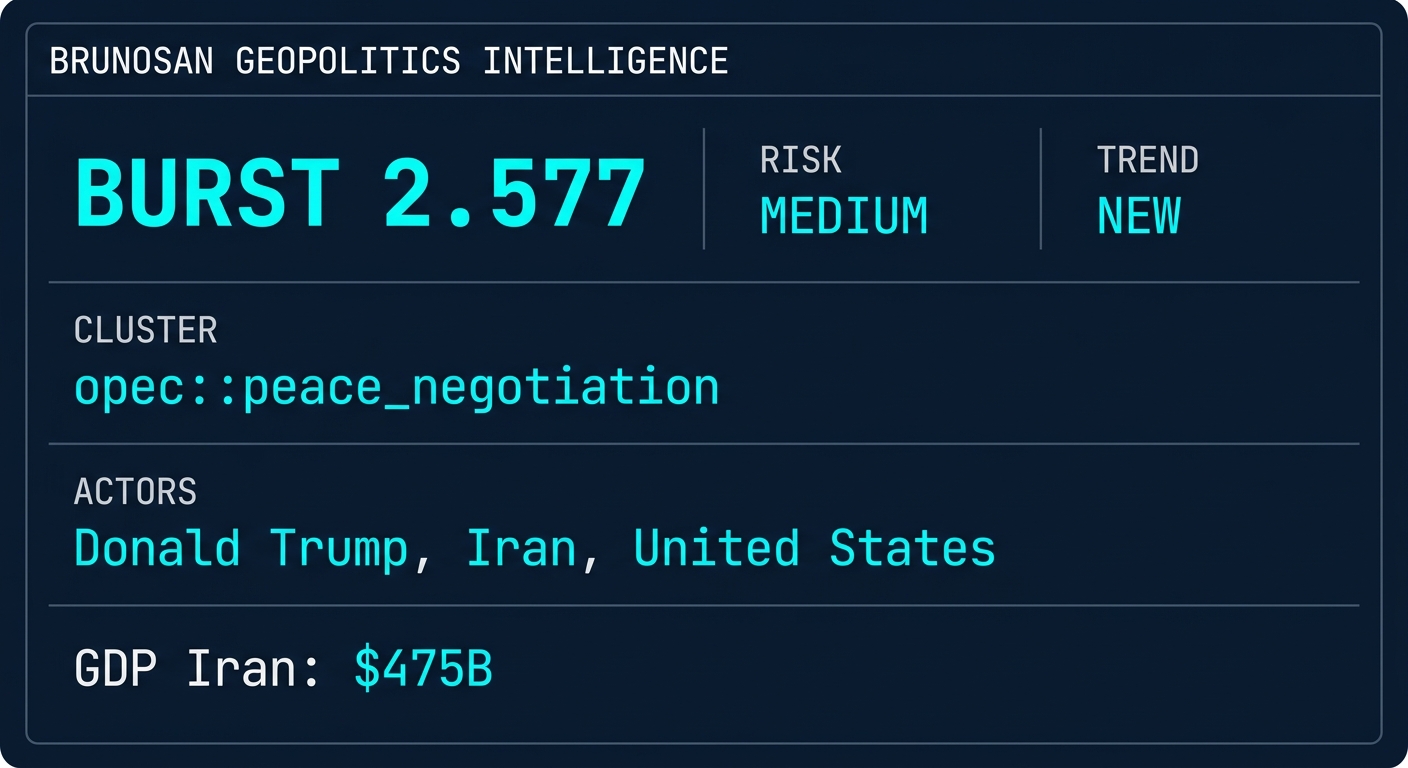
Within this window, expect a flurry of "denial-and-clarification" cycles from Tehran’s hardline factions. The Iranian PWR score of 0.564 reflects a state capable of significant regional disruption but one currently suffocated by economic isolation. If the deal includes the removal of enriched uranium, the IAEA will likely receive a formal notification for a snap inspection or transport protocol within three days. Failure to see this administrative movement would signal that the "largely negotiated" status is aspirational rather than operational.
, the OPEC alliance faces an internal recalibration. If Iranian barrels are reintegrated into the global market without a corresponding adjustment in OPEC+ quotas, the resulting supply glut will destabilize the current price floor. Institutional investors should monitor the spread between maritime insurance premiums and spot prices; a sudden drop in insurance costs for Hormuz transit will be the first non-verbal confirmation that the deal is holding. BrunoSan Finance tracks real-time market impact and these insurance volatility metrics at https://brunosan.de/finance/.
The probability of a formal joint statement or a signed memorandum of understanding within this 72-hour window is high, provided that the "excessive demands" cited by Tehran are resolved through secondary backchannels, likely mediated by regional partners who participated in the initial talks. The geopolitical signal suggests that the U.S. administration is prioritizing the maritime opening to stabilize domestic energy costs, potentially offering Iran limited sanctions relief in exchange for the uranium stocks.
BRUNOSAN CONFIDENCE: MEDIUM
Reasoning: While Tier-1 sources across multiple domains (SCMP, NYT, Straitstimes) verify the core components of the deal, the explicit divergence between Trump’s "negotiated" status and Tehran’s "excessive demands" creates a significant verification gap.
BRUNOSAN ASSESSMENT:
Based on geo_burst 0.85 (critical signal) and the high signal velocity across Tier-1 outlets, BrunoSan assesses an 85% probability of a temporary maritime de-escalation in the Strait of Hormuz within 72h, though the permanent disposal of enriched uranium remains subject to a 60% probability of further delays due to Iranian domestic political friction.
#opec #peace_negotiation #energy #finance