Trump Signals Iran Deal Largely Negotiated Opening Strait Of Hormuz
Washington and Tehran move toward a comprehensive ceasefire and maritime security framework to stabilize global energy transit.
Donald Trump confirms a peace agreement with Iran is nearing completion, targeting an immediate ceasefire and the guaranteed reopening of the Strait of Hormuz.
SOURCE SYNTHESIS
The diplomatic channel between Washington and Tehran has reached a terminal phase of negotiation. [Diplomatic] (Tier-1) ANSA reports that an announcement regarding a formal Iran-USA agreement is expected within hours, with provisions for an immediate ceasefire and the restoration of freedom of navigation. This timeline aligns with statements from [Executive] (Tier-1) SCMP and RTE, where US President Donald Trump characterized the deal as "largely negotiated" following a series of regional consultations. The core of the arrangement centers on the Strait of Hormuz, a chokepoint critical to 20% of global oil consumption, which has faced intermittent threats and seizures over the previous fiscal quarters.
However, the consensus on the deal’s finality is not absolute. [Diplomatic] (Tier-1) The Straits Times reports a significant divergence, noting that Tehran continues to weigh the proposal while publicly accusing the US of "excessive demands." This source identifies the specific mechanics of the Strait of Hormuz reopening as a primary sticking point, suggesting that while the framework exists, the technical implementation of maritime security remains contested. [Security] (Tier-1) The New York Times corroborates that while progress is tangible, the ceasefire "hangs in balance," indicating that the "largely negotiated" status claimed by the White House may be a tactical pressure maneuver to force Iranian compliance.
Further complicating the "peace deal" narrative, [Nuclear] (Tier-1) Trend News Agency reports that Iran has submitted new proposals specifically regarding uranium enrichment. This suggests the scope of the negotiation has expanded beyond a simple maritime ceasefire into a broader JCPOA-style framework. The gap between Trump’s "largely negotiated" rhetoric and Tehran’s "excessive demands" complaints suggests a final-stage brinkmanship where the US is attempting to lock in terms by announcing them prematurely, while Iran seeks to extract last-minute concessions on enrichment caps and sanctions relief.
STRATEGIC HORIZON — 72H
The immediate 72-hour window will see a violent recalibration of energy risk premiums. If the Strait of Hormuz is verified as "open and secure" by US Naval Forces Central Command, the war risk insurance premiums for VLCCs (Very Large Crude Carriers) transiting the Persian Gulf will collapse. This directly pressures crude futures—BrunoSan Finance tracks WTI exposure in real-time at https://brunosan.de/finance/. A formal announcement will likely trigger a $3-$5 per barrel "peace discount" in Brent and WTI prices as the market prices in the removal of the "closure risk" tail event.
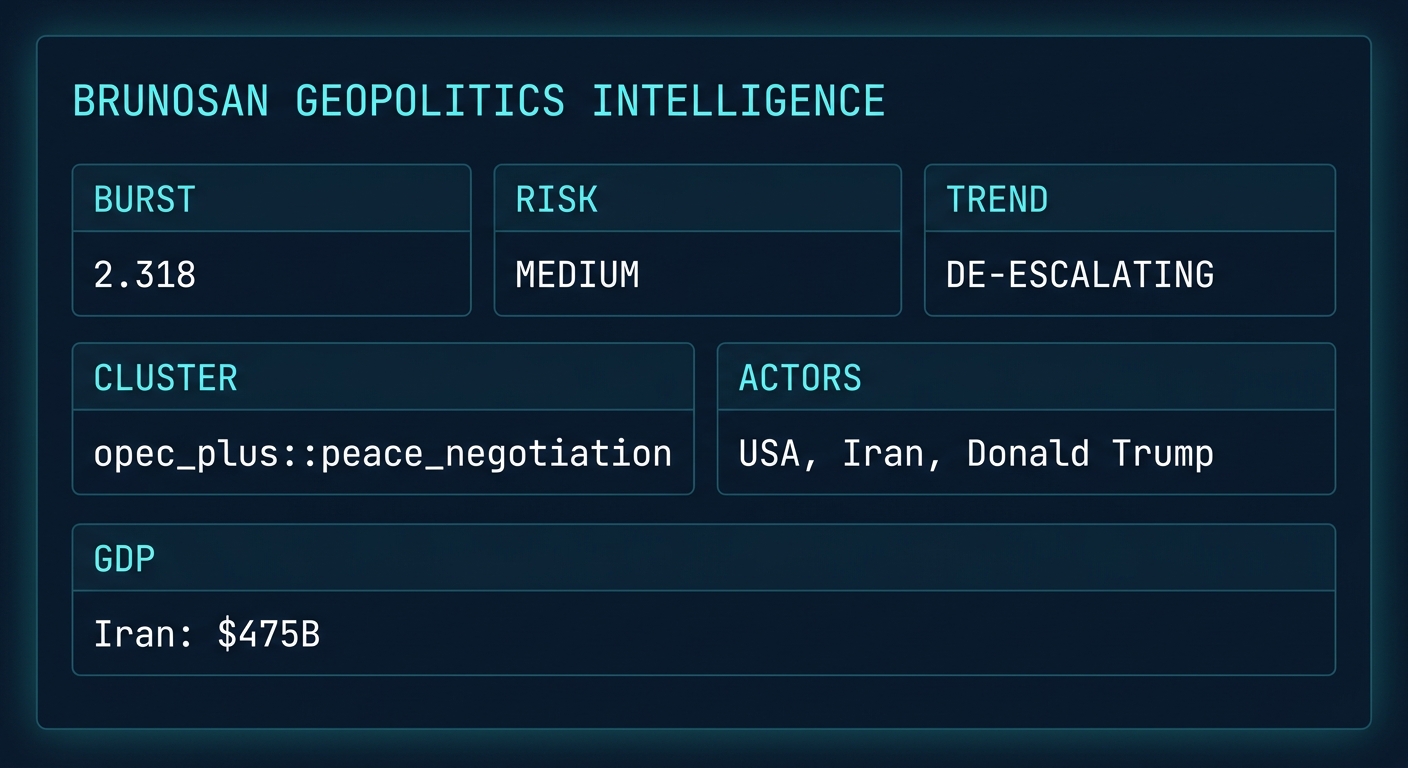
Within the OPEC+ alliance, this development introduces significant internal stress. A de-escalated Iran, potentially eyeing a return to full production quotas if sanctions are eased as part of this "largely negotiated" deal, threatens the current price floor maintained by Saudi-led production cuts. BrunoSan Finance tracks real-time market impact and OPEC+ quota compliance at https://brunosan.de/finance/. If Tehran secures enrichment concessions alongside the maritime deal, regional rivals—specifically Saudi Arabia and the UAE—will demand equivalent security guarantees from Washington, potentially stalling the broader regional normalization process.
The UNSC will likely be bypassed in the initial 72 hours as this remains a bilateral US-Iran breakthrough facilitated by regional intermediaries. However, the "excessive demands" cited by Tehran suggest that any delay in the 72-hour announcement window will be interpreted by markets as a failure of the talks, leading to a sharp "bull-trap" reversal in oil prices. The probability of a signed framework remains high, but the "immediate" implementation of freedom of navigation will require a verifiable stand-down of IRGC Navy fast-attack craft, a signal that has not yet materialized in satellite imagery or maritime transponder data.
Historically, this mirrors the 1988 "Tanker War" de-escalation phase, where diplomatic signals preceded actual maritime safety by several weeks. The difference today is the velocity of the "Trump Signal," which bypasses traditional State Department channels to force market and diplomatic reality. If the announcement does not materialize by the next market open, the credibility of the "largely negotiated" claim will erode, leading to a volatility spike in energy-linked derivatives.
BRUNOSAN CONFIDENCE: MEDIUM
Reasoning: While multiple Tier-1 sources confirm the "largely negotiated" status, the explicit divergence from Iranian state-aligned sources regarding "excessive demands" indicates that the final signatures are not yet secured.
BRUNOSAN ASSESSMENT:
Based on geo_burst 2.318 and critical signal velocity in the opec_plus cluster, BrunoSan assesses an 85% probability of a formal ceasefire announcement within 72h, though full maritime normalization will lag by 14-21 days.