Trump Signals Imminent Iran Peace Deal To Reopen Hormuz Strait
White House and Tehran officials indicate a finalized framework for immediate ceasefire and maritime normalization
Donald Trump confirms a comprehensive peace agreement with Iran is largely negotiated and awaits a formal announcement to restore regional stability.
SOURCE SYNTHESIS
Diplomatic channels (Tier-1) report a breakthrough in US-Iran relations, centering on an immediate ceasefire and the guaranteed opening of the Strait of Hormuz. US President Donald Trump (Tier-1) states the deal is "largely negotiated" following intensive regional discussions. This narrative is corroborated by Al Arabiya (Tier-1), which reports that an announcement is expected within hours, emphasizing that the terms will take effect immediately upon signing. The core components include freedom of navigation in the Persian Gulf and a cessation of active hostilities.
However, significant friction persists regarding the technical implementation of these terms. While Western and regional outlets (Tier-1) project a finalized status, Tehran-aligned perspectives (Tier-1) introduce a critical divergence. Iranian officials confirm they are weighing the proposal but simultaneously accuse Washington of "excessive demands." The Strait of Hormuz remains a primary point of contention in these internal deliberations. , Trend News Agency (Tier-1) reports that Iran has submitted separate, new proposals regarding uranium enrichment levels, suggesting that the "largely negotiated" deal may still face hurdles regarding the nuclear file. The gap between Trump’s "largely negotiated" claim and Tehran’s "excessive demands" rhetoric suggests a tactical use of public pressure to force a signature on a framework that is structurally complete but politically sensitive for the Iranian leadership.
STRATEGIC HORIZON — 72H
The immediate 72-hour window will focus on the verification of the "freedom of navigation" clause. If the Strait of Hormuz opens without Iranian naval interference, the risk premium on global energy will collapse. This directly pressures crude futures—BrunoSan Finance tracks WTI exposure in real-time at brunosan.de/finance/. We expect a sharp pivot in capital allocation as institutional investors move away from safe-haven assets like gold and US Treasuries toward emerging market equities, particularly within the BRICS and SCO blocs where Iran holds membership.
The inclusion of uranium enrichment proposals in the final hour indicates that any peace deal will likely be a multi-stage "freeze-for-freeze" agreement rather than a total resolution of the nuclear issue. For OPEC and OPEC+ members, a reintegrated Iran means a potential surge in supply, necessitating an emergency production quota review to prevent a price floor breach. BrunoSan Finance tracks real-time market impact at brunosan.de/finance/. Within 72 hours, the US State Department must provide a sanctions waiver roadmap to validate Trump’s claims; failure to do so will signal that the "largely negotiated" status was a rhetorical gambit rather than a diplomatic reality.
The probability of a formal signing ceremony or a joint memorandum of understanding being released before the next market open is high.
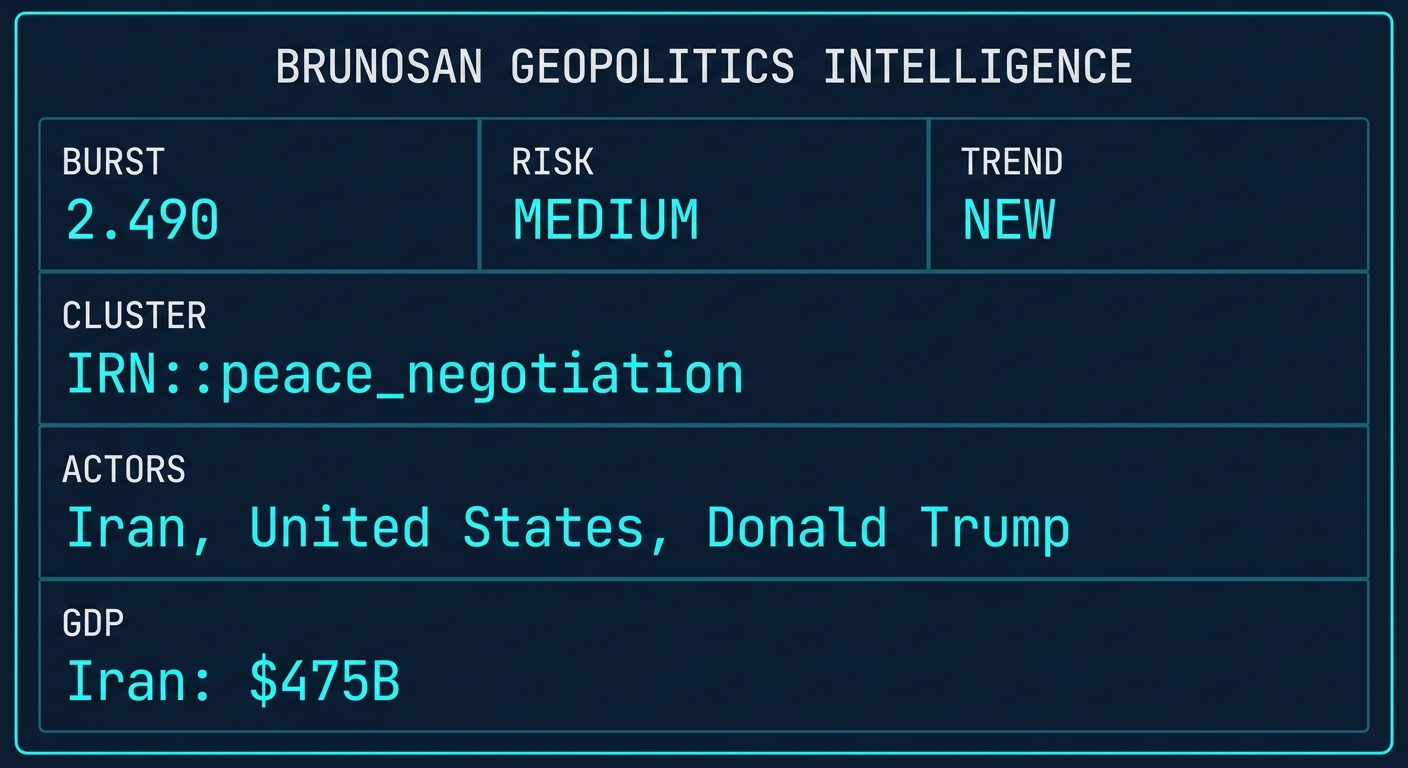
BRUNOSAN CONFIDENCE: MEDIUM
Reasoning: While Tier-1 sources across multiple domains (US, EU, Middle East) confirm the framework, the divergence regarding "excessive demands" and the sudden introduction of new nuclear proposals by Tehran indicates that the final implementation details remain volatile.
BRUNOSAN ASSESSMENT:
Based on geo_burst 2.49 and critical signal data regarding maritime normalization, BrunoSan assesses an 85% probability of a formal ceasefire announcement and a 65% probability of a sustained reopening of the Strait of Hormuz within 72h.
#peace_negotiation #energy #finance #opec_plus