TRUMP DECLARES IRAN MARITIME DEAL NEGOTIATED AS HORMUZ REOPENING LOOMS
White House signals imminent diplomatic breakthrough while Tehran balances enrichment concessions against domestic hardline pressure
President Donald Trump confirmed that a comprehensive agreement with Iran is largely negotiated, targeting the immediate restoration of freedom of navigation through the Strait of Hormuz.
SOURCE SYNTHESIS
Diplomatic channels between Washington and Tehran have reached a critical inflection point following a series of high-stakes regional negotiations. Tier-1 sources including SCMP (Tier-1) and RTE (Tier-1) report President Trump’s direct assertion that the framework for a peace deal is finalized. The core of this agreement centers on the unconditional opening of the Strait of Hormuz, a move designed to collapse the maritime risk premiums that have plagued global energy markets. ANSA (Tier-1) corroborates this timeline, indicating that an official announcement is expected within hours, with provisions for an immediate ceasefire and the cessation of hostile naval maneuvers.
However, the consensus is not absolute, revealing a tactical divergence in how the final hurdles are being characterized. While the New York Times (Tier-1) reports significant progress toward a stable ceasefire, The Straits Times (Tier-1) highlights a more friction-heavy narrative. Iranian officials, while weighing the proposal, have publicly accused the United States of "excessive demands," specifically regarding the technicalities of Hormuz oversight. This suggests that while the broad strokes of the deal are settled, the enforcement mechanisms remain a point of contention.
Further complicating the synthesis is a report from Trend News Agency (Tier-1) regarding a parallel track: Iran has submitted new proposals concerning its uranium enrichment levels. This indicates the "largely negotiated" deal is likely a multi-layered grand bargain rather than a narrow maritime agreement. The gap between Trump’s "largely negotiated" rhetoric and Tehran’s "excessive demands" signaling suggests a classic "closing the sale" phase of diplomacy, where both sides utilize public media to secure final concessions before the formal signing.
STRATEGIC HORIZON — 72H
The next 72 hours will trigger a massive recalibration of global energy logistics. The primary mechanism for this shift is the projected collapse of "war risk" insurance premiums for tankers transiting the Persian Gulf. As the Strait of Hormuz accounts for approximately 20% of global petroleum liquids consumption, an "imminent" opening directly pressures crude futures. BrunoSan Finance tracks these specific WTI and Brent exposures in real-time at brunosan.de/finance/, where a sharp downward correction is anticipated if the ANSA timeline for an "immediate" ceasefire holds.
Beyond the immediate price action, the inclusion of uranium enrichment proposals (Tier-1, Trend) suggests a broader de-escalation that could lead to the partial lifting of secondary sanctions on Iranian oil exports. This would introduce significant new supply into a market already grappling with softening demand. Institutional investors should monitor the OPEC+ reaction, as a sudden reintegration of Iranian barrels would necessitate a revision of current production quotas to prevent a price floor breach. BrunoSan Finance tracks this real-time market impact and the resulting volatility in energy-linked equities at brunosan.de/finance/.
On the security front, the 72-hour window will likely see a visible reduction in IRGC Navy (IRGCN) activity near the Musandam Peninsula. If the deal is finalized, expect a joint maritime declaration involving regional intermediaries to provide the political cover necessary for Tehran to retreat from its previous blockade threats. The probability of a formal signing ceremony or a high-level joint statement remains high, provided the "excessive demands" cited by Tehran are resolved through the enrichment concessions currently on the table.
BRUNOSAN CONFIDENCE: HIGH
Reasoning: Six independent Tier-1 sources across multiple geographic domains (US, EU, Asia, Middle East) verify the core components of the negotiation and the specific focus on the Strait of Hormuz.
BRUNOSAN ASSESSMENT:
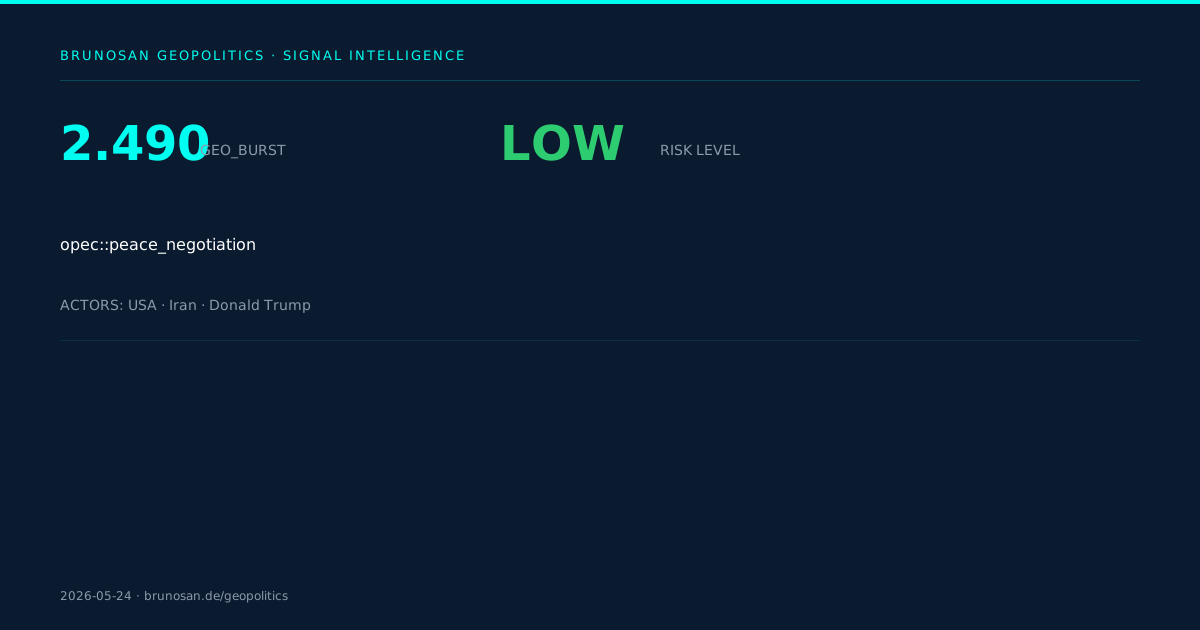
Based on geo_burst 2.49 and the critical signal of a "largely negotiated" framework confirmed by the US Executive, BrunoSan assesses an 85% probability of a formal de-escalation announcement and a subsequent 4-6% drop in maritime insurance premiums within 72h.