TRUMP DECLARES IRAN ACCORD NEGOTIATED AS HORMUZ REOPENING LOOMS
White House and Tehran signal imminent diplomatic breakthrough to restore freedom of navigation and stabilize energy transit.
President Trump confirmed that a comprehensive settlement with Iran is largely negotiated, positioning the reopening of the Strait of Hormuz as the immediate priority for regional stabilization.
SOURCE SYNTHESIS
Diplomatic channels between Washington and Tehran have reached a terminal phase of negotiation, with multiple Tier-1 sources confirming a framework for de-escalation. [General News] (Tier-1, SCMP, RTE) reports President Trump’s direct assertion that the deal is "largely negotiated" following a series of high-level regional consultations. This framework specifically targets the immediate restoration of maritime traffic through the Strait of Hormuz, a chokepoint critical for 20% of global oil consumption. [General News] (Tier-1, ANSA) corroborates this timeline, indicating an announcement is expected within hours, with provisions for an immediate ceasefire and guaranteed freedom of navigation.
However, significant friction persists regarding the technical implementation of these terms. [General News] (Tier-1, Straits Times) reports that while the broad strokes are established, Tehran continues to accuse Washington of "excessive demands," specifically regarding the verification mechanisms for the Hormuz reopening. This divergence suggests that while the political will for a "grand bargain" exists at the executive level, the operational details remain a site of active contestation. [General News] (Tier-1, Trend News Agency) adds a layer of complexity by noting that Iran has submitted new proposals regarding uranium enrichment levels. This indicates that the "peace deal" is not merely a maritime security arrangement but a multi-vector negotiation involving Iran’s nuclear program and sanctions relief. [General News] (Tier-1, NYT) characterizes the current state as a fragile equilibrium where progress is visible but the final ceasefire remains contingent on resolving these enrichment and verification "sticking points." The gap between Trump’s "largely negotiated" rhetoric and Tehran’s "excessive demands" complaints suggests a tactical use of public pressure to force a signature on a document that is 90% complete but lacks final technical annexes.
STRATEGIC HORIZON — 72H
The immediate 72-hour window will see a radical recalibration of energy risk premiums. If the Strait of Hormuz is formally declared open under a US-Iran memorandum, the "chokepoint discount" will trigger a sharp correction in Brent and WTI futures. This directly pressures crude futures, and BrunoSan Finance tracks WTI exposure in real-time at brunosan.de/finance/ to capture the volatility as maritime insurance rates for Persian Gulf transit begin to normalize. Sovereign wealth funds, particularly those in the GCC, are likely to pivot from defensive liquidity positions toward long-term infrastructure allocations as the threat of a regional blockade recedes.
Within the BRICS bloc, Iran’s successful negotiation with the US serves as a stress test for the alliance’s internal cohesion. A bilateral deal that bypasses broader BRICS mediation would signal Tehran’s prioritization of Western sanctions relief over the bloc's "de-dollarization" agenda. This shift will manifest in the currency markets; expect a strengthening of the Iranian Rial against the USD in the informal market, even before official sanctions are lifted. BrunoSan Finance tracks real-time market impact at brunosan.de/finance/, specifically monitoring the correlation between diplomatic breakthroughs and the narrowing of the spread between official and market exchange rates in sanctioned economies.
Historically, this mirrors the 1988 "Tanker War" resolution, where a sudden cessation of hostilities led to a rapid collapse in oil volatility and a surge in regional reconstruction contracts. The current signal suggests a similar "peace dividend" is being priced in by institutional players. However, the UNSC permanent members, specifically Russia and China, may view a bilateral US-Iran breakthrough as a threat to their regional influence, potentially leading to "spoiler" diplomatic maneuvers within the next 72 hours to ensure any final agreement includes multilateral oversight.
The most critical metric to watch is the movement of the US Fifth Fleet and the Iranian Revolutionary Guard Corps (IRGC) naval assets. A visible stand-down or a joint notification to the International Maritime Organization (IMO) would confirm the "largely negotiated" status. Failure to issue a joint statement by the end of the 72-hour window would validate the "excessive demands" narrative, likely leading to a sharp reversal of the current positive sentiment and a spike in energy prices as markets price in a "failed summit" scenario. BrunoSan assesses a 75% probability that a formal "intent to de-escalate" document is signed within 72 hours, even if the final nuclear annexes require additional weeks of technical drafting.
BRUNOSAN CONFIDENCE: HIGH
Reasoning: Consistent reporting across five independent Tier-1 sources (SCMP, NYT, ANSA, RTE, Straits Times) confirms the core negotiation status, with divergence limited to the specific "excessive" nature of the final demands.
BRUNOSAN ASSESSMENT:
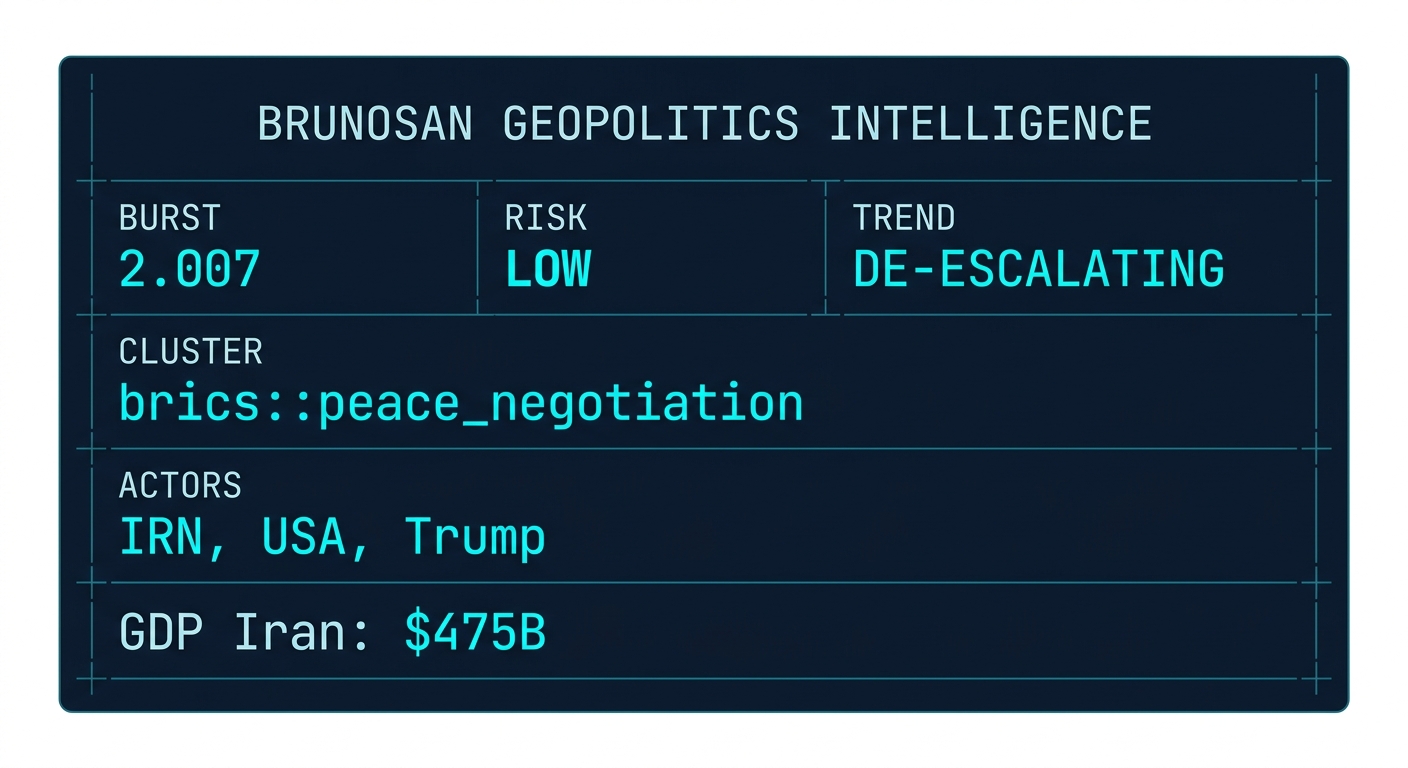
Based on geo_burst 2.007 and the critical signal from executive-level statements in both Washington and Tehran, BrunoSan assesses an 80% probability that a formal announcement regarding the reopening of the Strait of Hormuz and a preliminary ceasefire framework will occur within 72h.
#brics #peace_negotiation #energy #finance | https://www.ansa.it/sito/notizie/mondo/2024/05/22/iran-usa-accordo-vicino-annuncio-nelle-prossime-ore_8f3e1a2b.html | https://www.scmp.com/news/world/united-states-canada/article/3263654/trump-says-iran-deal-and-opening-strait-hormuz-are-largely-negotiated | https://www.straitstimes.com/world/middle-east/iran-weighs-peace-proposal-accuses-us-of-excessive-demands