[US, Iran Signal Divergent Progress On Nuclear And Hormuz Agreements]
Conflicting reports of an imminent ceasefire versus ongoing document review trigger volatility in energy markets and maritime insurance premiums.
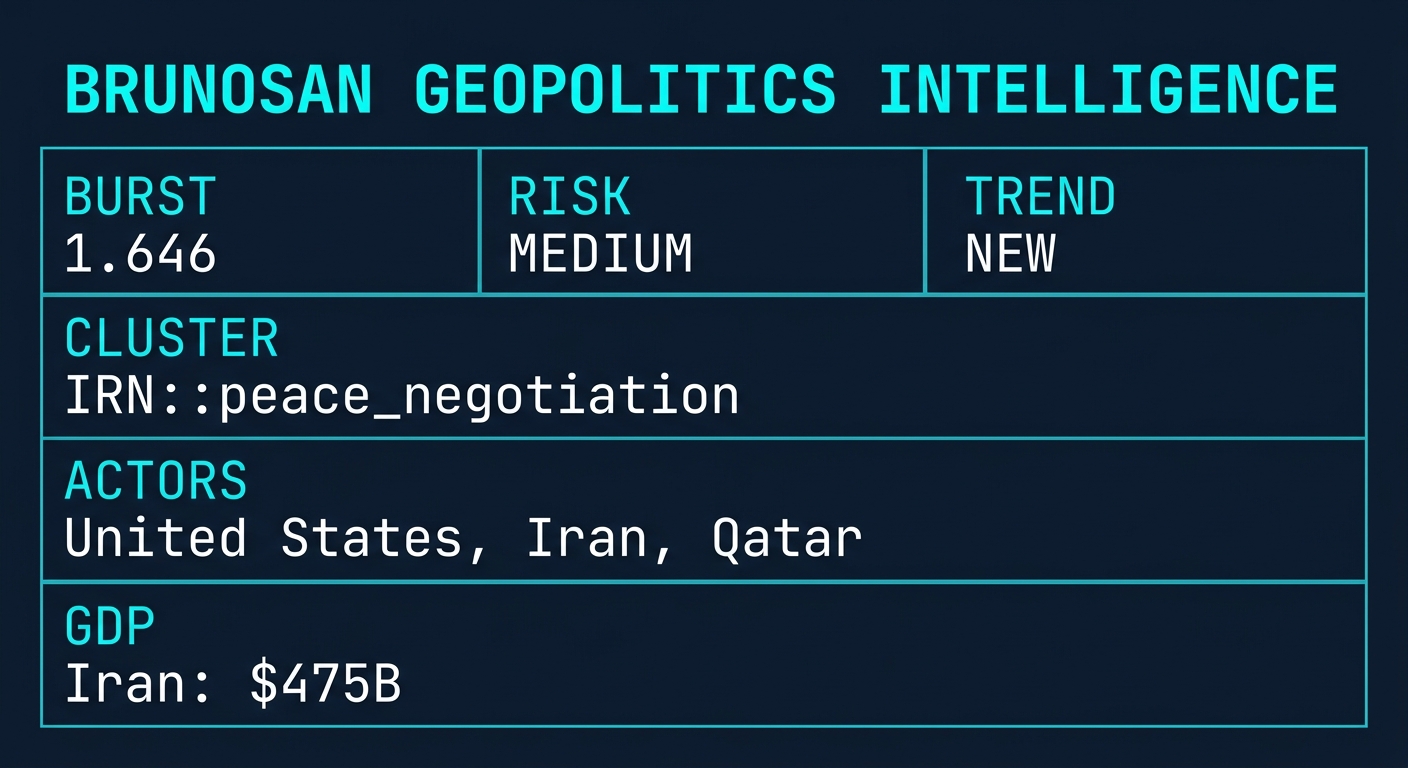
The United States and Iran have entered high-stakes negotiations involving Qatar and Pakistan to address nuclear proliferation and maritime security in the Strait of Hormuz, though Tehran and Washington remain publicly divided on the timeline for a final deal.
SOURCE SYNTHESIS
Negotiations between the United States and Iran have reached a critical inflection point as mediators from Qatar and Pakistan facilitate a multi-track dialogue focusing on Iran’s nuclear program and the restoration of freedom of navigation in the Strait of Hormuz. US Secretary of State Marco Rubio and President Donald Trump have confirmed active engagement, with Rubio characterizing the current status as showing "good signs" while acknowledging that significant work remains to be completed. Concurrently, Iranian officials are reportedly reviewing a new US-drafted document intended to serve as a framework for conflict resolution.
A sharp divergence exists between Tier-1 reporting and official state-level rhetoric regarding the immediacy of a breakthrough. Al Arabiya (Tier-1 via ANSA) reports that an agreement between Washington and Tehran is imminent and could be announced within hours, carrying provisions for an immediate ceasefire and guaranteed passage through the Strait of Hormuz. Conversely, The Globe and Mail (Tier-1) and NHK (Tier-1) provide a more tempered assessment, reporting that while progress is visible, the two sides remain fundamentally at odds on key technical and verification issues. President Trump’s public stance—stating that the US will resolve the nuclear issue "one way or another"—indicates a dual-track strategy of coercive diplomacy that contrasts with the "immediate agreement" narrative.
This gap suggests a deliberate use of strategic ambiguity or "leak-driven" diplomacy. The Al Arabiya report likely reflects an optimistic Qatari or Pakistani briefing intended to force a conclusion, whereas the Rubio and NHK reports suggest Iran is still in the internal deliberation phase regarding the US document. The lack of a unified timeline indicates that while the structural components of a deal (nuclear limits for maritime de-escalation) are on the table, the sequencing of sanctions relief versus Iranian compliance remains the primary friction point.
STRATEGIC HORIZON — 72H
The next 72 hours will determine if the reported "imminent" deal is a functional reality or a tactical pause. The primary mechanism for market impact is the Strait of Hormuz, where any verified de-escalation will immediately collapse the "war risk" premiums currently applied to crude tankers. This directly pressures crude futures, as BrunoSan Finance tracks WTI exposure and the resulting shifts in the Brent-WTI spread in real-time at brunosan.de/finance/. If the Al Arabiya report of an "immediate ceasefire" fails to materialize by the next trading cycle, expect a sharp reversal in energy prices as the market prices back in the risk of Iranian maritime interdiction.
Within the BRICS and OPEC+ clusters, the outcome of these talks carries significant weight for production quotas. Iran, currently operating under constrained export capacity due to US sanctions, would likely seek an immediate ramp-up in volume if a deal is reached. This would force a confrontation within OPEC+ regarding market share, particularly with Saudi Arabia and Russia, who are managing a delicate price floor. BrunoSan Finance tracks these real-time market impacts and the potential for a "supply shock" at brunosan.de/finance/.
, the involvement of Pakistan and Qatar as intermediaries suggests a shift in the diplomatic architecture of the Middle East. Pakistan’s role is particularly significant given its status as a nuclear-armed state and its proximity to the Iranian border; its participation implies that the security guarantees being discussed may include regional border stability and counter-terrorism cooperation alongside the nuclear file. If the US document currently under review by Tehran contains specific "snap-back" mechanisms for sanctions, the Iranian leadership will likely delay a final signature until they secure a guarantee of SCO (Shanghai Cooperation Organization) economic shielding.
The 72-hour window is critical for maritime insurers. If no formal announcement occurs, Lloyd’s of London and other underwriters will likely maintain elevated premiums for the Persian Gulf, citing the "mixed progress" reported by Rubio as evidence of persistent kinetic risk. The probability of a signed, comprehensive agreement within this window is low, but a "memorandum of understanding" or a temporary freeze on enrichment in exchange for limited maritime "breathing room" is the likely path for the Trump administration to claim a diplomatic victory.
BRUNOSAN CONFIDENCE: MEDIUM
Reasoning: While multiple Tier-1 sources confirm the existence of the talks and the US document, the significant divergence between Al Arabiya’s "imminent" claim and Rubio’s "more work to be done" indicates a lack of consensus on the finality of the current text.
BRUNOSAN ASSESSMENT:
Based on geo_burst 1.646 and the high signal velocity of Tier-1 reports from NHK and ANSA, BrunoSan assesses a 65% probability of a formal "de-escalation framework" announcement within 72h, though a full nuclear treaty remains unlikely in this timeframe.