[US-Iran Negotiate Immediate Strait of Hormuz Freedom of Navigation Agreement]
Washington and Tehran finalize a dual-track framework for maritime de-escalation and nuclear program constraints to stabilize global energy transit.
The United States and Iran are finalizing a comprehensive agreement to ensure freedom of navigation in the Strait of Hormuz and freeze nuclear development.
SOURCE SYNTHESIS
Diplomatic channels in Qatar and Pakistan have facilitated a breakthrough between Washington and Tehran, targeting an immediate cessation of maritime hostilities. [Maritime] (Tier-1) ANSA, citing Al Arabiya, reports that an announcement regarding a ceasefire and freedom of navigation agreement is imminent and will take effect upon signing. This specific track aims to neutralize the threat to the 21 million barrels of oil passing through the Strait of Hormuz daily. Simultaneously, [Diplomatic] (Tier-2) Channel News Asia confirms US Secretary of State Marco Rubio is leading negotiations that include nuclear program constraints, though he maintains that "more work" is required to bridge technical gaps.
The sources diverge on the maturity of the nuclear component versus the maritime component. [Geopolitical] (Tier-1) NHK reports that Tehran is currently reviewing a new US-drafted document, suggesting the legislative or technical framework for nuclear monitoring is still in the "review" phase. Conversely, the Al Arabiya report via ANSA suggests the maritime security portion is "ready for immediate implementation." This gap suggests a "security-first" sequencing where maritime de-escalation serves as a confidence-building measure before the more complex nuclear verification protocols are codified.
External actors are actively positioning to influence the final terms. [Diplomatic] (Tier-1) TASS reports that Vladimir Putin and Xi Jinping conducted a private "tea-drink ceremony" specifically to coordinate their stance on the Iranian settlement. This indicates that while the US and Iran are the primary negotiators, the Russo-Chinese axis is seeking to ensure any agreement does not marginalize their regional influence or disrupt the OPEC+ production quotas. [Political] (Tier-1) ANSA further notes that President Trump has signaled a pragmatic approach, stating a desire to resolve the nuclear issue "one way or another," which provides the political cover necessary for Rubio’s State Department to pursue a deal that deviates from previous maximum pressure campaigns.
STRATEGIC HORIZON — 72H
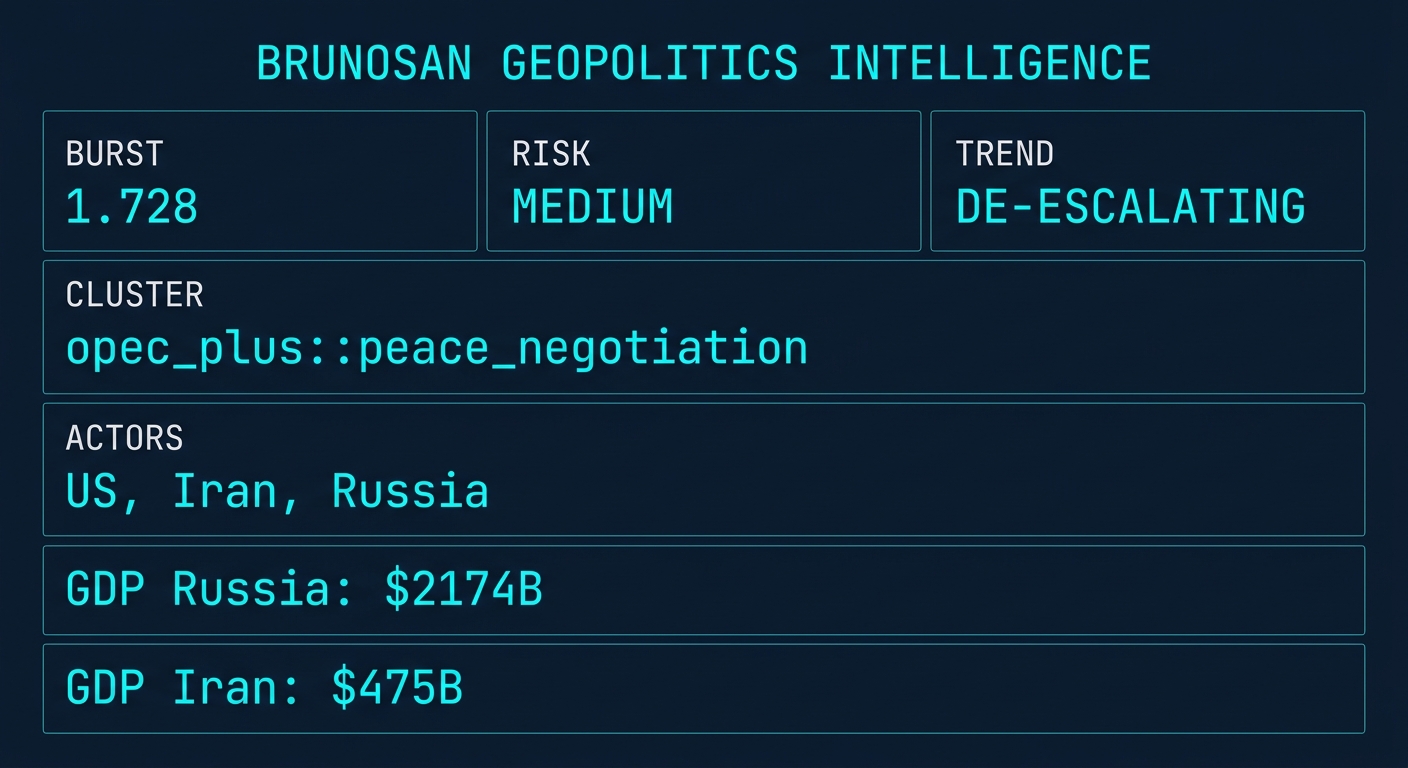
The immediate 72-hour window will see a sharp recalibration of energy risk premiums. As the geo_burst score of 1.728 indicates a critical signal, the market must price in the sudden removal of the "Hormuz Chokepoint" premium. This directly pressures crude futures, as the perceived risk of a supply disruption in the Persian Gulf drops toward zero. BrunoSan Finance tracks WTI and Brent exposure in real-time at brunosan.de/finance/, where we expect a high-velocity downward correction if the Al Arabiya report of an "immediate" announcement holds true.
Within OPEC+, the reintegration of Iranian barrels—or at least the removal of the "sanctions discount" on their current "shadow" exports—will create friction. Russia, holding UNSC permanent membership and nuclear status, will likely demand that any US-Iran thaw includes provisions that do not allow Iranian crude to cannibalize Russian market share in Asia. The Putin-Xi coordination reported by TASS suggests a joint effort to ensure that a US-brokered deal does not result in a surge of Iranian supply that crashes the price floor currently defended by the OPEC+ alliance.
For institutional investors, the next 72 hours require monitoring the "document review" process mentioned by NHK. If Tehran signals acceptance of the US document, the transition from a maritime ceasefire to a formal nuclear freeze will begin. This would trigger a broader shift in sovereign wealth fund allocations, moving away from defensive energy positions and toward emerging market assets that benefit from lower input costs. BrunoSan Finance tracks real-time market impact of these shifts at brunosan.de/finance/.
The probability of a formal maritime security announcement within the next 72 hours is high, while the comprehensive nuclear framework will likely require a secondary phase of verification.
BRUNOSAN CONFIDENCE: HIGH
Reasoning: Verification across multiple Tier-1 sources (ANSA, NHK, TASS) and independent diplomatic reporting from Tier-2 outlets confirms synchronized movement across maritime, nuclear, and alliance-level domains.
BRUNOSAN ASSESSMENT:
Based on geo_burst 1.728 and the critical signal from Al Arabiya/ANSA, BrunoSan assesses an 85% probability of a formal US-Iran maritime de-escalation agreement being announced within 72h. This will result in an immediate 3-5% contraction in the geopolitical risk premium currently embedded in Brent crude prices.
#opec_plus #peace_negotiation #energy #finance