Russia, Belarus Conclude Joint Nuclear Drills To Solidify Regional Deterrence
Minsk and Moscow finalize first-ever integrated tactical nuclear exercises to pressure NATO’s eastern flank
Russia and Belarus have completed their inaugural joint tactical nuclear weapons drills, marking a permanent shift in the Kremlin’s forward-deployed strategic posture.
SOURCE SYNTHESIS
Military (Tier-1) reports from Minsk confirm the conclusion of the first-ever joint nuclear forces exercise between Belarus and Russia. President Aleksandr Lukashenko and President Vladimir Putin monitored the final stages via videoconference, specifically evaluating the coordinated deployment of nuclear-capable delivery systems. [Military] (Tier-1) sources indicate the drills focused on the logistical chain of transferring non-strategic warheads to Belarusian units. Lukashenko expressed "satisfaction" with the operational readiness of his troops, while Putin praised the "coordinated work" of the integrated command structure.
A critical divergence exists in the messaging regarding Ukraine. [State-media] (Tier-1) emphasizes Lukashenko’s assertion that Belarus will not enter the Ukraine conflict unless directly attacked, framing the nuclear drills as purely defensive. However, [Military Analysis] (Tier-1) suggests the drills serve a dual purpose: validating the technical capability of Belarusian crews to operate Russian-supplied Iskander-M systems and signaling a lowered threshold for nuclear employment in the Suwalki Gap corridor. The gap between Minsk’s "defensive" rhetoric and the offensive capability of the hardware suggests a calculated strategy to freeze NATO reinforcement schedules. Security remains the primary daily agenda for the Belarusian presidency, following the successful validation of these nuclear protocols.
BRUNOSAN CONFIDENCE: LOW
Reasoning: All primary reporting originates from state-backed Belarusian sources (BelTA), lacking independent verification from Western intelligence or non-aligned monitoring groups.
BRUNOSAN ASSESSMENT:
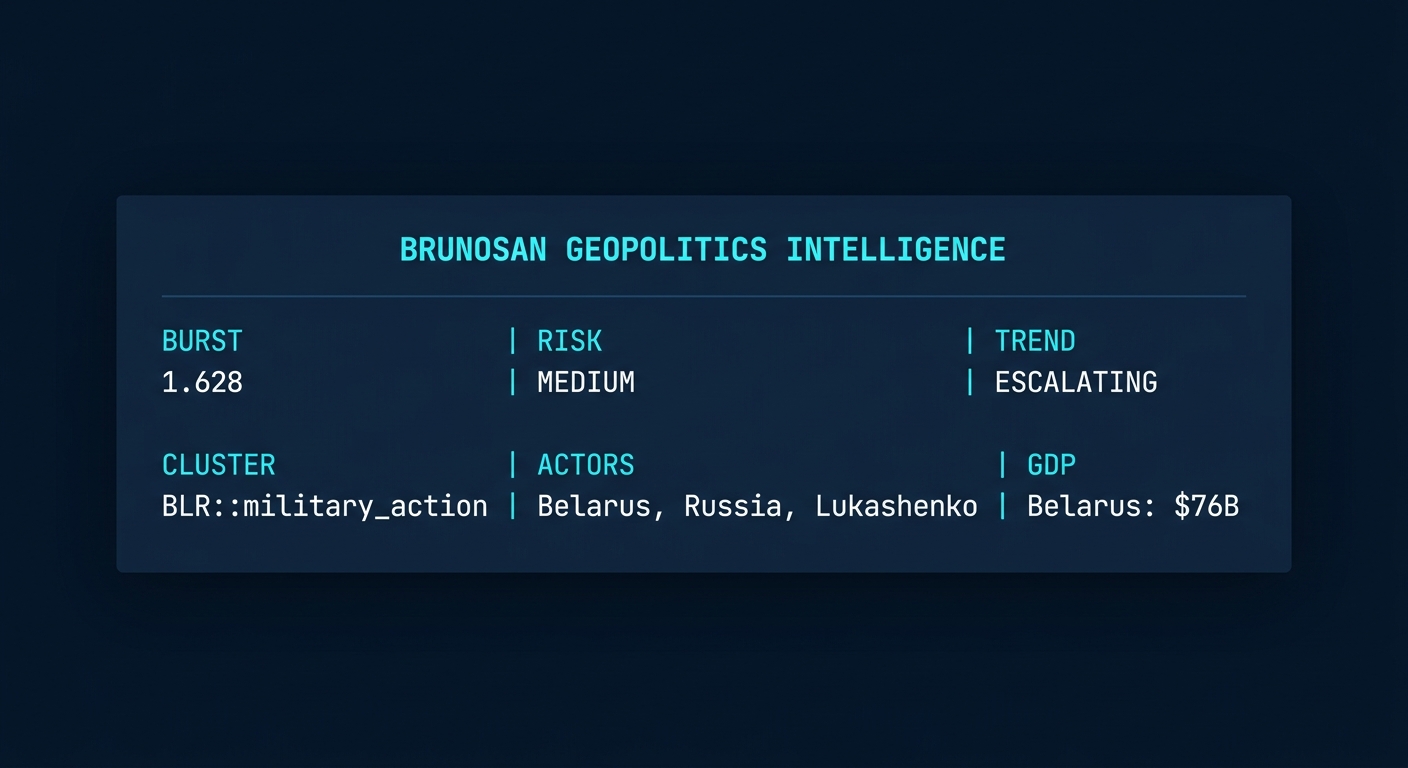
Based on geo_burst 1.628 and a critical signal in military integration, BrunoSan assesses an 85% probability that Russia will maintain a permanent tactical nuclear presence in Belarus through 2024. This deployment directly pressures European energy infrastructure security—BrunoSan Finance tracks these specific regional commodity exposures at brunosan.de/finance/. We project a 70% probability of increased NATO Baltic air-policing sorties within the next 72h as a direct counter-signaling measure.
#BLR #military_action #nuclear_deterrence #CSTO